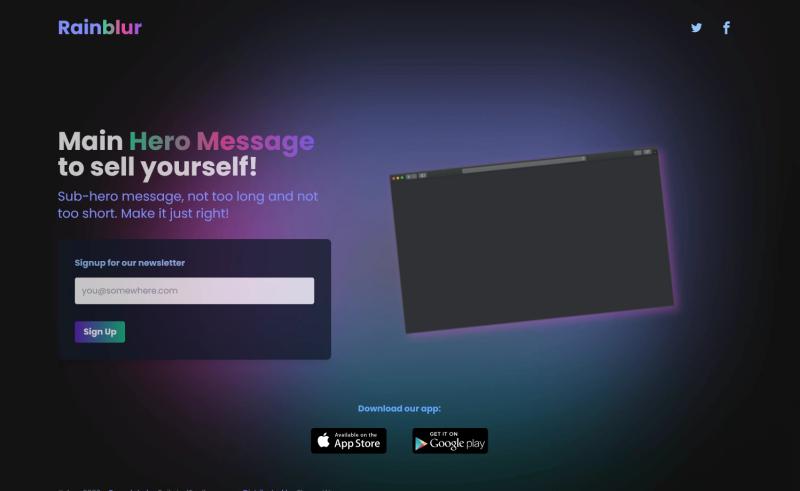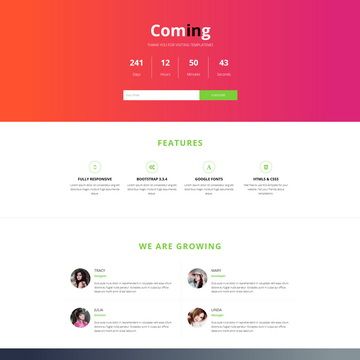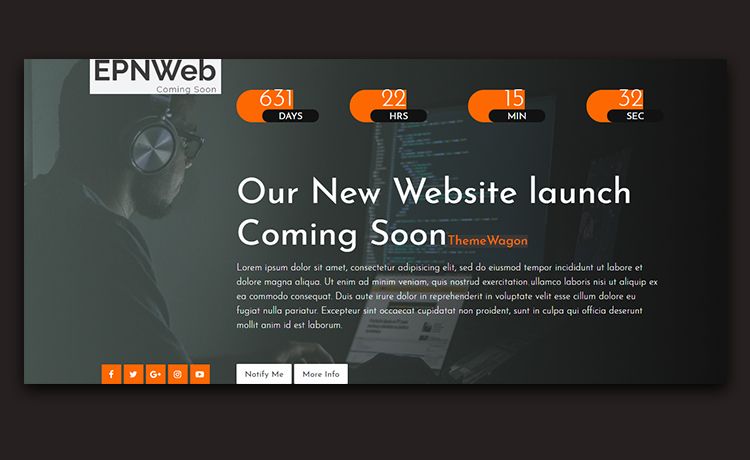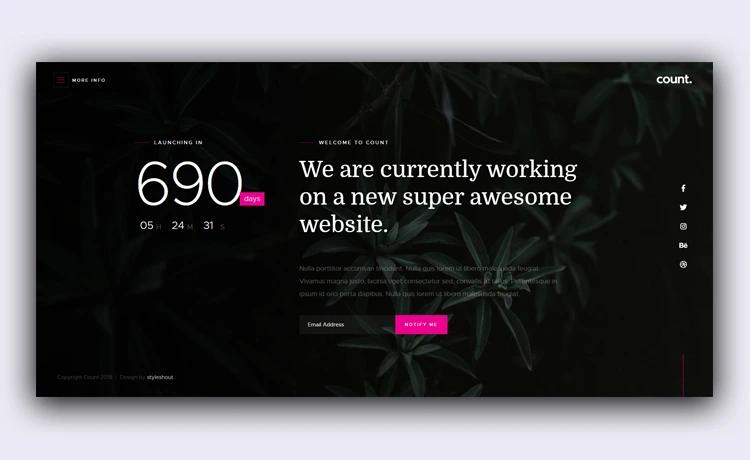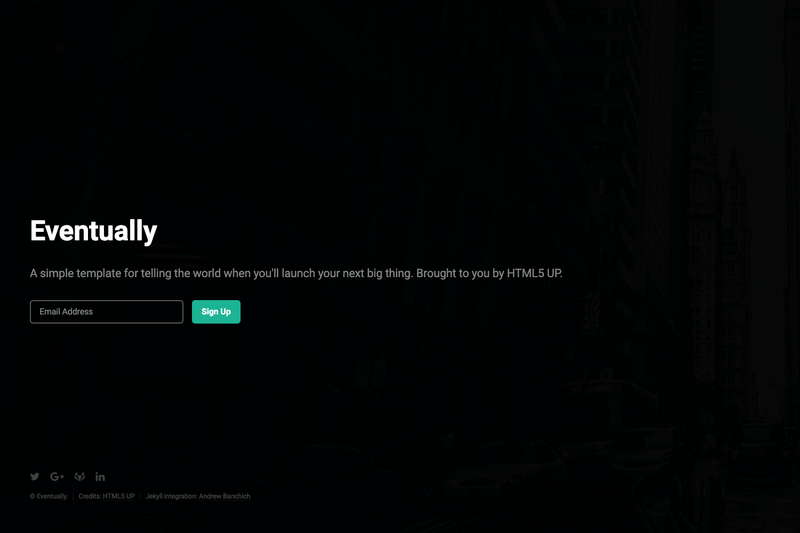
Eventually is a Jekyll theme that ports HTML5 UP's 'Eventually' placeholder template into a static-site generator workflow, giving you a coming-soon page with an email signup form and a slideshow background.
What is Eventually Jekyll Theme?
Eventually Jekyll Theme is a Jekyll adaptation of the "Eventually" theme by HTML5 UP. It takes the original single-page placeholder design and rebuilds it for Jekyll, so you configure content through _config.yml and front matter instead of editing raw HTML. The theme outputs a static coming-soon page built with HTML, CSS, and JavaScript, and it is maintained by Andrew Banchich on GitLab, with a GitHub mirror. It inherits the CCA 3.0 license from HTML5 UP, meaning free use for personal and commercial projects.
Key Features
- Social profile links — Add your social profiles in
_config.yml; only the profile buttons you enter appear in the site footer. - Automatic sitemap generation — Uses the Jekyll Sitemap Generator plugin to create a
sitemap.xmlfor your site. - Automatic SEO — Uses the Jekyll SEO Tag plugin to inject meta tags and structured data into the page.
- Email signup form — A ready-to-connect form that can be wired to a third-party service like MailChimp or your own backend, with conventional and AJAX approaches documented.
- Slideshow background — Configure a list of images with vertical alignment (top, center, or bottom) and a transition delay; browsers without CSS transitions, such as IE9 and below, display only the first image.
- Simple Jekyll setup — Fork the repository, edit
_config.yml, and for GitHub Pages create agh-pagesbranch; GitLab works out of the box. - Lightweight static output — The final site consists of static files only, with no server-side dependencies beyond Jekyll itself.
Who is it for?
- Startups and product teams — Set up a professional coming-soon page before launch to collect email addresses and build an early audience.
- Jekyll developers — Need a minimal placeholder page that fits into an existing Jekyll project and can be customized through configuration rather than HTML.
- Freelancers and agencies — Use it as a quick launch page for client projects, with social links and email capture included.
What can you do with it?
- Build an email list pre-launch — Connect the signup form to MailChimp or another email service to start collecting subscriber addresses immediately.
- Showcase visual content — Use the slideshow background to cycle through product screenshots, brand imagery, or atmospheric photos from Unsplash-style sources.
- Personalize social presence — List only the social media profiles you want to display in the footer, controlled entirely from
_config.yml.
How does it work?
Start by forking or cloning the repository. Then edit _config.yml to set your site title, social profile URLs, and any content you want on the page. For the background slideshow, adjust the images array and delay setting in assets/js/main.js. If you are hosting on GitHub Pages, create a gh-pages branch; on GitLab, the default branch works directly.
FAQ
Is Eventually Jekyll Theme free?
Yes. It is released under the CCA 3.0 license from HTML5 UP, which allows free personal and commercial use. You do not need to pay a license fee to use the theme.
Does the email signup form work without any setup?
No. The form itself is static and will only show a thank-you message until you connect it to a third-party service like MailChimp or to your own backend. The theme includes basic JavaScript to help you implement an AJAX submission.
How do I change the slideshow images?
Edit the images list in assets/js/main.js. Each entry should be an image URL and a vertical alignment value (top, center, or bottom). The delay setting controls how long each image is shown; it must be at least twice the transition speed.
Where can I report bugs or request features?
Open an issue on the GitLab repository. The GitHub repository is only a mirror, so issues should go to GitLab. You can also email issues to the maintainer's GitLab-managed inbox.
Can I use this theme with GitHub Pages?
Yes. Fork the repository and create a branch named gh-pages. Then start editing _config.yml; GitHub Pages will build the Jekyll site automatically.