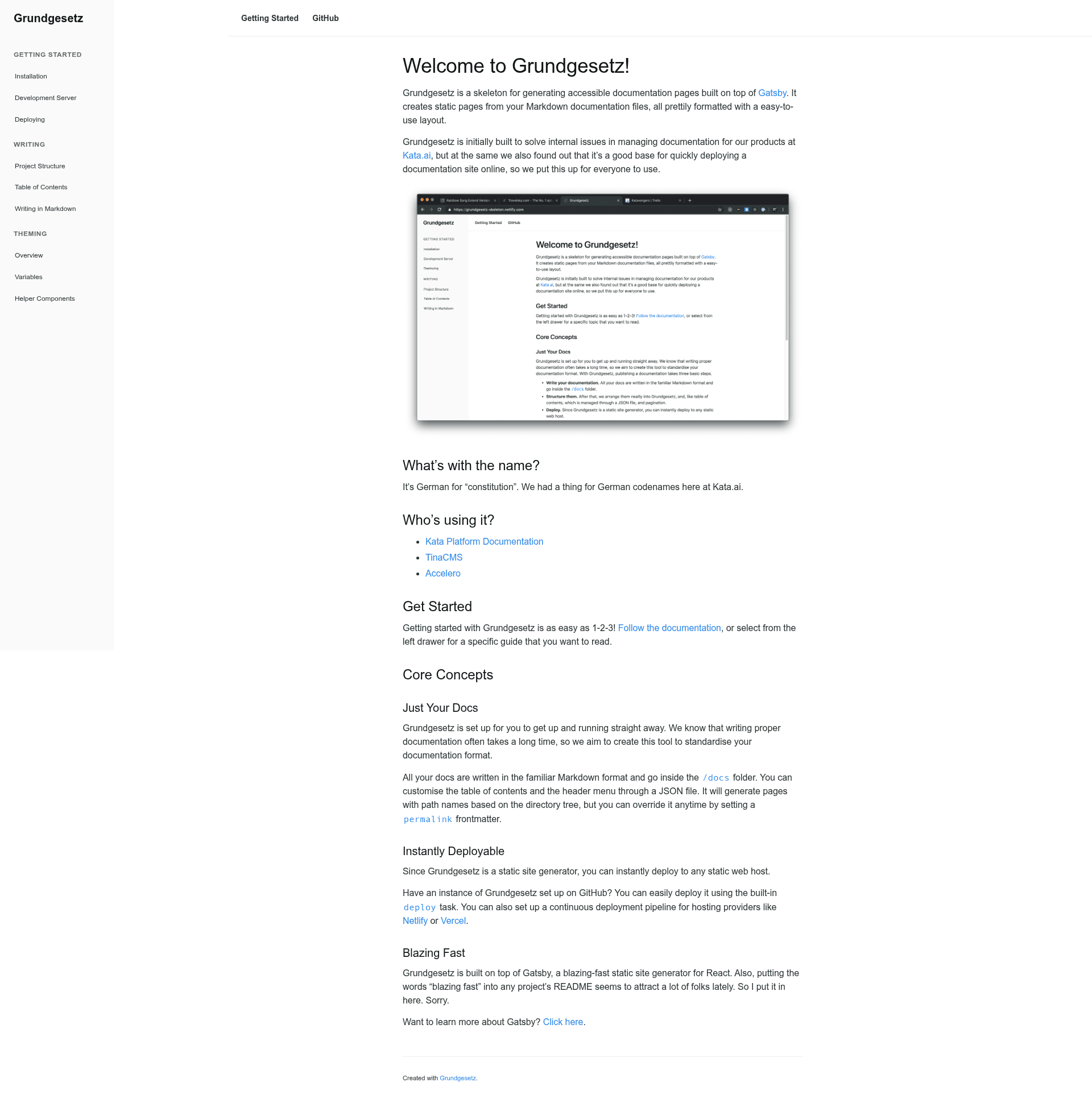
Grundgesetz Skeleton is a Gatsby-based starter template for building accessible documentation websites from Markdown files.
What is Grundgesetz Skeleton?
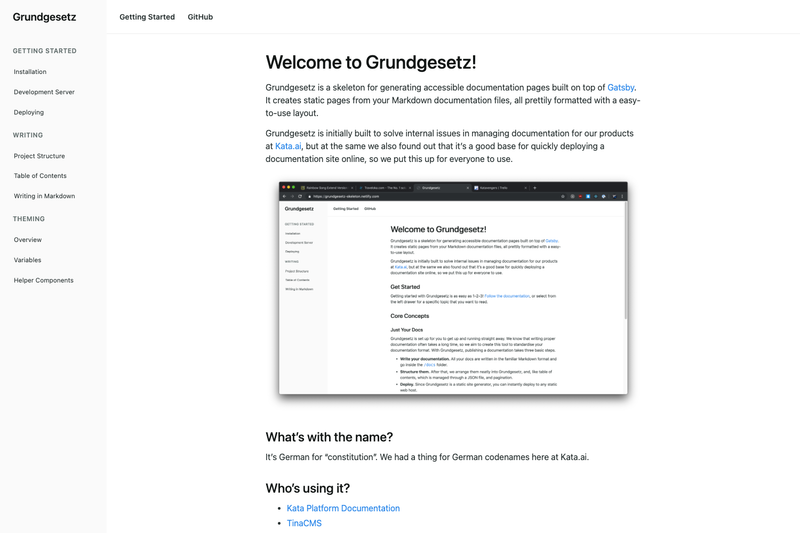
Grundgesetz Skeleton is a starter skeleton created by Kata.ai that generates static documentation websites from Markdown documentation. You write your docs in Markdown inside a docs folder, and the site outputs navigable HTML pages through Gatsby. It is built on React and Gatsby, and is designed to be deployed to any static web host. The template is used in production by Kata Platform Documentation, TinaCMS, and Accelero.
Key Features
- Markdown-based documentation — Place all documentation in Markdown format inside the
docsdirectory, and pages are generated automatically from the directory tree. - Customizable navigation — The table of contents and header menu are configured through a JSON file, so you can adapt the layout without touching templates.
- Permalink overrides — Set a
permalinkfrontmatter field on any Markdown page to override its generated URL path. - Static site generation — Because Gatsby outputs static files, the site can be hosted on any static web host, including Netlify and Vercel.
- Built-in deploy task — For projects hosted on GitHub, a
deploytask is available to publish the generated site directly. - Hot-reloading development server — Running
yarn devornpm devstarts a local server with live reloads atlocalhost:8000. - TypeScript support — The repository's topic list indicates TypeScript is used as part of the starter stack.
- Template-based initialization — You can create a new repository from GitHub's "Use this template" button, or bootstrap with
gatsby newusing the repository URL.
Who is it for?
- Documentation maintainers — Set up a clean, navigable docs site without building infrastructure from scratch; just write Markdown and push.
- Open-source project maintainers — Publish project documentation quickly and host it for free on Netlify or Vercel.
- Product teams — Standardize internal documentation across multiple products, as Kata.ai did for its own platform documentation.
What can you do with it?
- Open-source projects: Create a documentation site for your repository and wire up continuous deployment to Netlify or Vercel so docs update when your Markdown changes.
- Product docs: Build a branded documentation hub for your product, with a TOC and header menu you control via JSON, and links to additional resources.
- Internal knowledge bases: Use the skeleton to maintain internal engineering documentation with a consistent structure and static hosting.
How does it work?
Start by using the "Use this template" button on GitHub or running gatsby new project-name https://github.com/kata-ai/grundgesetz-skeleton. Install dependencies with yarn (or npm install). Place your Markdown files in the docs folder and adjust the JSON navigation file. Run yarn dev to preview at localhost:8000 with hot reloading. When ready, use the built-in deploy task or a Netlify/Vercel pipeline to publish static files.
FAQ
What is Grundgesetz Skeleton?
Grundgesetz Skeleton is a starting point for a documentation website, built with Gatsby. It reads Markdown files from a docs folder and generates static HTML pages that you can host anywhere.
How do I start using it?
You can click "Use this template" on the GitHub repository to create a new repo, or run gatsby new project-name https://github.com/kata-ai/grundgesetz-skeleton with the Gatsby CLI. Then install dependencies and run yarn dev.
Can I host the generated site on Netlify or Vercel?
Yes. Because Grundgesetz produces a static site, you can set up continuous deployment on Netlify or Vercel, and the README also mentions a built-in deploy task for GitHub-hosted projects.