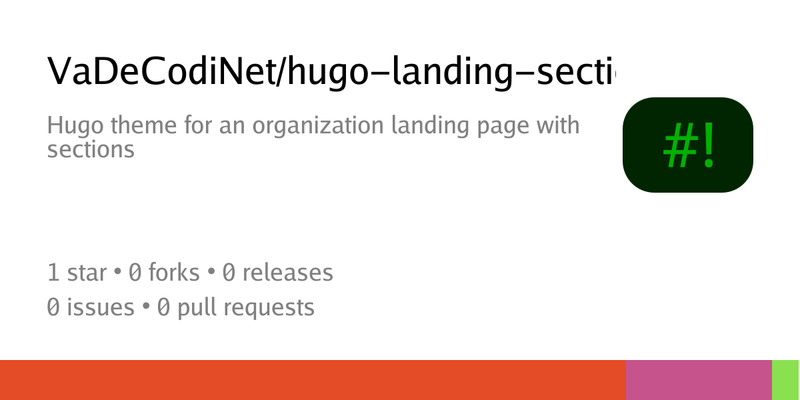
Hugo-landing-sections is a Hugo theme hosted on Codeberg under the VaDeCodiNet namespace, designed to produce an organization landing page with multiple content sections. It is a theme rather than a site, so it supplies layouts, SCSS sources, archetypes and an example site that plug into an existing Hugo project and are driven by hugo.yaml. The repository currently holds 26 commits on the main branch, one branch, zero tags, and a repository size of 49 MiB; its files break down to about 78.3% HTML, 18.3% SCSS and 3.4% Shell.
What is hugo-landing-sections?
Hugo-landing-sections is a Hugo theme for static organization landing pages, built and published on Codeberg by the VaDeCodiNet organization. It takes Hugo content files and configuration as input and renders a static HTML site using SCSS compiled at build time, with Bootstrap Icons installed through npm. Recent commit history is attributed to Mònica Ramírez Arceda (Codeberg user dunetna), and the latest change adds custom fonts and colors to the Hugo configuration.
Key Features
- Sectioned landing layout — The theme's stated purpose is an organization landing page with sections, so the homepage is structured into multiple named content sections instead of a single document.
- Custom fonts and colors — Committed as the latest update, fonts and colors are configurable through the site's hugo.yaml configuration.
- SCSS styling pipeline — Styles live in assets/sass and make up 18.3% of the repository, so visual changes are compiled through Hugo's SCSS processing.
- Bootstrap Icons from npm — package.json, package-lock.json and npm-postinstall.sh install bootstrap-icons as an npm dependency rather than vendoring icon files.
- i18n support — A dedicated i18n directory and the commit "Add translated literal strings" allow UI strings to be translated through Hugo's i18n workflow.
- Example site — The included exampleSite directory demonstrates the theme with real content so you can preview it before adopting it.
- Content archetypes — The archetypes directory defines templates used when generating new content files with hugo new.
- Quality tooling — The repository ships .pre-commit-config.yaml, .markdownlint.yaml, .stylelintrc.js and .prettierignore, enabling linting of Markdown, SCSS and formatting.
Who is it for?
Organizations and small teams using Hugo as their static site generator can use this theme for a sectioned landing page without building one from scratch. Hugo developers can treat the exampleSite and archetypes as a base for prototyping their own layout. Open-source projects that already host documentation on Hugo can reuse the same theme for a lightweight project front page.
Use cases
- Organization websites: Assemble a landing page that presents the group's mission, projects and contact information in separate sections.
- Design exploration: Copy the exampleSite and adjust fonts and colors in hugo.yaml to prototype a brand look quickly.
- Hugo front pages: Use the theme as the homepage of a larger Hugo site, keeping blog or docs as separate sections.
FAQ
Does hugo-landing-sections support custom fonts and colors?
Yes. The latest commit to the repository is titled "Custom fonts and colors in hugo configuration", which means site fonts and colors are set through the Hugo configuration file rather than hard-coded into templates.
Is there an example site included?
Yes. The repository contains an exampleSite directory (added in commit d44c54ec) with content and configuration so you can preview and test the theme before integrating it into your own Hugo project.
Does the theme support multiple languages?
The repository includes an i18n directory and a commit called "Add translated literal strings", which indicates the theme separates literal strings and supports Hugo's translation mechanism.
What assets does the theme use for styling?
The theme is built with SCSS stored under assets/sass, accounting for about 18.3% of the repository, and it pulls Bootstrap Icons through an npm package defined in package.json.
Where is the theme hosted and maintained?
The theme is hosted on Codeberg in the VaDeCodiNet/hugo-landing-sections repository, with recent commits authored by Mònica Ramírez Arceda and published under the VaDeCodiNet organization.