
Template details
Gatsby Starter Eventually
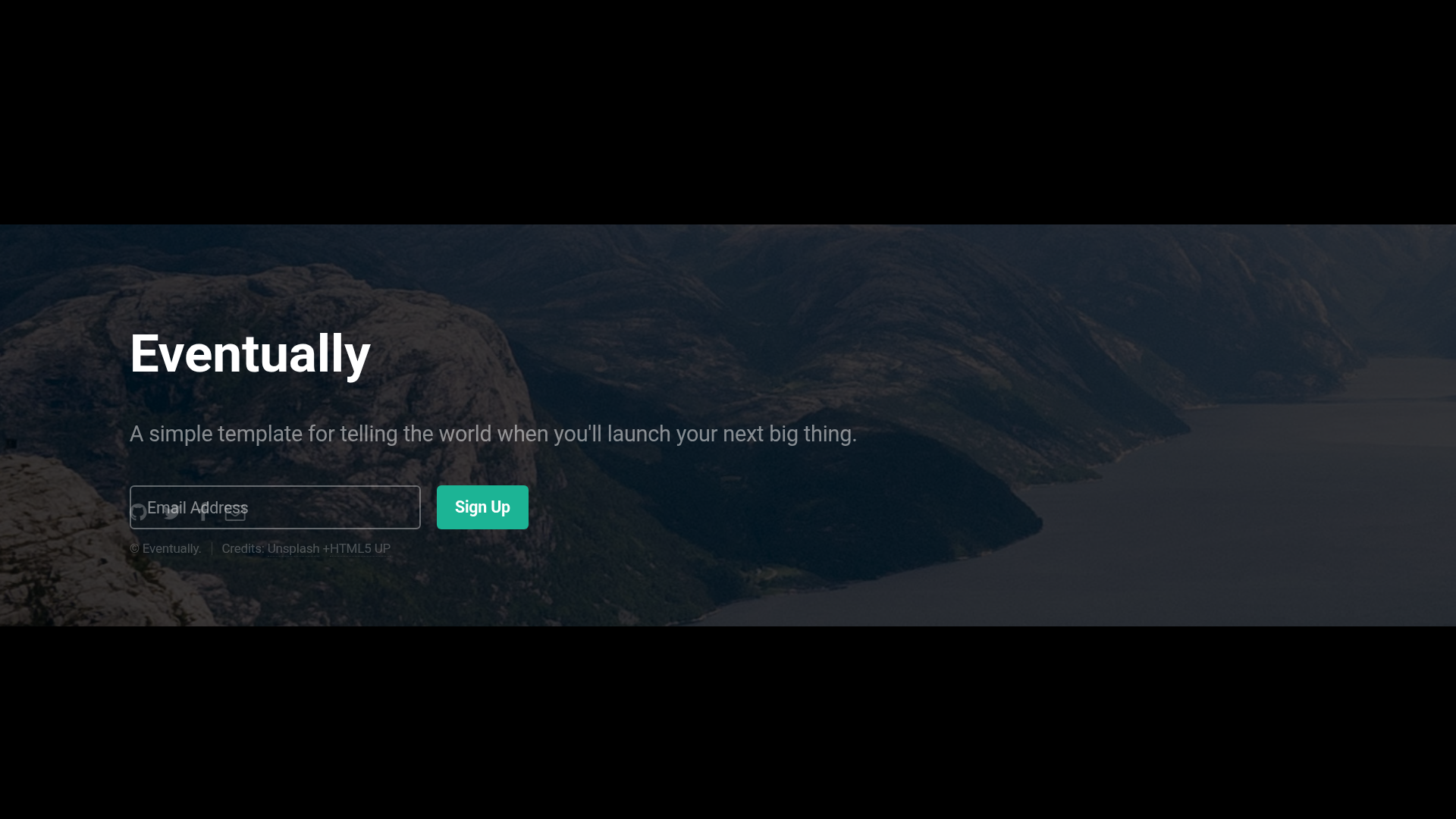
Gatsby.js V4 starter template for a coming-soon page, based on the Eventually design by HTML5 UP.
About this template
gatsby-starter-eventually is a Gatsby.js V4 starter template for building a single-page "coming soon" website, based on the Eventually design by HTML5 UP. It takes a minimal configuration file and outputs a static landing page with a heading, subheading, and social-media links, ready to be deployed to GitHub Pages.
What is gatsby-starter-eventually?
gatsby-starter-eventually is a starter template maintained by Anubhav Srivastava that scaffolds a Gatsby site pre-wired with the HTML5 UP Eventually theme. As input, it takes a project name and a configuration file; as output, it produces a static, responsive "coming soon" page that displays a headline, supporting text, and social icons. The template runs on Gatsby.js V4 and requires Node.js and the Gatsby CLI to install and develop locally.
The design is a single-page layout focused on a countdown-style announcement, with the page content and social links driven by JavaScript configuration. The starter includes a live preview hosted on GitHub Pages and is one of many HTML5 UP–based Gatsby starters from the same author.
Key Features
- HTML5 UP Eventually design — a minimal single-page layout intended for pre-launch announcement pages.
- Config-driven content — edit config.js to set siteTitle, heading, subHeading, and socialLinks; the page renders those values directly.
- Font Awesome social icons — socialLinks accept an icon name, a display name, and a URL; included examples use classes like fa-github.
- GitHub Pages deployment — package.json includes a deploy script that publishes the site via the gh-pages module when you run npm run deploy.
- path-prefix support — a pathPrefix value in config.js adapts the site for hosting under a subpath instead of the root domain.
- Gatsby.js V4 foundation — uses the Gatsby build pipeline for optimized static HTML and asset handling.
- MIT licensed — the starter is open source; the repository includes a LICENSE file.
Who is it for?
- Developers who need a fast "coming soon" placeholder while a larger Gatsby site is under construction, and who want to start from the HTML5 UP Eventually design.
- Indie makers and startups that want to collect early interest with social links before a product launch, without writing custom CSS.
- Gatsby learners who want to study a simple, minimal Gatsby project structure with a config file and deploy script.
What can you do with it?
- Product launches: create an announcement page that tells visitors when your next big thing will be available, and link to your social profiles.
- Personal websites: put up a temporary single-page presence with a heading and your GitHub, Twitter, or other social URLs.
- Open-source projects: use it as the landing page for a repository that isn't ready for a full site, with the option to deploy quickly to GitHub Pages.
How does it work?
After installing the Gatsby CLI globally with npm, you create a new site by running gatsby new <site-name> with the GitHub repository URL. Inside the project, npm install brings down dependencies and gatsby develop starts a local server. Customization happens in config.js, and npm run deploy publishes the built site to GitHub Pages using gh-pages.
Alternatives
Other Gatsby starters by the same author offer different HTML5 UP designs, such as gatsby-starter-grayscale, gatsby-starter-spectral, and gatsby-starter-identity. These are alternatives if you prefer a different visual style but the same Gatsby setup and configuration pattern.
FAQ
Is gatsby-starter-eventually free?
Yes, the template is released under the MIT license, so it is free to use, modify, and distribute. The repository includes the official LICENSE file.
How do I install gatsby-starter-eventually?
You need the Gatsby CLI installed globally, then run gatsby new <site-name> followed by the repository URL: https://github.com/anubhavsrivastava/gatsby-starter-eventually. After that, npm install and gatsby develop run the site locally.
How do I customize the text on the page?
Open config.js and edit the siteTitle, heading, subHeading, and socialLinks fields. The page renders those values directly, so changes appear after a restart of the development server.
Can I deploy this to GitHub Pages?
Yes, the starter includes a deploy script in package.json. Running npm run deploy uses the gh-pages module to push the built site to the gh-pages branch of your repository.
Where can I see a live preview?
The author hosts an online preview at https://anubhavsrivastava.github.io/gatsby-starter-eventually/.