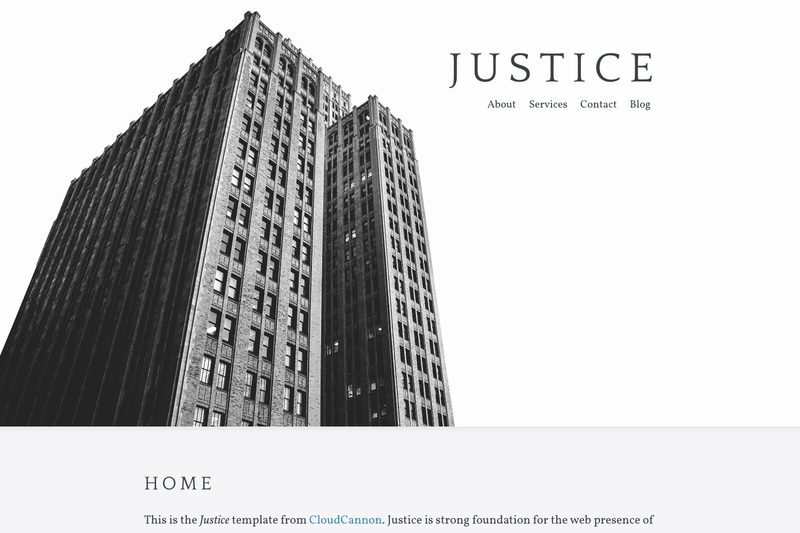
Justice is a law-firm-themed business template for the Hugo static site generator, created by CloudCannon for building professional services websites. It provides a complete starting point with pre-built pages, a blog, and CMS-ready content models.
What is Hugo Justice?
Justice is a Hugo template that turns site configuration and content files — posts, authors, company details, and footer settings — into a static law firm or business website. It runs on Hugo 0.80.0 and supports newer versions, and it is optimized for editing in CloudCannon, though it also works with a plain Hugo local workflow. The template was made by CloudCannon, a Jamstack platform, and a live demo is linked from its repository.
Key Features
- Blog with pagination and category pages — This feature provides a full blog that automatically groups posts into categories and includes paginated archives, so site visitors can browse articles by topic.
- Contact form — Preconfigured to send email to the address in company details via CloudCannon, and it can easily be changed to another provider such as FormSpree.
- Author system — Posts link to an author data model that is reused around the site, so bios and bylines are updated from a single location.
- Configurable footer — Footer navigation and content are controlled per page through front matter under
menu.footer. - Disqus comments — Post pages support Disqus comments after you add your Disqus shortname in
config.toml. - SEO tags and Google Analytics — Built-in SEO meta tags and Google Analytics hooks are activated by adding your keys to
config.toml. - RSS/Atom feed — The template generates a feed automatically from your blog content.
- CloudCannon editing support — Pages, posts, authors, company details, and footer elements can be managed directly in CloudCannon’s CMS, with defaults for new posts set in
_posts/_defaults.md.
Who is Hugo Justice for?
- Law firms and legal practices — Build a professional website with practice area pages, attorney profiles, and a legal news blog without starting from scratch.
- Professional services businesses — Use the pre-built pages and contact form to establish an online presence and publish updates.
- Hugo developers and agencies — Use the template as a client starter, since it’s easy to customize and integrates with CloudCannon for editing.
What can you do with Hugo Justice?
- Legal marketing teams: publish articles and case studies through the blog, using category pages to organize content by practice area and enabling comments via Disqus.
- Site administrators: manage attorney bios, company details, and footer elements in CloudCannon’s data sections without writing code.
- Developers: run the site locally with
hugo server, deploy to CloudCannon, or adapt the Hugo templates to extend the design.
How does Hugo Justice work?
Setup follows the README instructions: add site and author details in config.toml, then add Google Analytics and Disqus keys in the same file. You can serve the site locally by running hugo server, or connect the GitHub repository to CloudCannon to get a hosted, CMS-driven workflow. Content is then edited in CloudCannon through dedicated sections for posts, authors, company details, and footer elements.
Pros and cons
- Pros: Ships with pre-built pages and styled components, includes blog and contact form, has SEO and analytics built in, and is easy to manage in CloudCannon.
- Cons: The template is no longer actively maintained, according to the note on its page, so new feature development is unlikely, though it remains available for reference and learning.
FAQ
Is Hugo Justice free to use?
The template is distributed on GitHub and can be deployed to CloudCannon with the Deploy button or run locally with Hugo. No price or license is mentioned on the page, so it is best treated as a free open-source starter until you confirm the repository license.
Does Justice include a blog with categories?
Yes. The template has a blog with pagination and category pages, allowing posts to be organized by topic. It also supports Disqus comments on individual posts.
Can I use Justice without CloudCannon?
Yes. Justice was built with Hugo 0.80.0 and should support newer versions. You can serve it locally using the Hugo standalone executable with hugo server, or build and host it on any Hugo-compatible platform.
Is the contact form tied to CloudCannon only?
No. The contact form is preconfigured for CloudCannon, but the README says it can be easily changed to another provider such as FormSpree.