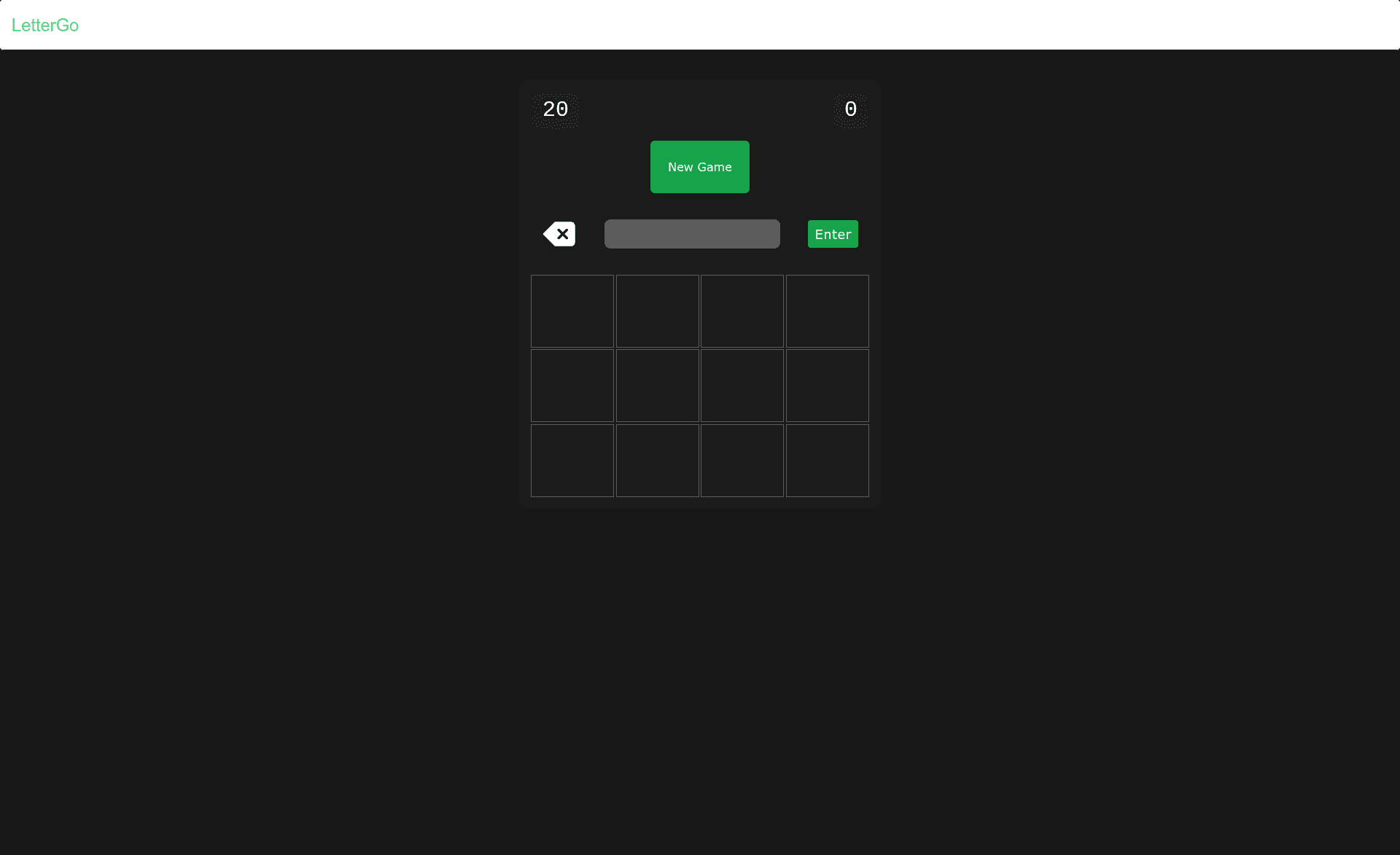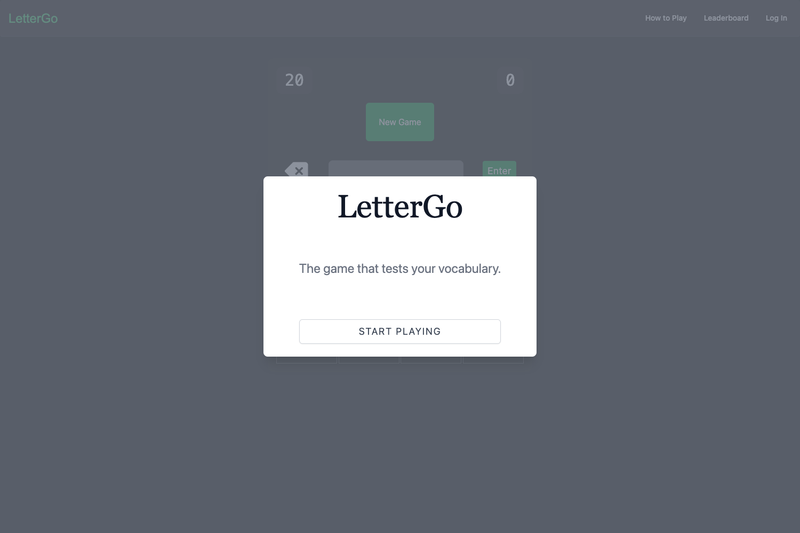
LetterGo is a browser-based word game built with Next.js that challenges players to form as many heterograms as possible from 12 random letters before a timer runs out.
What is LetterGo?
LetterGo is a web-based word game where players are given 12 random letters and must create as many heterograms — words with no repeated letters — as possible within a time limit. The game runs on Next.js with a React front end, a Node.js back end, and a PostgreSQL database accessed through Prisma, and it is hosted on Vercel with the database hosted on Render. It was developed as a personal project to practice implementing game logic and web development.
Key Features
- Heterogram gameplay — Players form words with unique letters from a randomly generated set of 12 letters, scoring for each valid heterogram before the timer expires.
- Global leaderboard — High scores are stored and displayed on a global leaderboard, letting players compare results against others.
- GitHub OAuth login — Users can register and sign in securely using OAuth 2.0 authentication via GitHub, powered by NextAuth.
- Modern tech stack — Built with Next.js, React-Redux for state management, Tailwind CSS for styling, Prisma as an ORM, and PostgreSQL as the database.
- Hosted on Vercel and Render — The front end and back end are deployed on Vercel, while the PostgreSQL database runs on Render.
- TypeScript — The codebase is written in TypeScript, adding static typing to the project.
Who is it for?
- Word game enthusiasts who enjoy fast-paced spelling challenges and competing for high scores.
- Aspiring web developers looking for a reference project that demonstrates Next.js with Prisma, NextAuth, Tailwind CSS, and React-Redux in a working application.
- Anyone seeking a casual browser game that requires no downloads or installs, playable directly at lettergo.vercel.app.
What can you do with LetterGo?
- Play the game: Form heterograms from 12 random letters under a time limit and see your score.
- Compete on the leaderboard: Sign in with GitHub and submit your high score to the global leaderboard.
- Explore the codebase: Developers can study the project to learn how OAuth, leaderboards, and game logic are implemented in a full-stack Next.js app.
How does LetterGo work?
Players start with a set of 12 random letters and a timer. They type or select words; each valid heterogram earns points, and once the timer expires, their score is recorded. The app uses NextAuth for GitHub OAuth authentication and stores high scores in PostgreSQL via Prisma.
FAQ
How do you sign in to LetterGo?
Sign in is handled with OAuth 2.0 through GitHub. Clicking the login button redirects to GitHub's authorization page, and after approval, you are authenticated and can submit your scores to the leaderboard.
What is a heterogram in LetterGo?
A heterogram is a word in which no letter repeats. In LetterGo, you must form such words from the 12 provided letters to score points; common letters like the letter E appear at most once per word.
Is there a time limit in LetterGo?
Yes, gameplay is timed. You must form as many heterograms as possible before the timer expires, and your final score is determined by the words you successfully submitted in that time.
Can I play LetterGo without an account?
The readme only documents GitHub OAuth registration and a global leaderboard; it does not mention guest access. Submitting a high score requires authentication, but the availability of anonymous play is not specified.