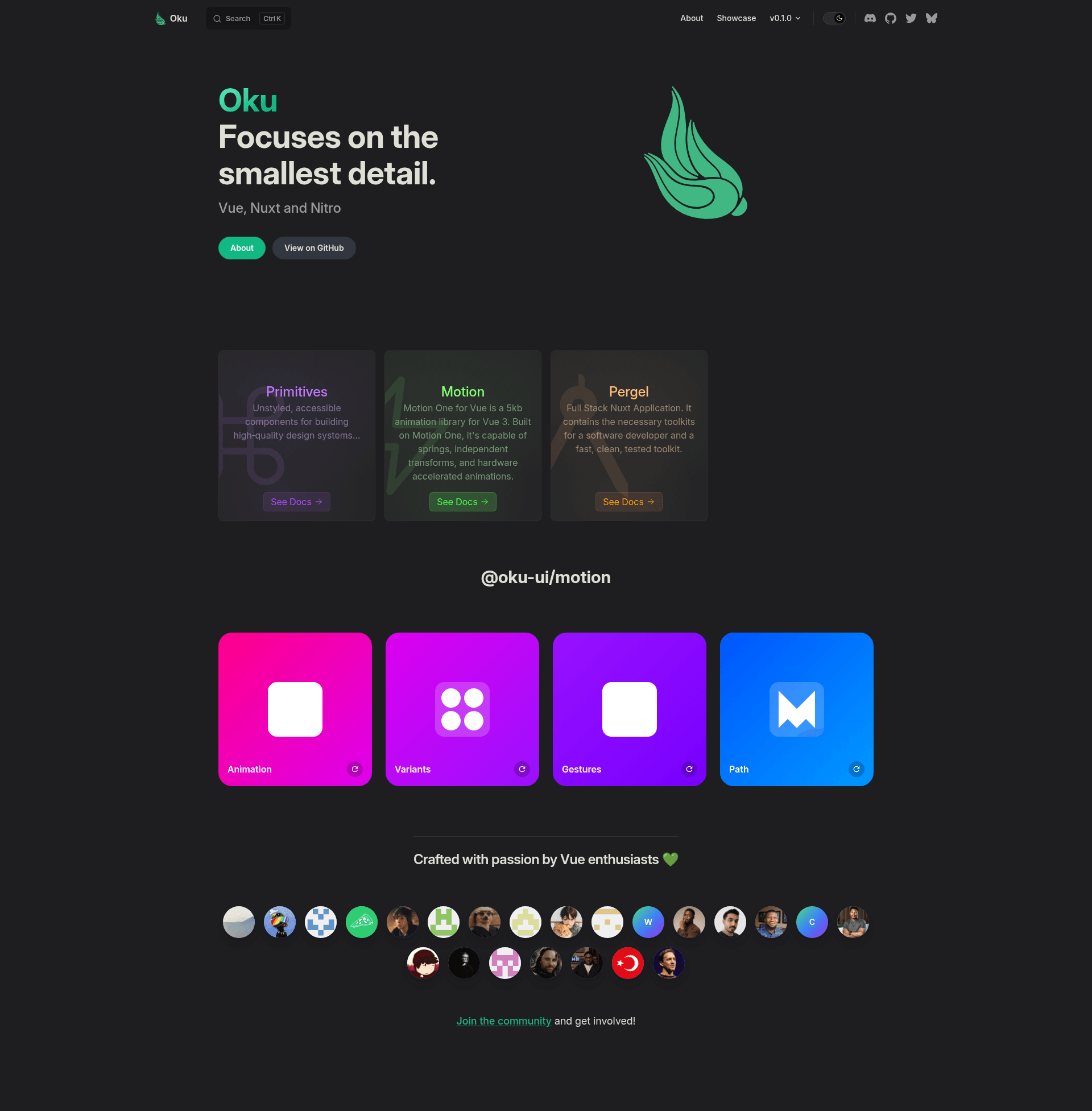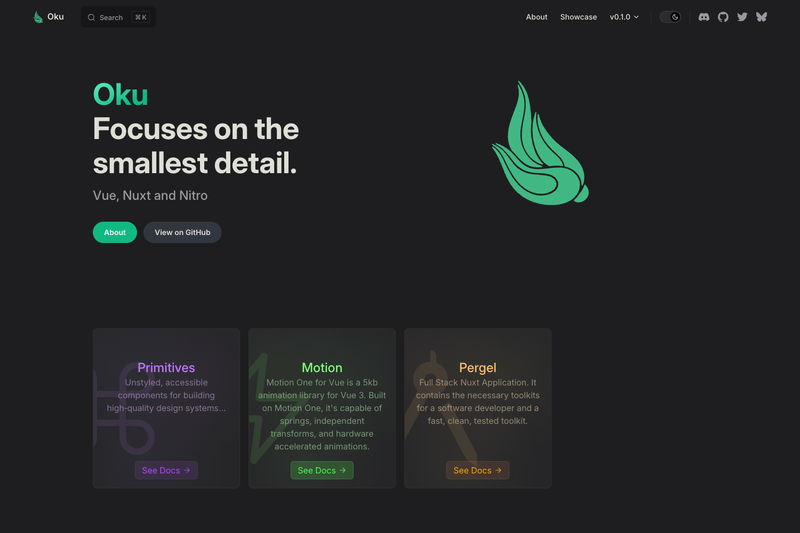
Oku UI is the official website for the Oku open-source ecosystem, built with Nuxt on the Vue tech stack, and its core function is to introduce and link out to the organization's three tools: Primitives, Motion, and Pergel.
What is Oku UI?
Oku UI is the project website for the Oku organization, a group of Vue enthusiasts who build tools for the Vue, Nuxt, and Nitro ecosystem. The homepage showcases three upcoming projects — Primitives, Motion, and Pergel — each with a short description, an icon, a COMING SOON badge, and a See Docs link that points to its own documentation subdomain (primitives.oku-ui.com, motion.oku-ui.com, pergel.oku-ui.com). The page also displays a grid of contributor avatars linking to GitHub profiles and a Join the community link to the Oku chat. The site itself is made with Nuxt, confirming the Vue-based toolchain of its creators.
Key Features
- Built on Nuxt — The website runs on Nuxt, part of the Vue ecosystem, and the organization lists Vue, Nuxt, and Nitro as its technology focus.
- Project card layout — Each of the three Oku tools is presented on a card containing an SVG icon, a title, a one-sentence description, a
COMING SOONmarker, and a link to external documentation. - Primitives showcase — The Primitives card describes unstyled, accessible components for building high-quality design systems, targeting design-system builders.
- Motion showcase — The Motion card explains that Oku Motion is a 5kb animation library for Vue 3, built on Motion One, capable of springs, independent transforms, and hardware-accelerated animations.
- Pergel showcase — The Pergel card describes a full-stack Nuxt application that includes toolkits for software developers and claims to be fast, clean, and tested.
- Community and contributors — The footer section titled Crafted with passion by Vue enthusiasts shows avatars linking to GitHub profiles, and a button invites visitors to join the community chat.
- Separate documentation sites — Each tool has its own documentation domain, indicating a multi-site architecture rather than hosting all docs on the landing page.
Who is it for?
- Vue.js developers — developers evaluating accessible component primitives like Primitives to build unstyled, accessible UI foundations for their own design systems.
- Nuxt full-stack developers — developers who want a ready-made, full-stack Nuxt application scaffold with built-in toolkits through Pergel.
- Frontend motion designers — Vue 3 developers looking for a lightweight 5kb animation library with spring physics and hardware acceleration via Motion.
- Open-source contributors — developers interested in joining the Oku community chat or contributing to the projects via GitHub.
What can you do with Oku UI?
- Build accessible design systems: Use Primitives as a starting point for unstyled, accessible components and apply your own CSS or design tokens.
- Add animations to Vue 3 apps: Use Motion to script spring-based animations, independent transforms, and gesture-driven interactions with a small bundle size.
- Scaffold a full-stack Nuxt app: Use Pergel to begin a Nuxt application with a toolkit that covers common development needs, positioned as tested and clean.
- Follow the ecosystem: Use the landing page as a hub to navigate to the individual documentation sites and stay up to date via the community chat.
FAQ
What is Oku?
Oku is an open-source organization focused on the Vue ecosystem, producing tools like Primitives (accessible unstyled components), Motion (animation library for Vue 3), and Pergel (full-stack Nuxt toolkit). Its official website is built with Nuxt.
What is Oku Motion?
Oku Motion is an animation library for Vue 3 that is about 5kb in size, built on Motion One. It supports springs, independent transforms, and hardware-accelerated animations, and has its own documentation site.
What is Pergel?
Pergel is a full-stack Nuxt application template that includes toolkits for software developers. According to the site, it aims to be fast, clean, and tested, and is available through its own documentation domain.
Is Oku UI free to use?
The landing page does not mention any pricing or paid tiers. The projects are linked to GitHub and include public documentation links, suggesting an open-source distribution, but no license details are shown on the page.