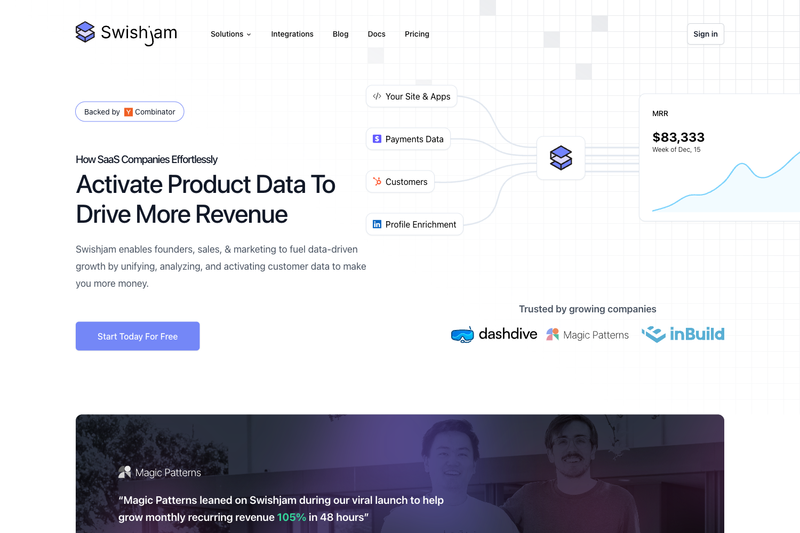
Swishjam is an open-source product analytics platform for B2B SaaS teams that unifies customer data into meaningful insights, built on a Next.js frontend and Ruby on Rails backend with Tailwind CSS and Shadcn styling. The project, authored by Collin Schneider and Zach Zimbler, is backed by Y Combinator's W23 batch and released under the MIT License.
What is Swishjam?
Swishjam is a self-hosting-ready analytics application designed to serve as the central intelligence layer for a SaaS business. It takes customer data from various sources as input and produces unified analytics and SaaS metrics as output, with the goal of delivering actionable insights without heavy setup. The repository is open source, licensed under MIT, and includes a full web application rather than just a library or snippet.
Key Features
- Open-source MIT license — The entire codebase is freely available on GitHub, so you can audit, modify, and self-host it.
- Modern frontend stack — Built with Next.js and styled using Tailwind CSS and Shadcn components, giving developers a familiar React-based UI.
- Ruby on Rails backend — The server side is powered by Rails, providing a mature framework for data processing and APIs.
- Customer data unification — The stated purpose is to combine customer data from disjoint sources into one coherent dataset.
- Out-of-the-box insights — The README's promise is to deliver "meaningful insights out of the box" for B2B SaaS.
- SaaS-focused metrics — Repository topics include product-analytics, saas-metrics, website-analytics, and google-analytics, indicating built-in tracking of these categories.
- Y Combinator W23 backing — The project was part of Y Combinator's Winter 2023 batch, adding startup validation.
Who is it for?
- B2B SaaS founders looking for an open-source alternative to commercial analytics tools to understand customer behavior.
- Product managers who need a unified view of how customers interact with their product features.
- Developers wanting to run their own analytics stack on infrastructure they control, using a Next.js and Rails codebase.
- Data teams that need SaaS-specific metrics such as website analytics and product analytics in one place.
Use cases
- Self-hosted analytics: Deploy Swishjam on your own servers to keep customer data in-house and avoid third-party data sharing.
- Customer data consolidation: Unify data from different sources (marketing, product, billing) into a single analytics backend.
- SaaS metric tracking: Use the built-in product and website analytics to monitor funnel and feature adoption metrics.
FAQ
Is Swishjam free?
Yes, Swishjam is open source under the MIT License, meaning you can use and modify it without paying licensing fees. This applies to the self-hosted version described in the repository.
What tech stack does Swishjam use?
Swishjam uses Next.js for the frontend, Ruby on Rails for the backend, and Tailwind CSS with Shadcn for styling. The codebase is designed as a full-stack web application.
Is Swishjam affiliated with Y Combinator?
Yes, Swishjam was backed by Y Combinator as part of the Winter 2023 (W23) batch. This is stated in the repository metadata.
Who created Swishjam?
Swishjam was created by Collin Schneider and Zach Zimbler, who are listed as authors in the repository.