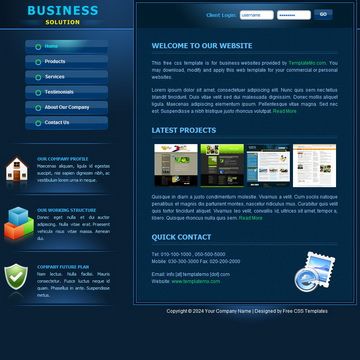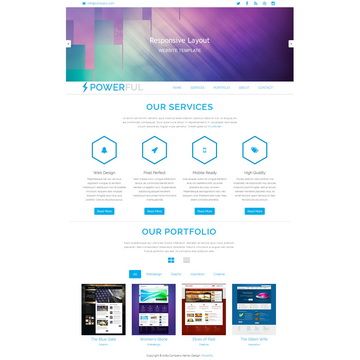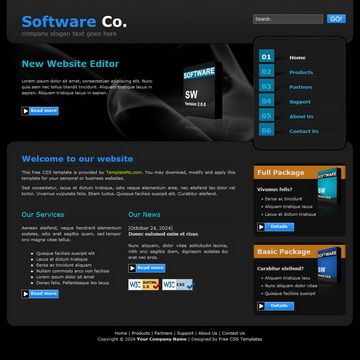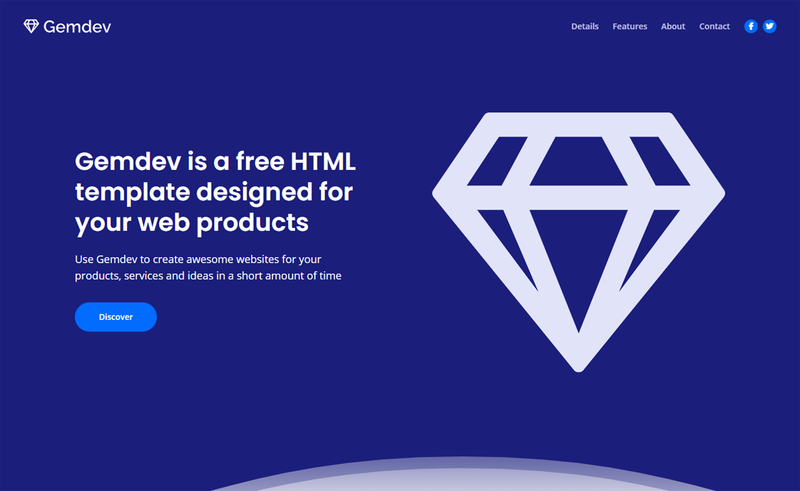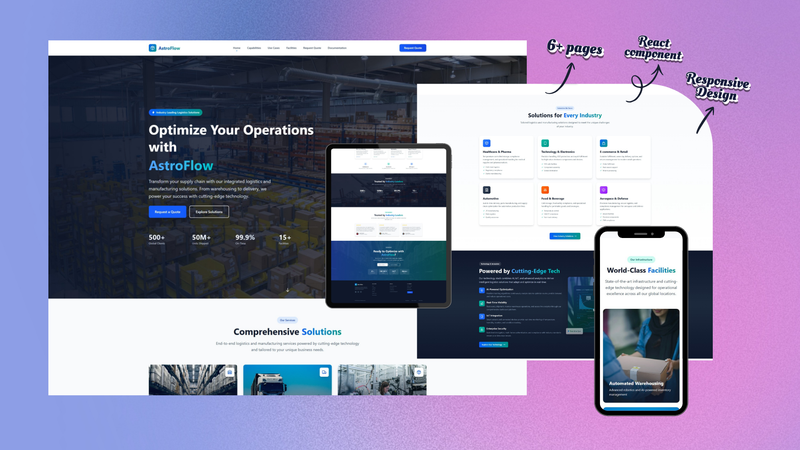
AstroFlow is an open-source Astro.js website template for logistics, manufacturing, and supply chain companies, built to produce a fast static marketing site with a built-in request-quote form.
What is AstroFlow?
AstroFlow is a static-site generator template built on Astro (version 7.0.6) that compiles React components, TypeScript, and Tailwind CSS into a deployable dist/ folder. It takes a configuration file at src/config/site.ts for company name, description, URL, author, and social links, and produces a six-page corporate website: Home, Capabilities, Use Cases, Facilities, Request Quote (RFQ), and Documentation. The template is released under the MIT License and is available on GitHub, where it has 43 stars at the time of this description.
Key Features
- Astro static generation — The template is built with Astro 7.0.6, which outputs a fully static
dist/folder that can be hosted on any static file server. - React 19 interactive components — Interactive elements such as the RFQ form are written as React components (e.g.,
src/components/react/RFQForm.tsx) and load only where needed. - Tailwind CSS 4 styling — All styling uses utility-first Tailwind CSS 4.3.2; colors are customized in
src/styles/global.css. - Six included pages — Home (hero, features, stats, testimonials), Capabilities, Use Cases, Facilities, Request Quote, and Documentation are pre-built as Astro pages in
src/pages/. - Responsive and accessible — The layout is mobile-first by default and the page claims accessibility built in.
- SEO optimized — Meta tags and semantic HTML are included by default.
- Motion animations — Smooth animations are powered by the Motion library.
- Icon management — Icons are managed with the
astro-iconsetnpm package.
Who is it for?
- Logistics companies — Get a professional marketing site with a quote-request form to capture leads.
- Manufacturing firms — Showcase capabilities, facilities, and industry-specific use cases without building a site from scratch.
- Supply chain businesses — Use the Facilities page to display locations and the RFQ form to solicit partnership inquiries.
- Web developers and agencies — Use AstroFlow as a customizable starting point for client projects; the source is MIT-licensed and easy to adapt (replace images, text, and config).
What can you do with AstroFlow?
- Launch a corporate site quickly — Clone the repo, run
npm install, thennpm run devto start a local server atlocalhost:4321; editsrc/config/site.tsand component text to replace placeholder content. - Capture customer requests — The Request Quote page includes a React form (RFQForm.tsx) that currently logs submissions to the browser console; you can wire it to Formspree, Netlify Forms, or a custom API using the sample code in the README.
- Deploy to static hosting — Run
npm run buildto generate adist/folder and deploy it to Vercel, Netlify, GitHub Pages, Cloudflare Pages, AWS S3, or any other static host. One-click deploy buttons for Vercel and Netlify are included in the README. - Match industry-specific needs — The Use Cases page is built for showcasing industry-specific solutions, so you can adapt it to freight, warehousing, or production scenarios.
How does AstroFlow work?
AstroFlow is a standard Astro project. You install dependencies with npm install, start development with npm run dev, and edit pages in src/pages/ and components in src/components/. The site content is configured centrally in src/config/site.ts, where you set the company title, description, URL, author, and social links. Builds are produced with npm run build, outputting a static dist/ folder suitable for deployment.
Pros and cons
- Fast static output — Generates a
dist/folder with pre-rendered HTML, which can be served from a CDN for performance. - Modern framework versions — Uses Astro 7.0.6, React 19.2.7, TypeScript 5.0, and Tailwind CSS 4.3.2.
- Easy deployment — Provides one-click deploy buttons for Vercel and Netlify and works with any static host.
- MIT licensed — Free to use, modify, and redistribute.
- RFQ form not connected to a backend — The form currently logs to the console; you must integrate a form service or API yourself.
- Placeholder content — The template ships with placeholder images and sample text that need to be replaced for production.
Pricing
The project is free and open source under the MIT License; there is no paid tier mentioned.
FAQ
Is AstroFlow free?
Yes, the template is released under the MIT License, so you can use and modify it freely. The GitHub repository contains the full source code; there is no mention of a paid version.
What tech stack does AstroFlow use?
AstroFlow uses Astro 7.0.6 for static site generation, React 19.2.7 for interactive components, TypeScript 5.0 for type safety, and Tailwind CSS 4.3.2 for styling. Animations use the Motion library, and icons are handled with astro-iconset.
How do I set up the request quote form?
The RFQ form is a React component at src/components/react/RFQForm.tsx. By default it logs submissions to the console. The README shows how to change the submit handler to POST to a service like Formspree or Netlify Forms, or to a custom API endpoint.
What pages are included?
AstroFlow includes six pages: Home, Capabilities, Use Cases, Facilities, Request Quote (RFQ), and Documentation. The Home page has a hero section, features, stats, and testimonials.
Can I deploy AstroFlow to Vercel or Netlify?
Yes, the README includes one-click deploy buttons for both Vercel and Netlify. The build command is npm run build, which produces a static dist/ folder that any static host can serve.