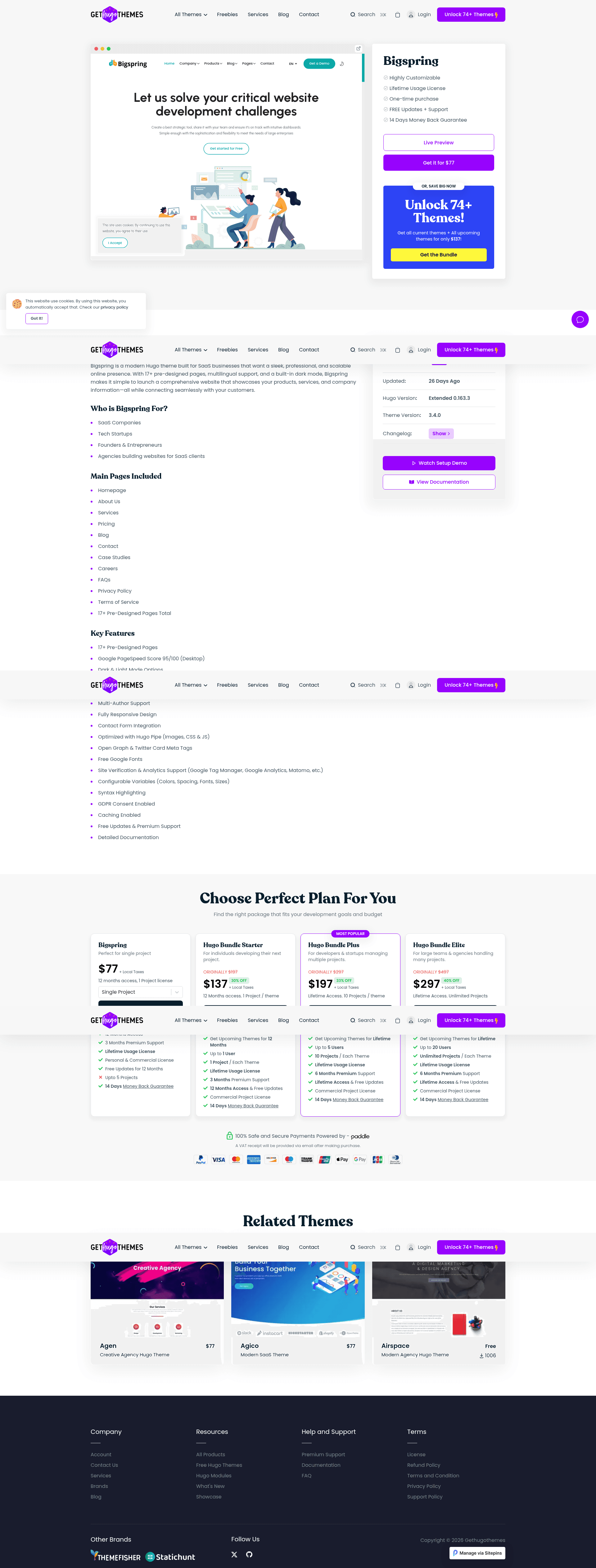
Bigspring Light Hugo is a free, open-source Hugo theme for building fast SaaS marketing websites and digital agency sites, developed and maintained by Gethugothemes on GitHub.
What is Bigspring Light Hugo?
Bigspring Light Hugo is a static website theme built on the Hugo framework. It takes Markdown content and renders a performant, JAMstack-ready website that can be deployed to Netlify, Vercel, or any static host. The theme requires a minimum Hugo version of 0.163.3 and is distributed under the MIT code license, with demonstration images carrying their own licenses. The official live demo is hosted at bigspring-light-hugo.vercel.app.
Key Features (What makes Bigspring Light Hugo stand out?)
- Light and minimal UI — the design is clean and fresh, matching the startup positioning.
- Tailwind CSS styling — the layout is built with the Tailwind CSS utility framework, visible through the project setup.
- Swiper.js integration — Swiper is included in the special thanks, indicating slider/carousel support.
- Font Awesome Icons — Font Awesome is listed as a dependency, so rich iconography comes ready to use.
- Google Fonts — the project includes Google Fonts linking for typography.
- Dark mode — the repository tags include dark-mode, so the theme responds to dark-mode preferences.
- Fast loading and high performance — being a Hugo static site, the output is pre-rendered HTML with no database or heavy runtime.
- JAMstack friendly — the theme is tagged with jamstack and netlify, making it suitable for modern static deployments.
- Blog capability — the repository is tagged as a blog-theme, meaning it includes blog templates in addition to the marketing pages.
Who is it for?
- SaaS startups — teams that need a professional marketing site with fast performance and minimal overhead.
- Digital agencies — studios that want a company website with portfolio and blog sections to showcase client work.
- Hugo developers — individuals comfortable with Hugo and Tailwind who want a maintainable starting point for client projects.
What can you do with Bigspring Light Hugo?
- SaaS marketers: create a clean landing page with company information, call-to-action areas, and a blog to publish updates, all without a separate CMS.
- Agency principals: set up a site that presents the agency's services and portfolio, using the included blog for case studies and news.
- Freelance developers: use the theme as a base for rapid website delivery, customizing Hugo partials and Tailwind classes.
How does Bigspring Light Hugo work?
The local development workflow is documented in the README. After cloning the repository, run npm run project-setup to initialize the project, install dependencies with npm install, and then use npm run dev to launch the local Hugo server. The theme's source is organized as a Hugo module with npm-based tooling.
FAQ
Is Bigspring Light Hugo free?
Yes, the theme is free and open source under the MIT license. The code is free to use and modify, though the included demonstration images are not covered by the MIT license and are only for preview purposes.
What Hugo version does Bigspring Light Hugo require?
The GitHub badge indicates a minimum Hugo version of 0.163.3. Make sure your Hugo installation is at least this version to build the theme correctly.
Does Bigspring Light Hugo support dark mode?
The repository's topic list includes dark-mode, so the theme provides dark-mode support out of the box. Users can switch between light and dark appearances depending on their system preference, subject to the theme's implementation.
Can I use Bigspring Light Hugo for a blog?
Yes, the repository is tagged with blog-theme. In addition to marketing and agency landing pages, the theme includes blog layouts, making it suitable for content publishing.
What technologies does Bigspring Light Hugo use?
The theme is built with Hugo as the static site generator, uses Tailwind CSS for styling, Swiper.js for sliders, Font Awesome for icons, and Google Fonts for typography. This combination keeps the frontend lightweight and fast.