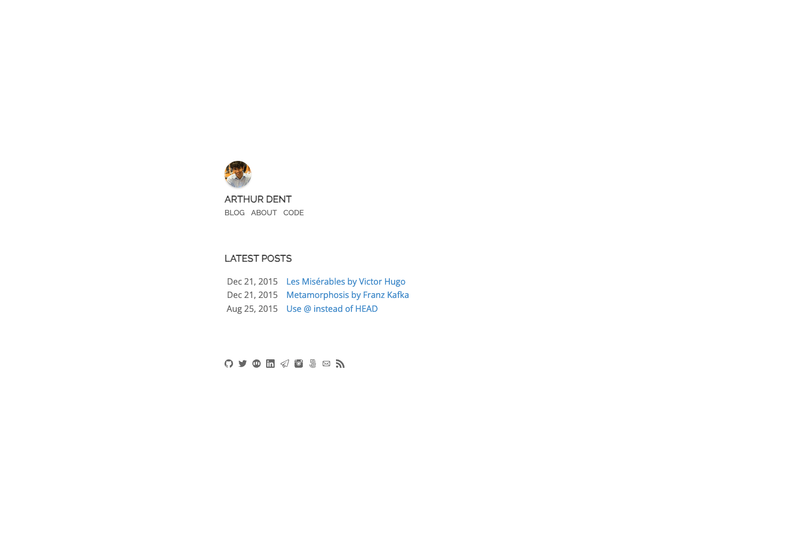
Cocoa is a responsive Hugo theme for blogging and personal websites that turns Markdown content into a static site with clean typography and optional integrations like Disqus, Google Analytics, and syntax highlighting.
What is Cocoa Hugo Theme?
Cocoa is a Hugo theme built for blogs and personal webpages. It takes Markdown posts and fixed pages from your Hugo content directory and outputs a static, responsive website. The theme is maintained by nishanths and contributors, and is released under the MIT License. The author notes the project is not actively developed but accepts pull requests.
Key Features
- Responsive layout — the theme adapts to mobile and desktop screens; no extra configuration needed.
- Disqus support — enable comments by setting your Disqus shortname in
config.toml. - Syntax highlighting — code blocks are highlighted with highlight.js, contributed by @andy4thehuynh.
- Profile image — choose a Gravatar or a static profile image, contributed by @remeh.
- RSS feed — the theme generates an RSS feed and shows an icon, contributed by @mvrilo.
- Optimized SVG icons — icons for Instagram, 500px, and more, contributed by @robinst.
- Cache busting — asset URLs get fingerprints so updated files load fresh.
- Analytics and comments — Google Analytics, Piwik, and Gitalk are supported and toggled through
config.toml.
Who is it for?
- Bloggers — publish Markdown posts from
content/blogand get a fast static site with comments and analytics. - Personal site owners — add about or contact pages under
content/fixedwithout mixing them with blog posts. - Hugo developers — customize templates or contribute features, since the project explicitly welcomes pull requests for fixes and new features.
What can you do with Cocoa?
- Independent writers: set up a blog with Disqus comments and Google Analytics without managing a database or backend.
- Portfolio owners: create fixed pages like About while keeping a separate section for updates or posts.
- Learners: study how a modular Hugo theme organizes layouts, config, and optional features.
How does Cocoa work?
From the root of your Hugo site, clone the theme into themes/cocoa, then run hugo -t cocoa to generate the site into the public directory. For local development, hugo -t cocoa --watch serve serves the site at localhost:1313. New posts are created with hugo new blog/your-new-post.md, and you must set draft = false in front matter or use --buildDrafts to publish them. If you upgrade to Hugo 0.18 or later, lowercase every parameter name in config.toml.
Pricing
Cocoa is free and open source under the MIT License, so you can use, modify, and redistribute it without cost.
FAQ
Is Cocoa Hugo Theme free?
Yes. The theme is licensed under the MIT License, which permits free commercial and personal use, including modification and redistribution.
Does Cocoa support comments?
Yes, it supports Disqus and Gitalk. Disqus is configured by adding your shortname to config.toml, and Gitalk is another optional comment integration.
How do I create a new post?
Run hugo new blog/your-new-post.md from your site root, then set draft = false in the post's front matter for it to appear in the built site.
Is the theme still maintained?
The author states they do not actively work on the theme now, but pull requests for bug fixes and new features are welcome. The project remains usable and builds with current Hugo versions.
What typefaces does Cocoa use?
The theme uses Open Sans, Raleway, and Ubuntu Mono for its typography, giving clean, readable text on blog pages.