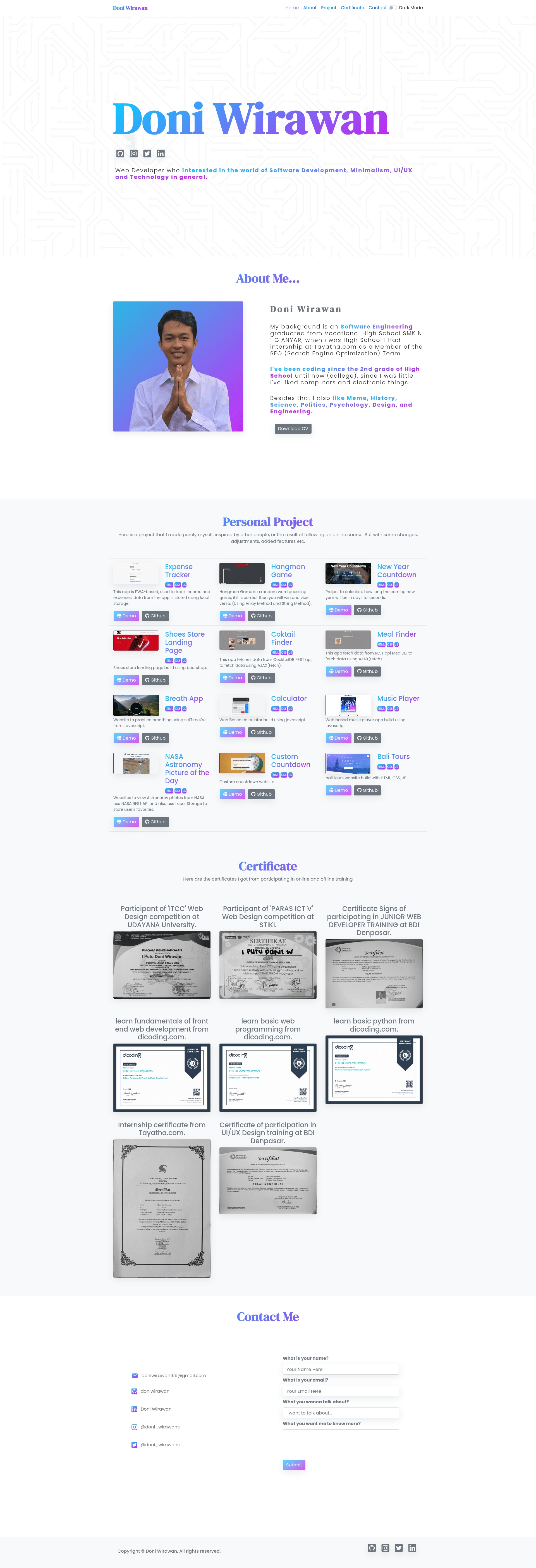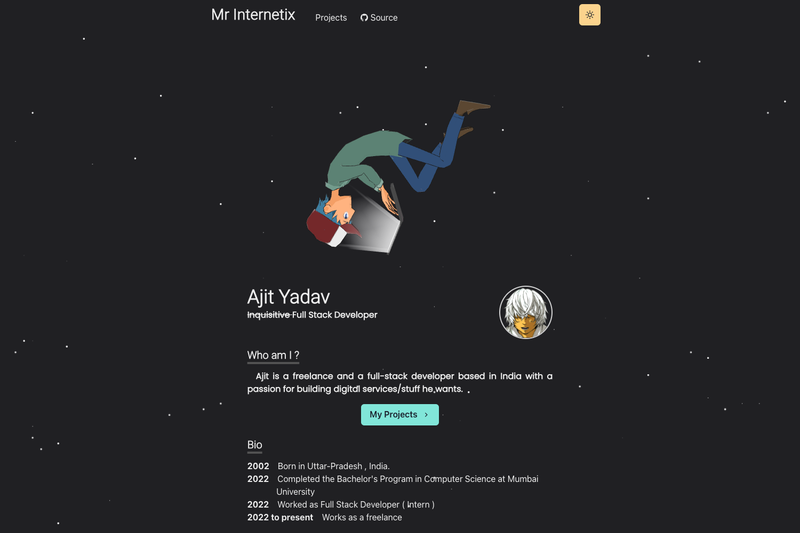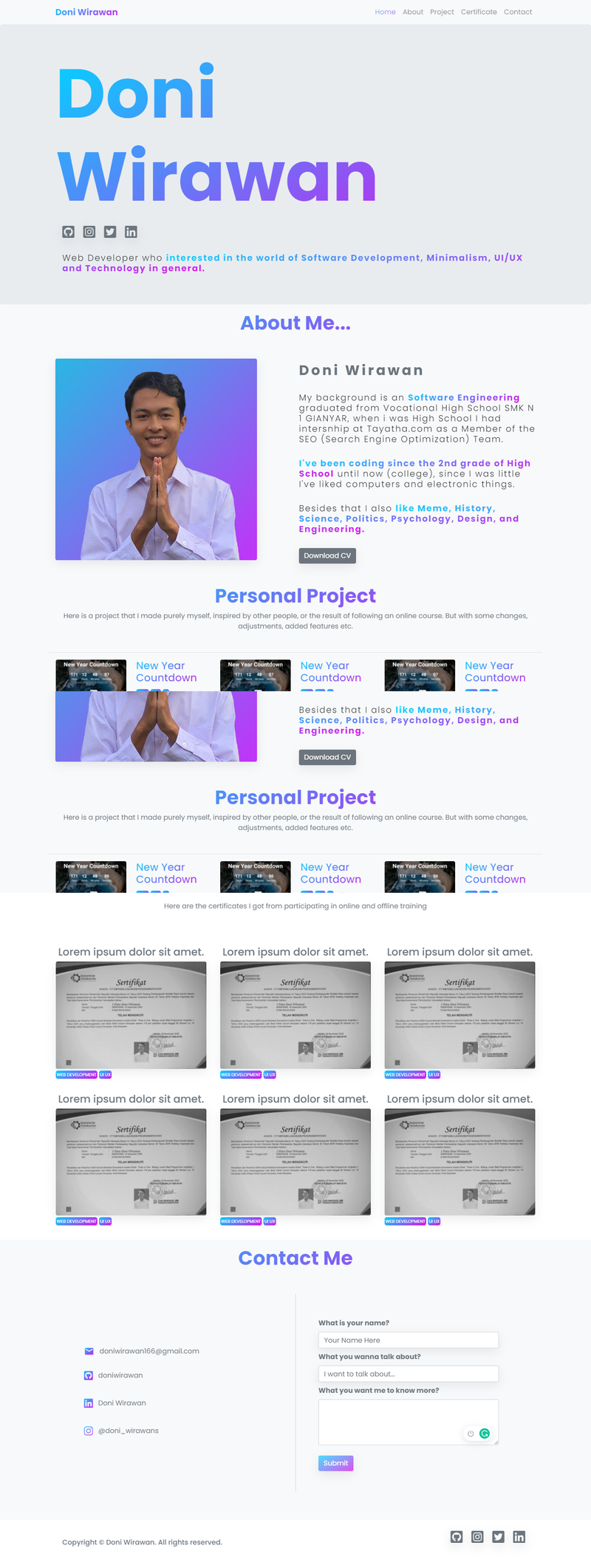
Gradient-Landing-Page by Doni Wirawan is an open-source personal portfolio landing page template that pairs a cyberpunk palette with vibrant gradients, designed for developers and creative professionals who want a single-page web presence. The template is a static site built with Bootstrap, as indicated by the project's landingpage-bootstrap topic tag, and its demo is deployed live on Netlify at the provided demo URL. The GitHub repository currently has 20 stars and is tagged with cyberpunk, gradient, personal, and portfolio, reflecting both its visual style and intended use as a personal showcase.
What is Gradient-Landing-Page?
Gradient-Landing-Page is a single-page portfolio template that lets you present your name, work, and links inside a gradient-heavy, cyberpunk-styled layout. It takes content like a person's profile information and renders it as a static HTML landing page; the only input is your edits to the HTML source. The project was created by Doni Wirawan, is hosted on GitHub, and includes a live Netlify preview. Its Bootstrap foundation means the layout is responsive out of the box, and the repository topics 'personal' and 'portfolio' confirm that the page is tailored to present an individual's public identity and projects.
Key Features
- Cyberpunk gradient aesthetic — The template's defining visual trait is its use of vivid gradients paired with a cyberpunk style, matching the project's cyberpunk topic.
- Bootstrap-based layout — The landingpage-bootstrap topic tag identifies Bootstrap as the underlying CSS framework, giving responsive grid structure and prebuilt components.
- Personal portfolio focus — Repository topics 'personal' and 'portfolio' indicate the page is tailored to present an individual's profile and projects.
- Live Netlify demo — The project includes a working demo at the provided Netlify URL, letting you preview the page before using it.
- Open-source with community interest — The GitHub repository is public and has earned 20 stars, showing early community traction.
- Static-site ready — As a plain HTML/Bootstrap page, it can be deployed to any static host without server-side dependencies.
Who is it for?
Gradient enthusiasts — Use the page to experiment with gradient-heavy, cyberpunk color schemes while building a personal site. Developers and designers — Fork the repository to quickly scaffold a portfolio landing page without writing a layout from scratch. Students and job seekers — Deploy the template to Netlify to create a personal branding page that links to resume, social profiles, and projects. Open-source learners — Study the Bootstrap markup and gradient CSS techniques in a small, readable codebase.
What can you do with it?
Personal branding: Replace the default content with your name, bio, and social links to publish a one-page portfolio. Design experimentation: Modify the gradient color stops to make the cyberpunk palette your own. Learning Bootstrap: Read the page source to see how Bootstrap classes structure a responsive landing page. Rapid deployment: Push the static files to Netlify or any static host and have a live portfolio in minutes.
FAQ
Is Gradient-Landing-Page free to use?
The template is open source, hosted on GitHub, with no license or pricing information shown on the repository page. You can fork it, modify it, and deploy your own copy; the live demo is also freely viewable on Netlify.
What technology does Gradient-Landing-Page use?
The project is built as a static landing page using Bootstrap, according to the repository's landingpage-bootstrap topic tag. No JavaScript framework is mentioned, so the page works with plain HTML and Bootstrap's CSS and components.
Where can I see a demo?
A live demo is hosted on Netlify and linked from the repository README at the project's demo URL. The demo shows the gradient, cyberpunk-styled landing page in action.
Can I use this template for my own portfolio?
Yes, the repository is open source, so anyone can fork or clone it and replace the placeholder content with their own profile information. Because it is a static page, no build step is required before deployment.