Hackercouch is a Jekyll-based community directory that lets hackers offer each other a free place to stay, with every listing contributed through a fork-and-pull-request GitHub workflow instead of a web form.
What is Hackercouch?
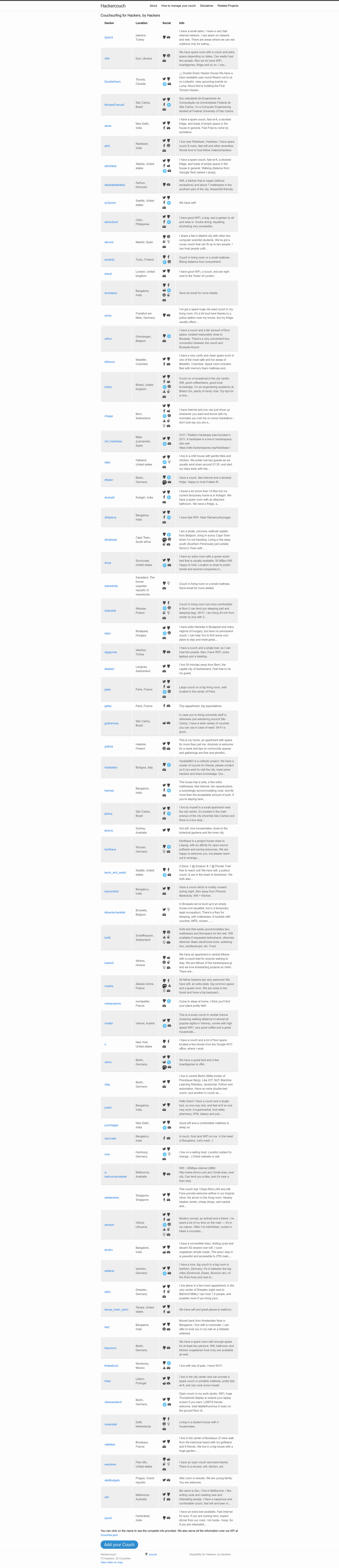
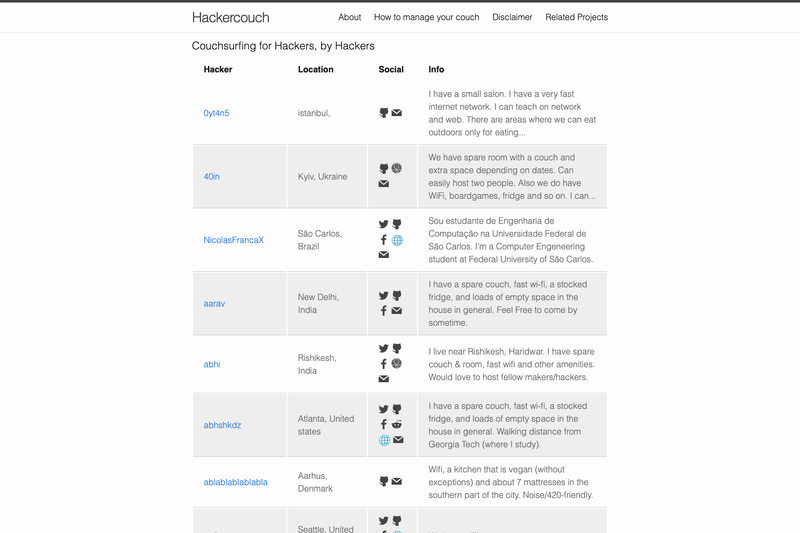
Hackercouch is an open-source Jekyll site that publishes a directory of "couches" — free accommodation offers from hackers for hackers. It takes markdown files added to the _couches directory of the GitHub repository as input and produces a browsable website at hackercouch.com as output. The project is hosted on GitHub under the hackercouch organization and builds on an earlier project by jancborchardt. The site runs on Jekyll with Ruby and Bundler for local development, and a GitHub Actions workflow builds and publishes the site automatically.
Key Features
- Fork-PR-Publish workflow — Contributions are made by forking the repo, adding your own markdown file, and opening a pull request; once merged, the site is regenerated and published at hackercouch.com.
- Jekyll collections — Each couch listing is a markdown file in the
_couchesdirectory, taking advantage of Jekyll's collection system to structure and display listings. - Minimal listing requirements — Only a nick, city, and country code are mandatory in a couch file, keeping the barrier to entry low.
- Dual licensing — The template code is MIT licensed while all content under
_couchesis CC0 public domain, and by filing a PR contributors agree to release their couch information under CC0. - Automatic build checks — The GitHub Actions workflow runs a build on every pull request, so only listings that pass the Jekyll build are merged.
- Based on a proven pattern — The fork-PR-publish mechanism is borrowed from remy/mit-license, and the idea was previously attempted by the original hackercouch project, with encouragement from a comment by @sirupsen on Hacker News.
Who is it for?
- Travelling hackers — People attending conferences, meetups, or just passing through a city can search the directory for a free couch instead of paying for a hotel.
- Hacker hosts — Developers and technical folks who have a spare couch or room can offer it to fellow hackers, building a global hospitality network.
- Open-source contributors — Anyone comfortable with git and GitHub can contribute a listing or help improve the site without needing to learn a CMS, since the entire contribution path is GitHub-native.
- Community organizers — Groups that host events can encourage attendees to both offer and request couches, using the PR flow as a filter to keep listings relevant.
What can you do with Hackercouch?
- Find a couch before a trip — Browse or search hackercouch.com for a couch in the city you are visiting and contact the host through the information in their listing.
- Offer your own couch — Add a markdown file with your nick, city, and country code, file a PR, and your couch becomes part of the public directory.
- Run your own instance — Since the code is open source under MIT, you can fork the repository and deploy your own hospitality directory for a different community or region.
How does Hackercouch work?
To add a couch, you fork the repository, add a markdown file named after your nick in the _couches directory, and open a pull request. The GitHub Actions build runs to verify the site compiles, and once a maintainer merges your PR, the site is automatically published to hackercouch.com. Locally, you can run bundle install and bundle exec jekyll serve --watch to preview changes on http://localhost:4000.
Pros and cons
Pros:
- The pull-request requirement naturally filters out non-technical spam and keeps the community hacker-focused.
- The licensing model makes couch information reusable, and the code is open for anyone to fork and improve.
- Contributions are easy to review because each listing is a simple markdown file.
Cons:
- Contributions require a GitHub account and familiarity with pull requests; there is no web form for adding a couch.
- Listings are only published after a maintainer merges the PR, so the directory depends on maintainer activity.
- The build and publish process relies on GitHub Actions and the repository staying online.
Pricing
Hackercouch is free and open source. The code is MIT licensed, and the couch content is CC0, so there are no usage fees or paid tiers.
Alternatives
- Couchsurfing — a large commercial hospitality exchange network with a matching system and reviews, but not open source and not specifically for hackers.
- Trustroots — an open-source hospitality exchange aimed at travelers and alternative communities, with a different contribution model based on profiles rather than GitHub PRs.
FAQ
How do I add my couch to Hackercouch?
Fork the repository at github.com/hackercouch/hackercouch, create a markdown file in the _couches directory using your nick as the filename, then open a pull request. Once the build passes and a maintainer merges it, your listing goes live at hackercouch.com.
What information do I need to provide in my couch listing?
The minimum required information is your nick, city, and country code. You can include additional details like contact info, availability, or house rules in the same markdown file, since the collection format supports extra fields.
Is my couch information open source?
Yes. Everything under the _couches directory is licensed under the CC0 license, and by filing a PR you agree to have your couch information available under that license. The rest of the template code is MIT licensed.
Do I need to know Jekyll to contribute?
No, you only need to create a simple markdown file. You can add it directly on GitHub through the web interface, or locally if you prefer. For local development, you will need Ruby and Bundler, and can run bundle exec jekyll serve --watch to preview.
Where is the project developed?
The project is developed on GitHub at github.com/hackercouch/hackercouch. It includes a HACKING.md file for development instructions, plus an add.md file with detailed contribution instructions and a disclaimer policy.