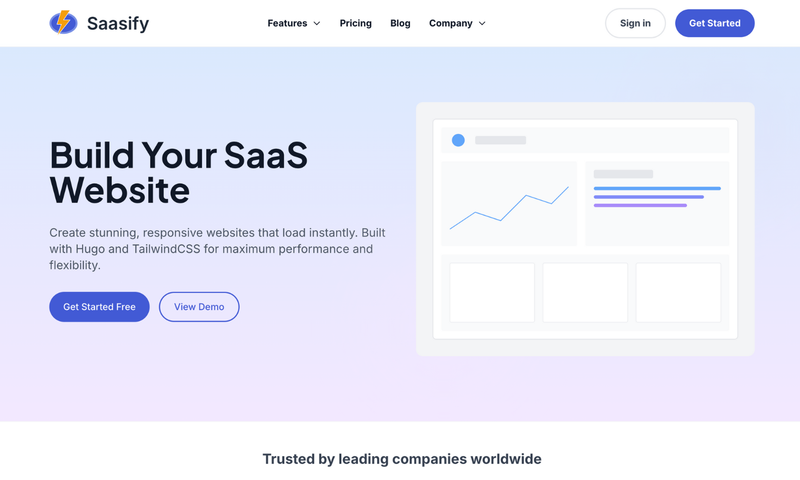
Hugo Saasify Theme is an open-source Hugo theme built with TailwindCSS for creating fast, multilingual SaaS marketing websites with landing pages, blogs, and documentation sections.
What is the Hugo Saasify Theme?
Hugo Saasify Theme is a Hugo theme designed specifically for SaaS marketing websites. It takes markdown content and hugo.toml site configuration as input and generates a static HTML site using Hugo Extended, version 0.80.0 or higher. The theme is created by Chaoming Li and ships with a full example site that includes sample blog posts, feature pages, a pricing page, a careers section, and a company information page.
Key Features
- TailwindCSS framework — The theme uses TailwindCSS for all styling, with a primary and secondary color palette defined in tailwind.config.js and global component styles in assets/css/main.css.
- Multilingual support — Full i18n with automatic language detection via VisitorAPI, a header language switcher, language-specific content directories, and translatable UI strings in i18n files.
- 21 pre-built shortcodes — A documented set of shortcodes in docs/SHORTCODES.md that speed up page building, covering common SaaS layout components.
- Documentation layout — A built-in docs section with automatic sidebar navigation, configured through the content structure under content/docs/.
- Analytics and tracking — Built-in Google Analytics and Google Tag Manager support that are enabled only in production, plus a custom head partial for adding third-party scripts such as Hotjar, Mixpanel, or site verification tags.
- Performance — The theme ships with no jQuery and minimal JavaScript, targeting 90+ Lighthouse scores for load time.
- Typography — Uses Inter for body text and Plus Jakarta Sans for headings, both customizable in tailwind.config.js.
- Docker preview — A multi-stage Dockerfile builds the example site with hugomods/hugo:exts and serves it via nginx:alpine, so you can preview without installing Hugo or Node.js.
Who is it for?
- SaaS founders who need a professional marketing site with pricing, features, blog, and docs pages they can launch quickly from a static site.
- Hugo developers who want a TailwindCSS-based theme with a clean, configurable codebase and an example site to copy.
- Product marketing teams that need a multilingual site with automatic language detection to reach audiences in different regions.
What can you do with it?
- SaaS startups: Build a complete marketing site by copying the example site content, then editing pages and navigation in hugo.toml.
- Documentation publishers: Create a docs section with automatic sidebar navigation by adding pages under content/docs/.
- Multilingual businesses: Set up English and Simplified Chinese versions of the site using language-specific content directories and menus, as shown in the demo repository.
How does the Hugo Saasify Theme work?
Installation follows a standard Hugo workflow: create a new Hugo site, add the theme as a git submodule, copy the theme's package.json, postcss.config.js, and tailwind.config.js to your site root, then run npm install. After configuring hugo.toml with the required module, build, security, and markup settings, you run npm run start for local development with live reload or npm run build for a minified production build in the public directory.
Pricing
The theme is free and open source under the MIT license.
FAQ
Is the Hugo Saasify Theme free?
Yes, the theme is free to use and distributed under the MIT license, so you can use it in commercial projects without a license fee.
What are the requirements to use this theme?
You need Hugo Extended version 0.80.0 or higher, Node.js 14 or higher, and npm or yarn to compile TailwindCSS and run the build commands.
Does it support multiple languages?
Yes, it has full multilingual support with automatic language detection via VisitorAPI, language switcher in the header, and language-specific content directories and menus.
How do I customize the colors?
Colors are controlled by the primary and secondary color palettes in tailwind.config.js. Fonts for body and headings are also defined there and can be changed by editing the fontFamily values.
What pages are included in the example site?
The example site includes a homepage, blog posts, feature pages, a pricing page, a careers section, a company information page, and a documentation section with multiple layouts.
Pros and cons
- Pros: MIT license, no jQuery, static site performance, built-in analytics integrations, and a documented example site.
- Cons: Requires Hugo Extended and a Node.js build step for TailwindCSS, so it is not a pure single-binary Hugo theme.