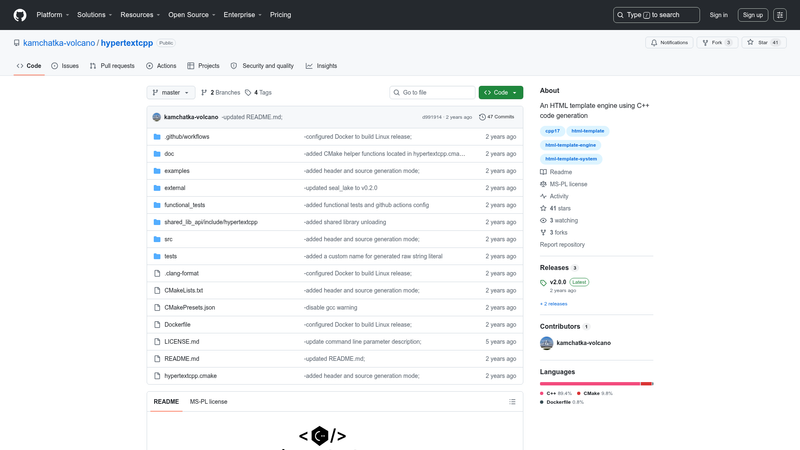
hypertextcpp is an HTML templating system for C++ applications that transpiles an .htcpp template file into C++ code for rendering HTML.
What is hypertextcpp?
hypertextcpp is a command-line tool that converts .htcpp template files into C++ rendering code. It accepts a template containing HTML markup with embedded C++ expressions, statements, control-flow extensions, sections, and procedures, and produces either a single C++ header, a header-plus-source pair, or a shared-library source file. The tool is developed by kamchatka-volcano and is distributed under the MS-PL license. Generated code targets C++17 and integrates with CMake through provided helper functions.
Key Features
- C++ expressions — Insert any C++ expression whose result streams to
std::ostreamdirectly into the HTML using$(...)syntax, such as$(cfg.name). - C++ statements — Embed arbitrary C++ code, like variable declarations or lambdas, within the rendering function using a statement marker.
- Global statements — Place includes and function definitions outside the rendering function so they appear once in the generated file.
- Conditional extension — Attach
?(condition)to an opening or closing tag to render that element only when the condition is true. - Loop extension — Attach
@(auto item : range)or a classic for-loop specification to a tag to repeat the element over a range or loop. - Sections — Wrap document fragments in
[[ ... ]]with an optional condition to control attribute inclusion or partial rendering. - Procedures — Define parameterless functions named with
#name()that capture thecfgvariable and can be called directly from C++ to render partial content. - Multiple generation modes — Generate header-only renderers, header-and-source renderers, or shared-library source files; CMake functions
hypertextcpp_GenerateHeader,hypertextcpp_GenerateHeaderAndSource, andhypertextcpp_BuildSharedLibraryare provided.
Who is it for?
C++ developers who want compile-time checked HTML templates without a runtime template engine. It suits teams building web applications in C++ that need fast, type-safe rendering, as well as developers generating static HTML pages from C++ programs. The shared-library mode also fits projects that need to update page templates without recompiling the entire application.
What can you do with it?
- C++ web developers: render HTML views from C++ data structures with full compile-time type safety, since the template is transpiled to C++ code.
- Tool builders: create reusable template libraries that can be linked into multiple projects or loaded dynamically as shared libraries.
- Build engineers: automate template compilation through CMake helpers so headers regenerate automatically whenever the
.htcppfile changes.
How does hypertextcpp work?
You write an .htcpp file with HTML and embedded C++ elements, then run the hypertextcpp command-line tool to transpile it into C++ code. The generated renderer is included in your project and called with a config object containing the data to render; CMake integration functions trigger regeneration during the build.
FAQ
Is hypertextcpp free?
Yes, hypertextcpp is open-source and licensed under the MS-PL license.
What C++ standard does it require?
The generated code and examples use C++17; the CMake example sets target_compile_features(... PUBLIC cxx_std_17).
Can templates be updated without restarting the application?
Yes, using the shared library generation mode, a template library can be rebuilt and reloaded dynamically, though this mode sacrifices compile-time type safety because the config structure must be duplicated and runtime errors abort the program on mismatch.
What output formats are supported?
Three: single header, header and source pair, and shared library source; the header-only mode is the simplest to integrate.