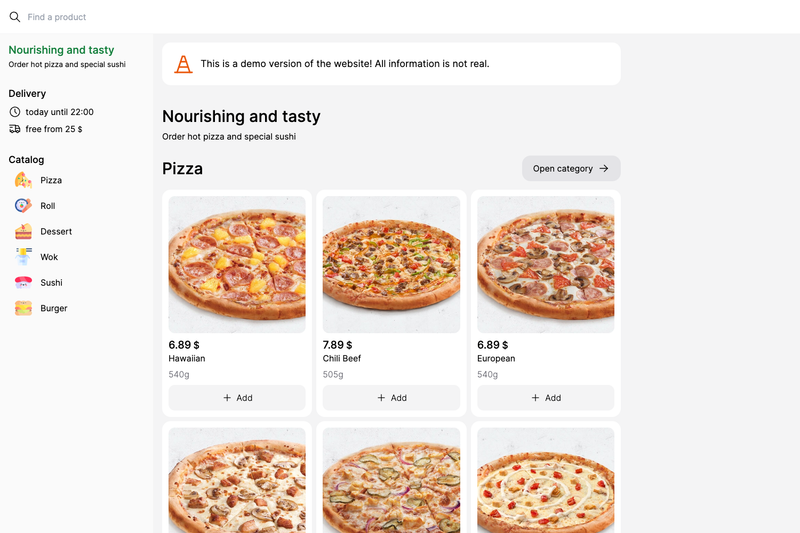
NextOrders: Food is a self-hosted, open-source food-delivery storefront built on Nuxt that gives restaurants their own ordering website with zero middleman fees. It is a frontend-only application that connects to any backend implementing the Food Schema API contract, so you keep ownership of your data and business logic. The project is MIT-licensed and maintained in the nextorders GitHub organization, with a live demo at demo.nextorders.space.
What is NextOrders Food?
NextOrders Food is a frontend-only storefront for food delivery. It takes your restaurant's menu (served by your own backend via a shared schema) and produces a customer-facing website with product pages, cart, and delivery/pickup options. It runs on Nuxt 3 with Nuxt UI, Pinia state management, and TailwindCSS, packaged as a monorepo with separate web-app, web-app-selector, and UI/core packages. The repository also includes an example backend service called Essence that demonstrates business logic and data flows.
Key Features
- PageSpeed 100: The demo storefront scores a perfect PageSpeed result with strong Core Web Vitals, verified via pagespeed.web.dev.
- Multi-page SSR: Server-side rendered pages are SEO-friendly and indexable by search engines.
- 11+ languages: Built-in i18n locales cover English, German, Greek, Spanish, French, Hindi, Italian, Georgian, Portuguese, Russian, and Simplified Chinese.
- Multi-city support: Separate storefronts for different locations, with a selector app that lists available cities.
- Conversion features: "Most often added" recommends frequently co-purchased items; product pages support embedded video; cart remains visible on desktop.
- Delivery and pickup: Flexible fulfillment methods are available out of the box.
- Typed backend contract: The packages/food-schema file defines all data structures with Zod validation, so any backend that implements the schema can power the frontend.
- Extensible UI layer: The UI package is a Nuxt Layer on top of @nuxt/ui, with TailwindCSS Motion animations, Iconify icons, and VueUse composables.
Who is it for?
- Small restaurants and cafes: Launch your own ordering site and avoid the 20-35% commission charged by aggregators like Uber Eats or DoorDash.
- Restaurant chains: Deploy modern, production-ready storefronts per city without high custom-development costs.
- Ghost kitchens: Build a direct customer relationship and own brand presence instead of relying entirely on delivery platforms.
- Dev agencies and integrators: Use this as a ready-to-deploy solution for clients; you only need to connect a backend that implements the Food Schema.
What can you do with NextOrders Food?
- Restaurant owners: publish menu items, prices, product videos, and delivery/pickup fulfillment options through the storefront.
- Multi-location brands: set up a city selector and separate storefronts per location, each localized into one of 11+ languages.
- Developers: clone the repo, run pnpm i and pnpm dev, and extend the Nuxt app—or integrate any backend that implements the Food Schema types.
How does it work?
Deploy the web-app container and connect it to your own service that implements the Food Schema. For local development, clone the repository, install dependencies with pnpm, run pnpm dev, and open http://localhost:3000 to see the city selector before picking a storefront. The architecture keeps the frontend in this repo, the backend as your own service, and the shared schema as a typed contract between them.
FAQ
Is NextOrders Food free to use?
Yes. The project is published under the MIT License, so you can use, modify, and deploy it freely. The only requirements are to keep the license notice and provide attribution as specified in the license file.
Does NextOrders Food include a backend or payment processing?
No. This repository is the frontend only. You provide your own backend that serves menu data and handles orders through the Food Schema API contract. The repo includes an example service called Essence that shows how business logic and data can be implemented.
Which languages does the storefront support out of the box?
The storefront ships with 11 locale files: English, German, Greek, Spanish, French, Hindi, Italian, Georgian, Portuguese, Russian, and Simplified Chinese. Each locale is available in the UI package's i18n directory and can be extended.
How do I try the live demo?
Visit demo.nextorders.space, select a city from the list, and you will see the full storefront experience. The demo uses sample data served by the included Essence service.
What tech stack does NextOrders Food use?
The frontend is built with Nuxt, Nuxt UI, Pinia, TailwindCSS, TailwindCSS Motion, Iconify, VueUse, and Zod. Dependencies are managed with pnpm workspaces, and the repository includes apps for the web storefront, a storefront selector, and an example backend.