Newsletter
Join the Community
Subscribe to our newsletter for the latest news and updates

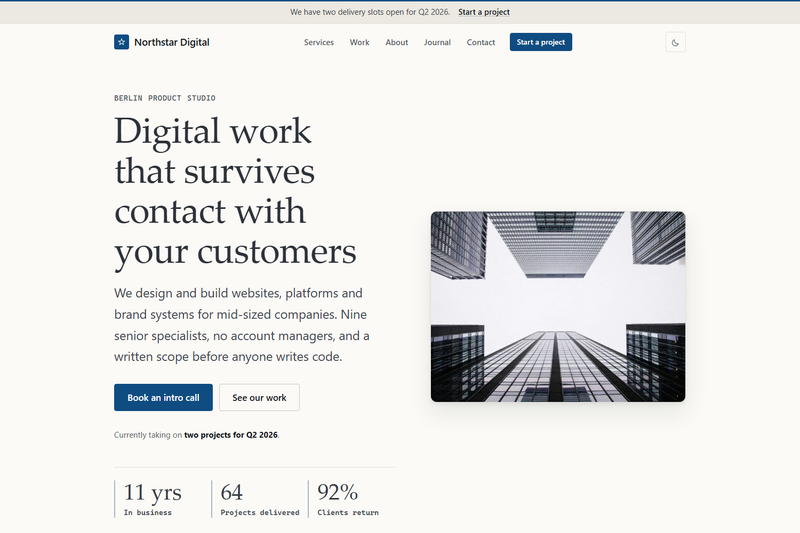
Minimal Hugo corporate and agency theme built on Pico CSS 2, with composable page sections, case studies, a journal, and light/dark schemes.
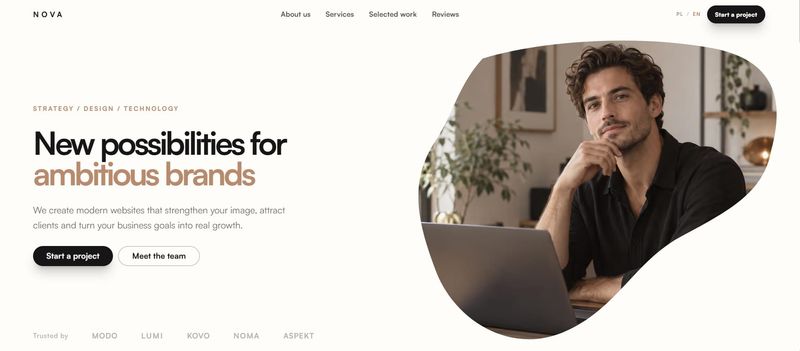
Astro 7 and Tailwind CSS 4 website template for creative agencies, with a bilingual English/Polish homepage and JSON-driven content.
Pico Corp (hugo-theme-pico-corp) is a minimal corporate and agency theme for Hugo, built on Pico CSS 2, that ships composable page sections, a case-study system and a complete demo site with no build step, no JavaScript framework and no webfont requests.
Pico Corp is an MIT-licensed Hugo theme for corporate and agency websites, developed by PhantomPixelDev on GitHub. It takes TOML site configuration, YAML front matter and YAML files in data/ as input, and outputs a static site produced by Hugo's asset pipeline — concatenated, minified and fingerprinted CSS and JS, plus build-time image processing.
The theme needs Hugo 0.146.0 or newer (tested on 0.161.1) and works with the standard Hugo edition, because there is no Sass and therefore no need for Hugo extended. No Node, package manager or build step is involved. Pico CSS 2.1.1 is vendored at assets/css/pico.min.css, and eight small theme stylesheets layer on top of it. A demo site for the fictional Berlin product studio Northstar Digital lives in exampleSite/ and doubles as the reference configuration: home page, about, six services, six case studies, a journal with categories and tags, contact and legal pages.
data/authors.yaml, an optional table of contents, and related articles from Hugo's built-in related-content index.clients.yaml, stats.yaml, values.yaml, process.yaml, testimonials.yaml, pricing.yaml, faq.yaml, team.yaml, timeline.yaml and authors.yaml each feed their matching section.utils/image.html partial emits a picture element with a WebP source, original-format fallback, srcset at 480/768/1200/1600 px, intrinsic width and height, and lazy loading except for a priority hero image.robots.txt; light and dark token sets driven by system preference, a localStorage toggle, or a forced scheme, with a ten-line inline script that applies the stored choice before first paint.netlify flag adds the expected attribute and honeypot) or your own endpoint, and every user-facing string lives in i18n/en.toml.exampleSite/hugo.toml) already sets every parameter the theme reads.sections list, then restyle by setting primaryColor, primaryColorDark, radius and headingFont instead of editing CSS.work section's featuredOnly and feature options.Install Pico Corp either as a Hugo module (add the module import path to hugo.toml and update with hugo mod get -u) or as a Git submodule in themes/ with theme = "hugo-theme-pico-corp". Sections and landing pages are assembled from a sections list in front matter, where each entry's type maps to a partial in layouts/_partials/sections/ and the remaining keys configure that block. Build the site with hugo --gc --minify; hugo.IsProduction gates minification, fingerprinting and analytics, so a plain build is already a production build. Netlify, Cloudflare Pages and GitHub Pages configurations are documented, including a netlify.toml that pins HUGO_VERSION.
Pico Corp requires Hugo 0.146.0 or newer because it uses the current template layout with _partials/ and flat kind templates; it is tested on 0.161.1. The standard Hugo edition is sufficient — there is no Sass, so Hugo extended is unnecessary, and no Node or package manager is needed.
Yes. Pico Corp is released under the MIT licence, and Pico CSS, vendored at assets/css/pico.min.css, is also MIT licensed. The demo photography comes from Lorem Picsum and is placeholder imagery only, so you should replace everything in assets/images/ before launching a real site.
No build step is required beyond running Hugo. Roughly 4 KB of deferred vanilla JavaScript handles the scheme toggle and mobile navigation; the page stays readable without it, FAQs are native details elements, and no third-party requests are made until you set an analytics parameter.
Set primaryColor, primaryColorDark, radius and headingFont under [params], which are compiled into the generated stylesheet. For deeper changes, add assets/css/custom.css in your own site; it is appended last, so overriding tokens such as the container width or display font wins.
The layouts are content-type driven rather than company-specific: case studies, services and journal posts are separate archetypes with their own front matter, and no company detail is hardcoded in a template. A studio, consultancy or in-house product team site can drop the sections it does not need and still use the same contact, legal and SEO scaffolding.