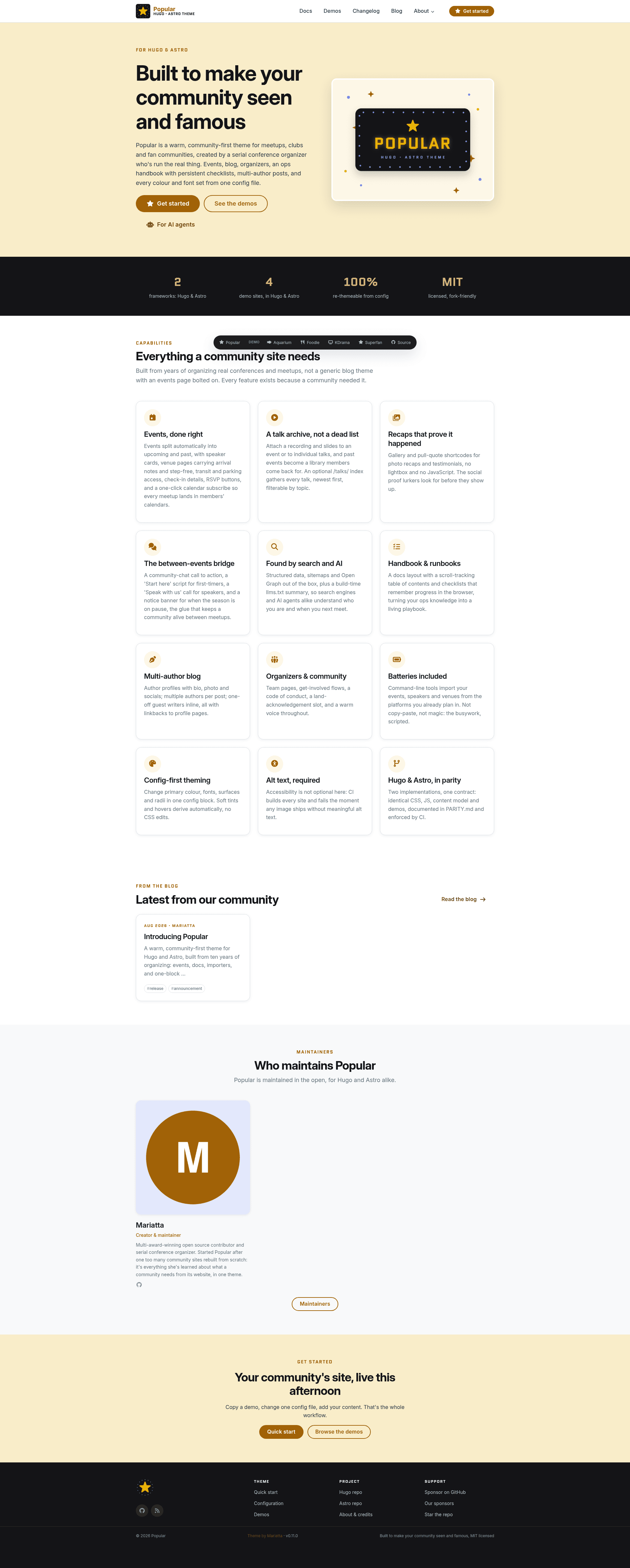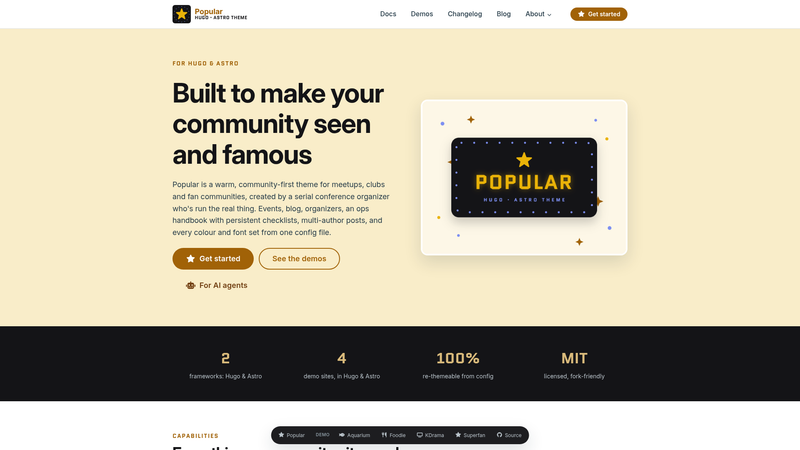
Popular is a free, MIT-licensed Hugo theme for meetups, user groups, small events, and fan communities, delivering an events-and-blog site with organizers, speakers, venues, and docs sections out of the box. It builds with standard Hugo (no SCSS and no Hugo Extended required) and is maintained by Mariatta, with a companion Astro theme released in version lockstep.
What is Popular?
Popular is a Hugo theme that takes Markdown content files defined by Hugo front matter and outputs a static community website with a home page, blog, events section, organizer profiles, speaker profiles, venue pages, and a docs area for handbooks and runbooks. The theme requires Hugo v0.146.0 or newer because it depends on [cascade.build] and .Fragments.Headings; styling uses plain CSS driven by design tokens under [params.brand] in the site config, so colors and fonts can be re-branded without editing a stylesheet.
Key Features
- Auto-splitting events — Event pages use their
dateas the start time; future events render under Upcoming and past events under Past automatically, with optionalvenueReflinks, speaker slugs, RSVP URLs, and avenueWanted = truebadge. - Composable home page — The home page is composed from
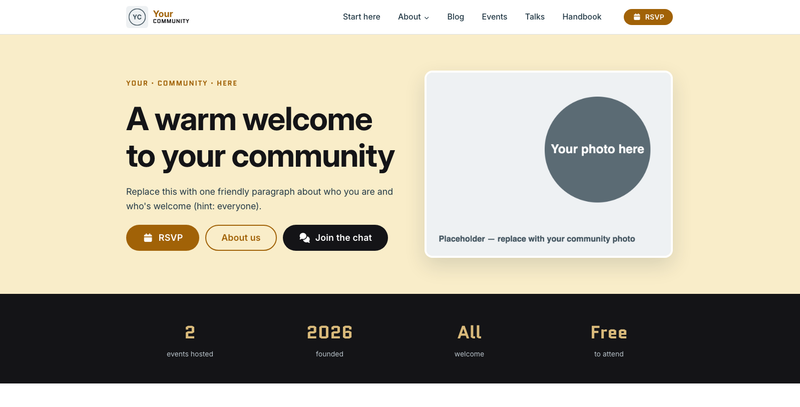
[hero],[[stats]],[[features]],[[testimonials]], and[getInvolved]front-matter blocks and also auto-populates the next event, the latest three posts, and organizers from content. - Multi-author blogging — Posts support author profile slugs with linked profile pages, inline guest authors, tag filtering, and per-post speaker bios for talk write-ups.
- Docs with progress-saving checklists — A docs layout with a scroll-tracking table of contents and a
checklistshortcode that stores the visitor's progress in the browser using a unique site-wide key. - One-command data import — Dependency-free Python scripts populate events, speakers, venues, sponsors, and organizers from a Sessionize API endpoint or a spreadsheet with tabs for each content type, never overwriting existing files.
- Alt-text-enforcing CI — The continuous integration build fails if any image lacks alt text, making accessibility part of the build pipeline.
- Config-driven branding — The complete palette and typography derive automatically from
[params.brand]tokens likeprimary,fontSans, andfontDisplay; custom fonts can also be loaded via custom CSS or token files. - Translatable UI — All interface strings live in Hugo
i18n/files, enabling a site to run in any language.
Who is it for?
- Meetup and user-group organizers who need a site that automatically separates upcoming from past events and includes speaker profiles and venue arrival notes.
- Club and fan-community admins who want a branded home page with hero, stats, testimonials, and land acknowledgement, plus a handbook where volunteer checklists persist.
- Conference or event teams that already plan in Sessionize or a spreadsheet and want to import their agenda into a polished static site in one command.
What can you do with Popular?
- Publish an event calendar: create dated event pages under
content/events/and trust the theme to file them as Upcoming or Past, with speaker cards, check-in instructions, and venue pages containing address, accessibility, and buzz-code arrival notes. - Run a community blog and docs site: add posts under
content/blog/with author bios and tag filters, and usetype = "docs"pages with sidebar navigation for the community handbook and step-by-step runbooks. - Re-skin the site for another group: change only the
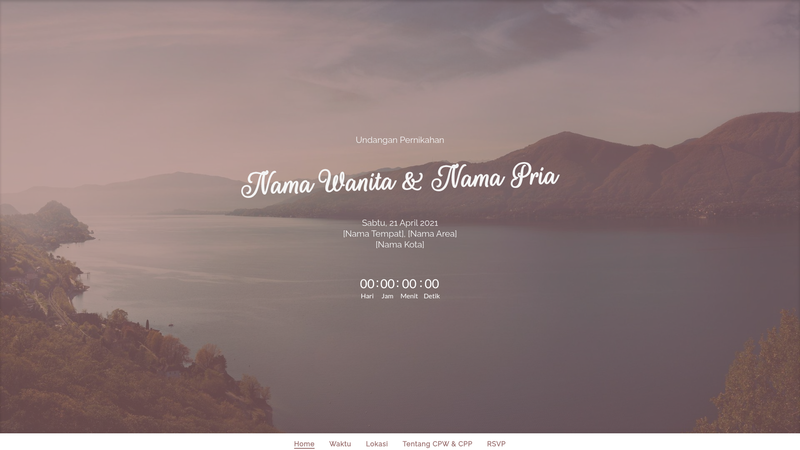
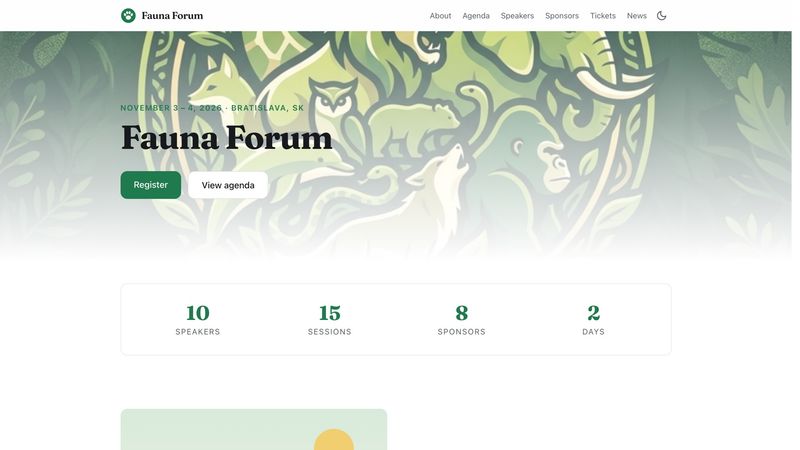
hugo.tomlbrand tokens to produce the four included demo sites (aquarium club, foodie club, K-drama fan club, and a personal superfan site) from the same theme codebase with no CSS edits.
How does it work?
Install Popular as a Hugo module, git submodule, or copied folder, then copy exampleSite/hugo.toml plus the content and static directories as a starting point. Run hugo server to preview, edit the front matter and [params.brand] tokens, and deploy the generated public/ directory to Netlify, GitHub Pages, or Cloudflare Pages, including subpath hosting when baseURL contains the full path.
FAQ
Does Popular require Hugo Extended?
No. Popular uses plain CSS rather than SCSS, so standard Hugo builds it. The minimum supported version is Hugo v0.146.0, which is required for features the theme uses.
Is Popular free?
Yes, Popular is released under the MIT License. The project is free to use, fork, and adapt, and there are no paid tiers. Support options are starring the repository, sharing it, or sponsoring the maintainer on GitHub.
Can I import my existing Sessionize data?
Yes. The included scripts/sessionize-import.py script fetches all sessions and speakers from a Sessionize public API endpoint and creates the corresponding content files. A spreadsheet importer also exists for planning data kept in .xlsx files or per-tab CSVs.
Does Popular work when hosted from a subpath?
Yes. Set baseURL in hugo.toml to something like https://your-name.github.io/your-community/ and every link, image, and feed URL resolves automatically without extra configuration or content changes.