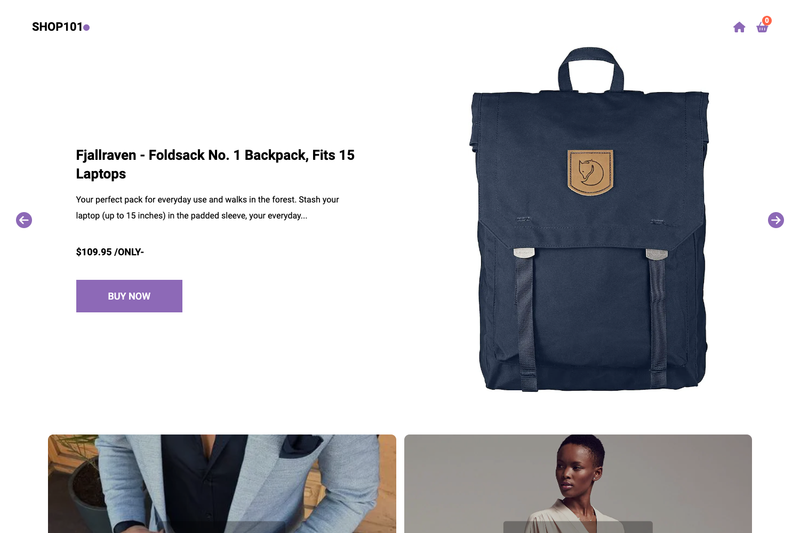
Shop101 is a fully functional e-commerce starter template built with Next.js and TypeScript that demonstrates a complete product browsing, filtering, cart, and Stripe checkout flow against the Fake Store API.
What is Shop101?
Shop101 is an open-source e-commerce website template built with Next.js and TypeScript. It takes product data from the Fake Store API and produces a complete storefront experience — product listing, category filtering, cart management, and Stripe-powered checkout — deployed via Vercel. The project was created by developer Yaya Usman and is available as a GitHub repository for anyone to use as a starting point for a real store.
Key Features
- Next.js and TypeScript — The app is built on the Next.js framework with full TypeScript typing, giving developers a strongly typed codebase for pages and components.
- Fake Store API integration — Products, categories, and images are fetched from the free Fake Store API, so the demo runs without a custom backend.
- React Context API state management — Cart state and product filtering logic are handled through React Context, with no external state library required.
- Stripe checkout — Payment processing uses Stripe; developers can test the flow with Stripe test card 424242424242424 and random values for the remaining fields.
- Material UI + Vanilla CSS — The UI combines Material UI components with hand-written vanilla CSS for layout and custom styling.
- Framer Motion animations — Page and UI transitions use Framer Motion to add motion to the storefront.
- FontAwesome icons and Freepik illustrations — Visual assets come from FontAwesome for icons and Freepik for illustration vectors.
- ESLint and Prettier — The repository includes linting and code formatting setup for consistent code style.
Who is it for?
- Frontend developers — Developers learning e-commerce patterns can read a complete Next.js + Stripe implementation and see how filtering, cart state, and checkout fit together.
- Startup founders building a storefront — A founder can fork the repo, swap the Fake Store API for a real product endpoint, and launch a minimal storefront with Stripe payments already wired.
- Next.js learners — Developers new to Next.js can study how API data is fetched, how Context provides global state, and how a payment gateway integrates into a Next.js app.
- Freelance developers — A freelancer can use Shop101 as a base to prototype e-commerce projects quickly, replacing placeholder data and styling as needed.
Use cases
- Rapid e-commerce prototyping — Teams can spin up a clickable storefront in hours by reusing the existing catalog, cart, and checkout pages.
- Learning Stripe integration — Developers can test a full checkout flow using Stripe's test card without setting up a merchant account.
- Custom storefront starter — Developers can replace the Fake Store API with their own product service and keep the existing UI and cart logic.
- Portfolio demonstration — Job candidates can deploy the live demo to Vercel to show a working e-commerce app with real product data and payments.
How does Shop101 work?
Users browse product listings sourced from the Fake Store API, filter products by category, and add items to a Context-managed cart. At checkout, Stripe processes the payment; the developer can test using card number 424242424242424 with any future expiry and CVC. Because it is deployed on Vercel, each push to the connected Git repository triggers a new production build automatically.
FAQ
Is Shop101 free to use?
The GitHub repository is public and the source code is open for anyone to view and reuse under the terms of the repository. No license file is visible on the page, so you should check the repository before commercial use.
Does Shop101 include user authentication?
No. The current version does not include user authentication or an account system. The author notes that authentication and an admin panel for managing products are possible future additions.
Which payment gateway does Shop101 use?
Stripe. The checkout page is wired to Stripe, and the README instructs testers to use the default Stripe test card 424242424242424 with random values for the remaining payment fields.
Where does the product data come from?
The store pulls product data from the Fake Store API, a free public API that returns sample products with titles, prices, descriptions, categories, and images. There is no custom backend or database.
Can I deploy Shop101 to Vercel?
Yes. The live demo is hosted at shop101.vercel.app, and the tech stack section lists Vercel as the deployment platform, so connecting the repository to a Vercel project will work.