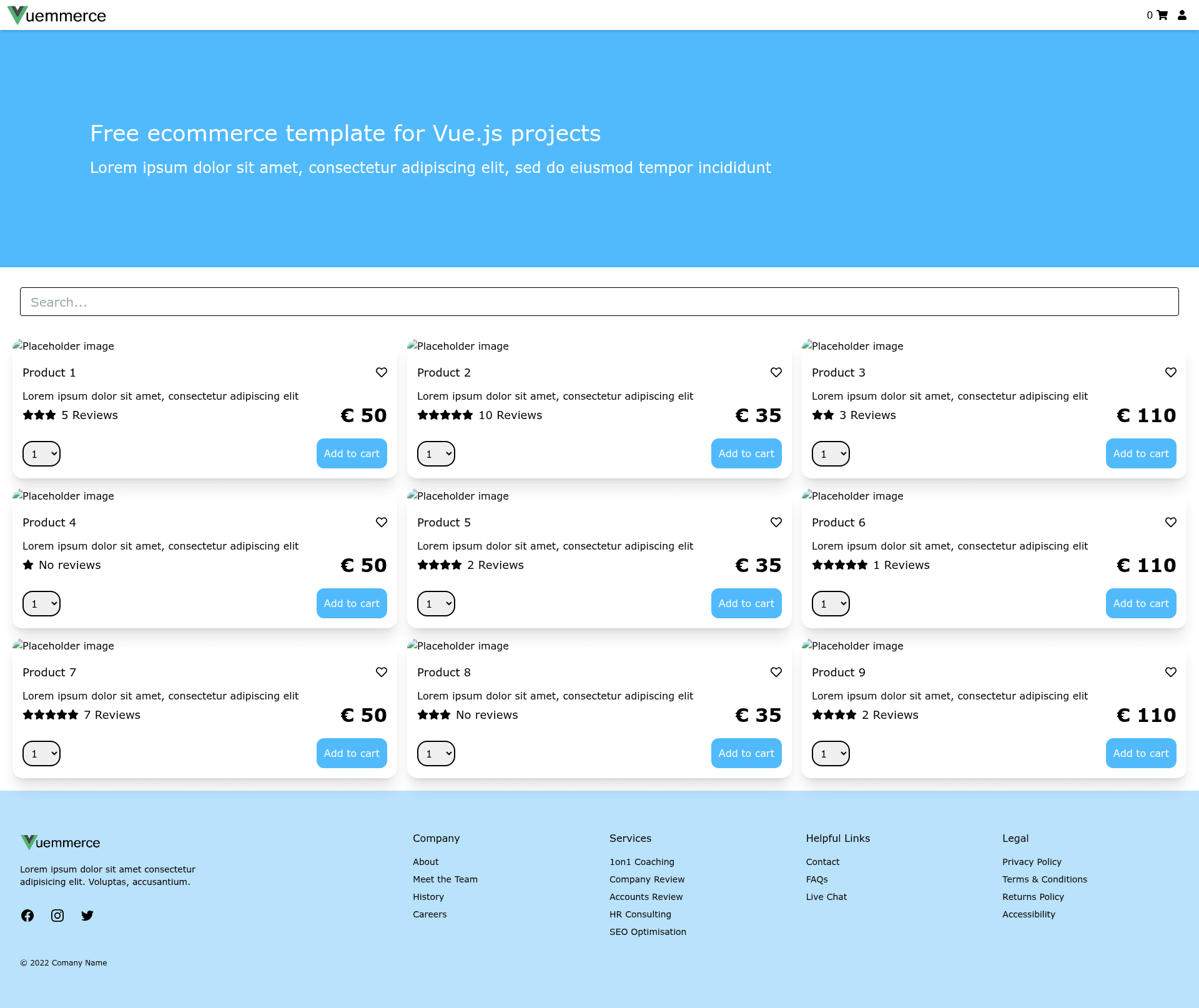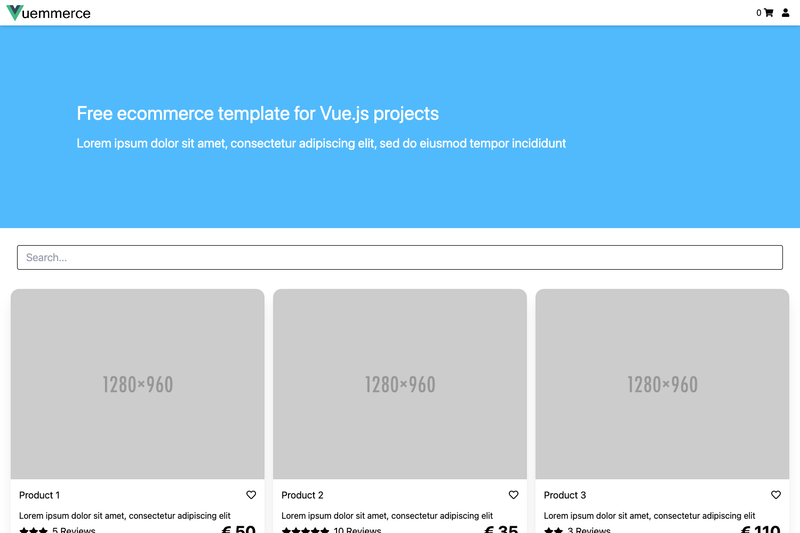
Vuemmerce is a responsive ecommerce template built with Vue.js and Nuxt.js, created by Italian developer Ivan Lori. It generates a full online storefront as a static site, with product and cart state managed through Vuex. The template is open source under the MIT license and has a live demo hosted on GitHub Pages.
What is Vuemmerce?
Vuemmerce is a front-end ecommerce template that uses Vue.js as its UI library and Nuxt.js for server-side rendering and static site generation. It provides the complete storefront experience — product listings, shopping cart, and storefront pages — with state handled by Vuex. The template takes no external backend configuration out of the box; you run build commands to generate static HTML, CSS, and JavaScript that you can deploy to any static hosting service like Netlify or GitHub Pages.
Key Features
- Vue.js and Nuxt.js stack — Built on Vue.js and Nuxt.js, leveraging the component model and SSR capabilities.
- Vuex state management — Cart, products, and other ecommerce data are stored and mutated through Vuex stores.
- Responsive design — The layout adjusts to desktop, tablet, and mobile viewport sizes.
- Static site generation — The
yarn buildcommand generates a static Nuxt.js site that can be hosted anywhere without a dedicated server. - Hot reload development —
yarn devstarts a development server at localhost:3000 with hot module replacement for fast iteration. - Node 16.x requirement — The project specifies Node.js version 16.x, ensuring a consistent runtime for installation.
- MIT license — You are free to use, modify, and distribute the template for personal and commercial purposes.
- Sibling Svelte version — The author also maintains Sveltemmerce, a comparable ecommerce template built with SvelteJs.
Who is it for?
- Developers — who want a ready-made Nuxt.js storefront to customize instead of building from scratch.
- Freelancers — who need to deliver an ecommerce site to clients quickly and can replace the default styling and data with client-specific content.
- Small business owners — with some technical skill who want to self-host a storefront and manage their own code.
- Students — learning Vuex state management and Nuxt.js routing by studying a real project.
What can you do with Vuemmerce?
- Evaluate the demo — Visit the live demo at ivanlori.github.io/Vuemmerce to see the storefront in action before downloading.
- Customize the storefront — Modify Vue components to restructure pages, change colors, and add new sections to match your brand.
- Deploy as a static site — Run
yarn buildto produce static files for hosting on GitHub Pages, Netlify, Vercel, or any CDN.
How does it work?
The workflow is clone, install, and run. Clone the repository with git clone, install dependencies with yarn install, then use yarn dev for local development with hot reload at localhost:3000. To prepare for production, run yarn build, which uses Nuxt.js to generate static pages.
Alternatives
- Sveltemmerce — A sibling project by the same author that builds the same kind of responsive ecommerce template using SvelteJs instead of Vue.js and Nuxt.js.
FAQ
Is Vuemmerce free?
Yes, Vuemmerce is completely free to use under the MIT license. You can use it for personal or commercial projects, modify the code, and redistribute it as long as you retain the original license notice.
What Node.js version is required?
The repository states a requirement of Node 16.x. For best results, use a Node.js version 16 or compatible LTS release when installing dependencies and running the build.
How do I run the template locally?
Clone the repository, then run yarn install to install dependencies, and yarn dev to start the development server with hot reload at http://localhost:3000.
Does Vuemmerce include a backend?
No, Vuemmerce is a front-end template. It uses Vuex for managing front-end state, but does not include a server-side backend. You would need to integrate an API or ecommerce backend yourself.
Can I contribute to Vuemmerce?
Yes, the project has a GitHub Issues page for bug reports and a Discussions page for questions, ideas, and requests. You can also fork the repository and open pull requests.