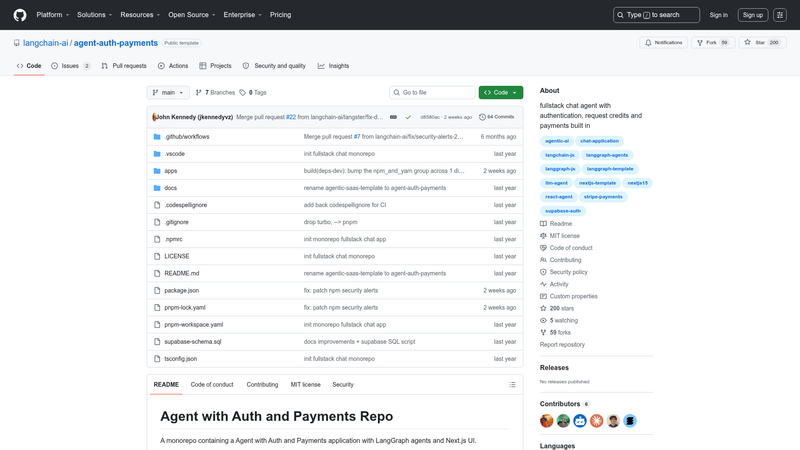
Agent with Auth and Payments is a fullstack boilerplate that pairs a Next.js 15 chat interface with a LangGraph.js agents backend, bundling Supabase authentication, Stripe payments, and a credit system into a single pnpm monorepo.
What is Agent with Auth and Payments?
Agent with Auth and Payments is a LangChain-originated GitHub template (from the langchain-ai organization) that gives developers a complete starter for an agentic SaaS product. It consists of two deployable apps: apps/web, a Next.js 15 chat UI, and apps/agents, a Node.js + TypeScript backend running LangGraph.js ReAct agents. The template outputs a fullstack application where users sign in, buy credits, chat with an AI agent, and have credits automatically deducted per conversation.
Key Features
- Monorepo structure — pnpm workspaces manage both apps from a single root, with commands like
pnpm dev,pnpm build, andpnpm testcontrolling everything in parallel. - Next.js 15 web app — the chat interface is built with Radix UI, Tailwind CSS, and shadcn/ui components, with state handled by Nuqs and Zustand.
- LangGraph agents backend — the agents app uses LangGraph.js with LangChain and Anthropic for the ReAct agent logic, and includes Jest for unit and integration tests.
- Supabase auth and database — a
supabase-schema.sqlfile creates a users table, Row Level Security policies, automatic profile creation, and performance indexes during setup. - Stripe payments and credits — the app listens for
customer.subscription.created,customer.subscription.updated, andcustomer.subscription.deletedwebhooks forwarded tolocalhost:3000/api/webhooks/stripe; purchased credits are stored and deducted per chat message. - Two-app development workflow —
pnpm web:devandpnpm agents:devstart each app independently, whilepnpm devruns both simultaneously. - Flexible deployment — the web app targets Vercel, Netlify, or any Node.js host, and the agents app can be containerized with Docker or deployed to Node.js hosting.
Who is it for?
- SaaS founders — launch an AI-powered chat product with usage-based billing without writing auth, payments, or credits infrastructure from scratch.
- LangGraph developers — use the repo as a reference for wiring ReAct agents to a modern Next.js frontend with proper middleware authentication.
- Fullstack engineers — want a concrete example of integrating LangChain, Supabase, and Stripe inside a pnpm monorepo with separate apps.
What can you do with it?
- Build a credit-based AI assistant — configure your LangGraph agent, connect your Stripe products, and let users purchase credits that are spent on each chat message.
- Create an agentic SaaS starter — extend the agent with additional tools and expose them through the existing chat UI, using the included auth and billing as your foundation.
- Study production monorepo patterns — examine how the template splits frontend and backend, shares environment variables, runs tests, and prepares both apps for independent deployment.
How does it work?
- Clone the repository and copy the
.env.examplefiles to.envfor bothapps/webandapps/agents, filling in credentials. - Run
pnpm installthenpnpm devto start both development servers. - Paste
supabase-schema.sqlinto the Supabase SQL Editor to create the users table and security policies. - Start the Stripe CLI with
stripe listenfor the three subscription events, forward to the webhook endpoint, and add the webhook secret. - Sign up, confirm your email, buy credits on the pricing page, then chat — each message decrements your credit balance.
FAQ
Do I need my own Supabase and Stripe accounts?
Yes, the template requires external services. You must create a Supabase project and run the provided SQL schema, and you need a Stripe account plus the Stripe CLI to test webhook events locally.
What Stripe events does the webhook handle?
The README's stripe listen command forwards customer.subscription.created, customer.subscription.updated, and customer.subscription.deleted to localhost:3000/api/webhooks/stripe, which updates the user's credit balance.
Can I deploy the web and agents apps separately?
Yes. The web app is a standard Next.js app that can be deployed to Vercel, Netlify, or any Node.js hosting; the agents app is a separate Node.js service that can be deployed independently or containerized with Docker.
Is this template free to use?
The repository is public on GitHub under the langchain-ai organization, so the source code is freely available to clone, modify, and reuse in your own projects.