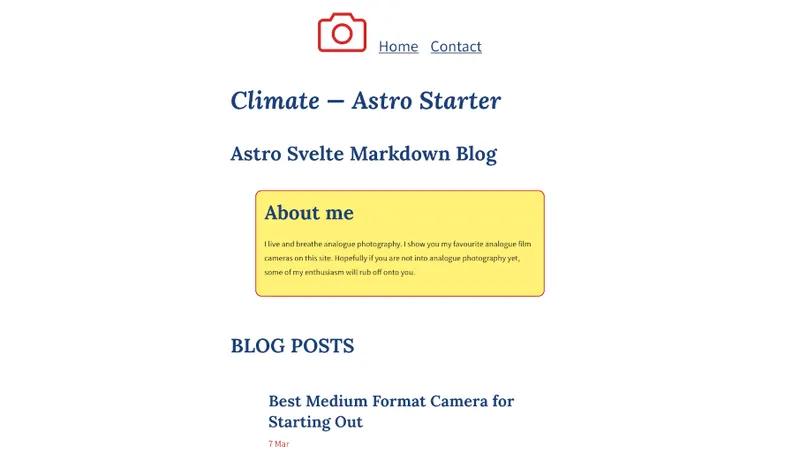
Astro Blog Markdown is a starter template by Rodney Lab for building a fast, accessible, SEO-friendly blog using Astro, Markdown, and a spot of Svelte. This open-source repository scaffolds a complete Astro site that reads posts written in Markdown and generates a static blog with a focus on performance and search visibility, as evidenced by a Lighthouse score of 100 in every category shown in the project's own screenshot.
What is Astro Blog Markdown?
Astro Blog Markdown is a GitHub starter project that acts as the foundation for a Markdown-based content site built with the Astro framework. It takes Markdown files as content input and produces a static blog site with HTML, CSS, and JavaScript as output, including interactive Svelte components where needed. The template was created by Rodney Lab, who also published an accompanying how-to article on getting started, and it is shared on GitHub under the topics astro, blog, markdown, starter, and svelte.
Key Features
- Markdown-first authoring — Write blog posts in Markdown and let Astro convert them into static pages without a database or CMS.
- Svelte integration — The starter uses Svelte for client-side interactive islands, letting you add dynamic behavior with minimal JavaScript.
- Astro Picture component — Included for responsive images in Markdown-based content sites, using Astro Content Collections to handle image optimization.
- Accessibility and SEO focus — The starter is designed for accessible markup and search-engine-friendly output, with details covered in Rodney Lab's related blog posts.
- Lighthouse perfect score — The repository's own screenshot shows 100 scores across performance, accessibility, best practices, and SEO.
- One-command scaffolding — Install with
pnpm create astro@latest -- --rodneylab/astro-blog-markdownand then copy.env.EXAMPLEto.envto start developing. - Netlify deployment ready — A Netlify deploy status badge links to a live site built from this template, showing it is compatible with Netlify.
- StackBlitz support — An Open in StackBlitz button lets you run and edit the template directly in the browser.
Who is it for?
- Independent bloggers who want a fast, static blog without configuring a full CMS and who are comfortable writing Markdown files.
- Astro developers looking for a lightweight starting point that already wires up Svelte components and Astro Content Collections.
- Performance-conscious site owners who want a template that scores 100 on Lighthouse out of the box and can be deployed to Netlify easily.
What can you do with it?
- Publish a Markdown blog: Write posts as Markdown files, add them to the content collection, and build a static blog with the included commands.
- Add responsive images: Use the Astro Picture component within Markdown content to serve optimized, responsive images without hand-coding picture elements.
- Deploy to Netlify: Push the repo to a Netlify-connected Git host and use the project's existing Netlify configuration to go live.
- Preview and build locally: Run
pnpm run devfor a local server atlocalhost:3000, andpnpm run buildto generate the production site in./dist/.
How does it work?
- Scaffold a new Astro project by running
pnpm create astro@latest -- --rodneylab/astro-blog-markdown. - Copy the environment file with
cp .env.EXAMPLE .env. - Start the dev server with
pnpm run dev, which serves the site atlocalhost:3000. - Build for production with
pnpm run build, outputting to./dist/, and preview withpnpm run preview.
FAQ
Is Astro Blog Markdown free?
Yes. The template is an open-source starter hosted on GitHub, so you can use, modify, and deploy it without paying a license fee. It is also available for instant experimentation through StackBlitz.
Does Astro Blog Markdown use a CMS?
No. It is a Markdown-based starter; you author content in Markdown files rather than through a separate CMS. It uses Astro Content Collections to manage those Markdown files, and the related guide explains how to add responsive images to such a site.
What do I need to run it?
You need Node.js and pnpm installed. The template provides pnpm-based commands for installing dependencies, running a dev server, building the production site, and previewing the build.