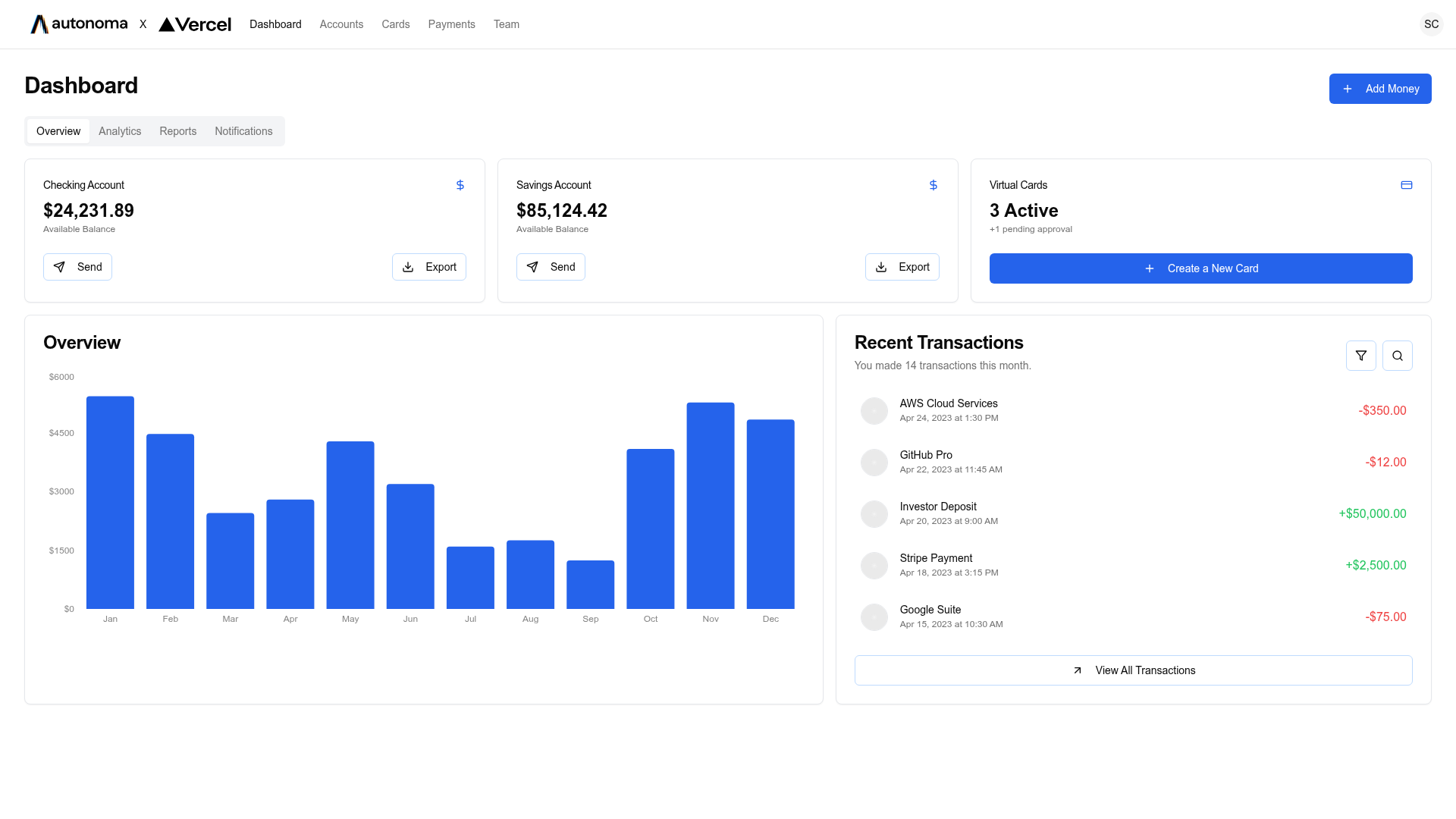

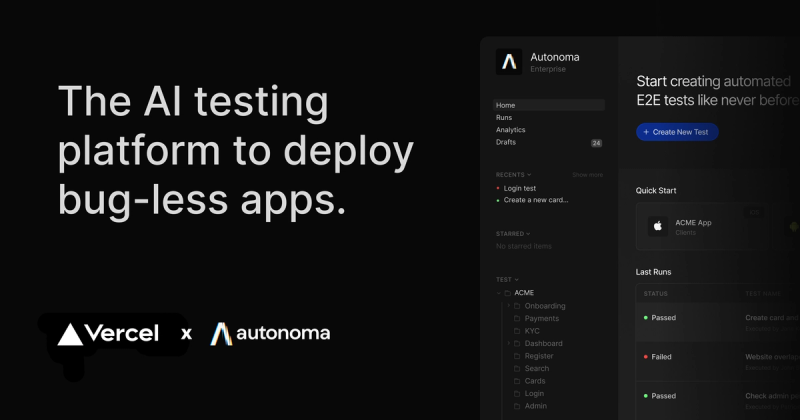
The Autonoma Bank Demo is an open-source Next.js front-end application that simulates a modern banking UI and serves as a sandbox for Autonoma AI's no-code end-to-end test generation.
What is the Autonoma Bank Demo?
The Autonoma Bank Demo is a demo front-end application — not a real bank — that mimics a modern banking interface with login, dashboard, transfers, and transaction history screens. It is built with Next.js, TypeScript, and Tailwind CSS, and is maintained by Autonoma Labs on GitHub. Its core purpose is to act as a testing sandbox for Autonoma AI, allowing users to automatically generate, execute, and maintain end-to-end tests across web and mobile environments.
Key Features
- Realistic banking flows — Includes login, dashboard, transfers, and transaction history screens that mirror real fintech products.
- Responsive UI — Optimized for desktop and mobile, ensuring tests cover multiple viewport sizes.
- Component-driven architecture — Organized with app/, components/, hooks/, lib/, and public/ directories for maintainability.
- Tailwind CSS design system — Styling is built with Tailwind, making it easy to modify tokens and class-based design.
- One-click Vercel deployment — A deploy button clones the repo and provisions a live instance on Vercel without manual configuration.
- pnpm package manager — Uses pnpm for dependency management, with scripts for development, building, and production.
- MIT License — Free to use, modify, and distribute, making it a safe starting point for experiments.
Who is it for?
- Test automation engineers — Use the demo's realistic flows to create and run end-to-end tests with Autonoma AI, validating login, payments, and transfers.
- Front-end developers — Explore a clean Next.js + TypeScript + Tailwind project structure for building fintech UIs.
- QA teams evaluating AI testing — Use the live demo to see how Autonoma AI can maintain tests across web and mobile environments.
- Vibe-coding enthusiasts — Fork the repo to practice with a working banking app scaffold.
What can you do with the Autonoma Bank Demo?
- Generate AI end-to-end tests: Point Autonoma AI at the live demo or a local instance to auto-generate tests for login, dashboard, transfers, and transaction history.
- Test UI consistency across devices: Use the responsive design to verify behavior on desktop and mobile viewports.
- Build a fintech prototype: Extend the existing components and hooks to create a custom banking or finance app.
- Deploy a demo quickly: Click the Vercel deploy button to spin up a shareable instance for stakeholders.
How does it work?
The project uses the Next.js app directory for routing and page structure, with custom components and hooks in separate directories. To run it locally, clone the repository, install dependencies with pnpm install, then start the dev server with pnpm dev, which serves at localhost:3000. For production, run pnpm build followed by pnpm start. The one-click deploy button on GitHub creates a Vercel project directly from the repository URL.
Pricing
The template is open source under the MIT License, so the code itself is free to use, modify, and deploy. You only pay for any hosting or third-party services you add.
FAQ
Is the Autonoma Bank Demo free?
Yes, the repository is licensed under the MIT License, allowing free use, modification, and distribution. You can clone it, deploy it to Vercel, and adapt it for your own testing or development without paying for the template itself.
What tech stack does it use?
It uses Next.js as the React framework, TypeScript for static typing, Tailwind CSS for styling, and pnpm as the package manager. The project also includes PostCSS and Tailwind configuration files.
Can I deploy it to Vercel?
Yes, the README includes a "Deploy with Vercel" button that clones the GitHub repository into a new Vercel project. You can also do a manual deployment by connecting your GitHub account to Vercel and importing the repo.
What is the Autonoma Bank Demo designed for?
It is designed as a sandbox for Autonoma AI: a demo web application with realistic banking flows that lets you generate, execute, and maintain end-to-end tests automatically. It also serves as a sample Next.js codebase for developers.