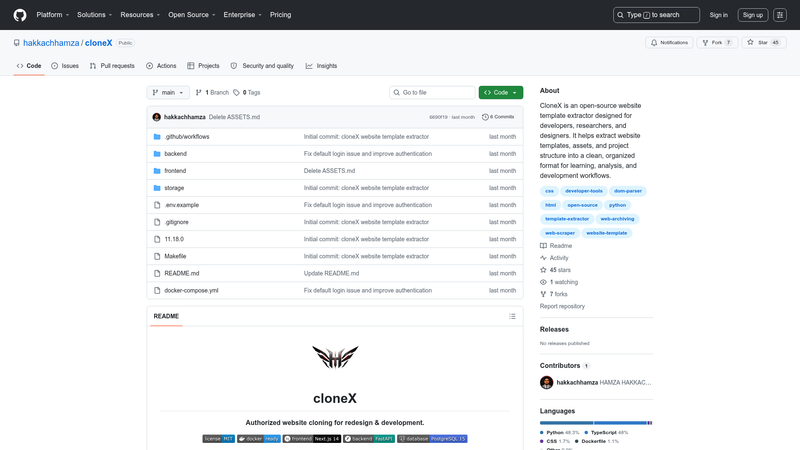
cloneX is an open-source website template extractor that crawls authorized websites, downloads their assets, and exports a clean, editable project for redesign and development.
What is cloneX?
cloneX is a self-hosted web application that turns any website you own or have permission to clone into a ready-to-edit local project. It takes a website URL as input and produces a ZIP export containing crawled HTML pages, CSS, JavaScript, images, fonts, and a generated package.json and README.md. The project runs on a Next.js 14 and React 18 frontend with a FastAPI backend, PostgreSQL 15 database, and Redis-backed Celery worker queue. cloneX is created by hakkachhamza and released under the MIT license.
Key Features
- Five-step cloning pipeline — Crawls internal links with sitemap detection, downloads assets, rewrites absolute URLs to local paths, strips analytics and tracking scripts, and exports a ready-to-edit project.
- Robots.txt and network safety — Respects
robots.txtby default, accepts only http and https URLs, and blocks private networks and localhost targets unless explicitly enabled via theALLOW_PRIVATE_NETWORKSenvironment variable. - Clean placeholder system — Exported HTML files contain placeholders for company name, email, phone, address, and copyright so you can drop in your own content.
- Docker Compose setup — The full stack (frontend, backend, worker, database) starts with a single command, and a default admin account is seeded on every startup.
- Export as ZIP — Download the complete project as a ZIP organized into
pages/andassets/subdirectories for CSS, JS, images, and fonts. - Production deployment path — Supports S3-compatible storage, Alembic migrations, and reverse-proxy TLS configuration for production.
Who should use cloneX?
- Web developers who need to rebuild a site they already own can use cloneX to extract the existing structure and assets, then redesign it without starting from scratch.
- Designers who want a clean starting template from an authorized source can download the project, swap in new branding, and customize the placeholders.
- Researchers and students studying website structure can clone sites they have permission to use and inspect the file organization and asset pipeline.
What can you do with cloneX?
- Redesign an existing site: Clone a site you own, download the ZIP, and replace the placeholders with your own company details and branding.
- Create a development template: Use the exported
package.jsonand page structure as a foundation for a new project, then build features on top of the cloned layout. - Analyze website structure: Run a crawler that respects
robots.txtand review how pages, stylesheets, scripts, and media are organized after sanitization.
How does cloneX work?
The clone process runs in five steps: crawl internal links with Playwright and BeautifulSoup, download HTML/CSS/JS/images/fonts, rewrite absolute URLs to relative local paths, sanitize the output by removing analytics and tracking scripts, and export the project as a ZIP. You can monitor, pause, resume, or cancel crawls from the project dashboard, and compare the original and generated previews side by side.
Pricing
cloneX is free and open source under the MIT license. There are no paid tiers; you self-host it with Docker Compose.
Alternatives
HTTrack is an open-source website mirroring tool that downloads full sites for offline browsing, though it focuses on preservation rather than template extraction and does not sanitize branding or generate a package.json.
FAQ
Is cloneX free?
Yes, cloneX is released under the MIT license and is completely free to use and modify. You run it yourself from the source on GitHub.
Can I clone any website?
No. cloneX is designed for sites you own or have explicit written permission to clone. It blocks private networks by default, respects robots.txt, and strips analytics, tracking, and authentication tokens from exports.
What does the exported project contain?
The exported ZIP contains crawled HTML pages in a pages/ folder, CSS/JS/images/fonts in assets/, a README.md, and a package.json. HTML files include placeholders for company name, email, phone, address, and copyright.
How do I deploy cloneX to production?
Change the SECRET_KEY, use managed PostgreSQL and Redis, configure S3-compatible storage, run Alembic migrations, and place a reverse proxy with TLS in front of the app. Set NODE_ENV=production and DEBUG=false.
Does cloneX have an API?
Yes, the backend exposes interactive Swagger UI at /api/docs and ReDoc at /api/redoc once running, and you can authenticate to download projects as ZIP files via the API.