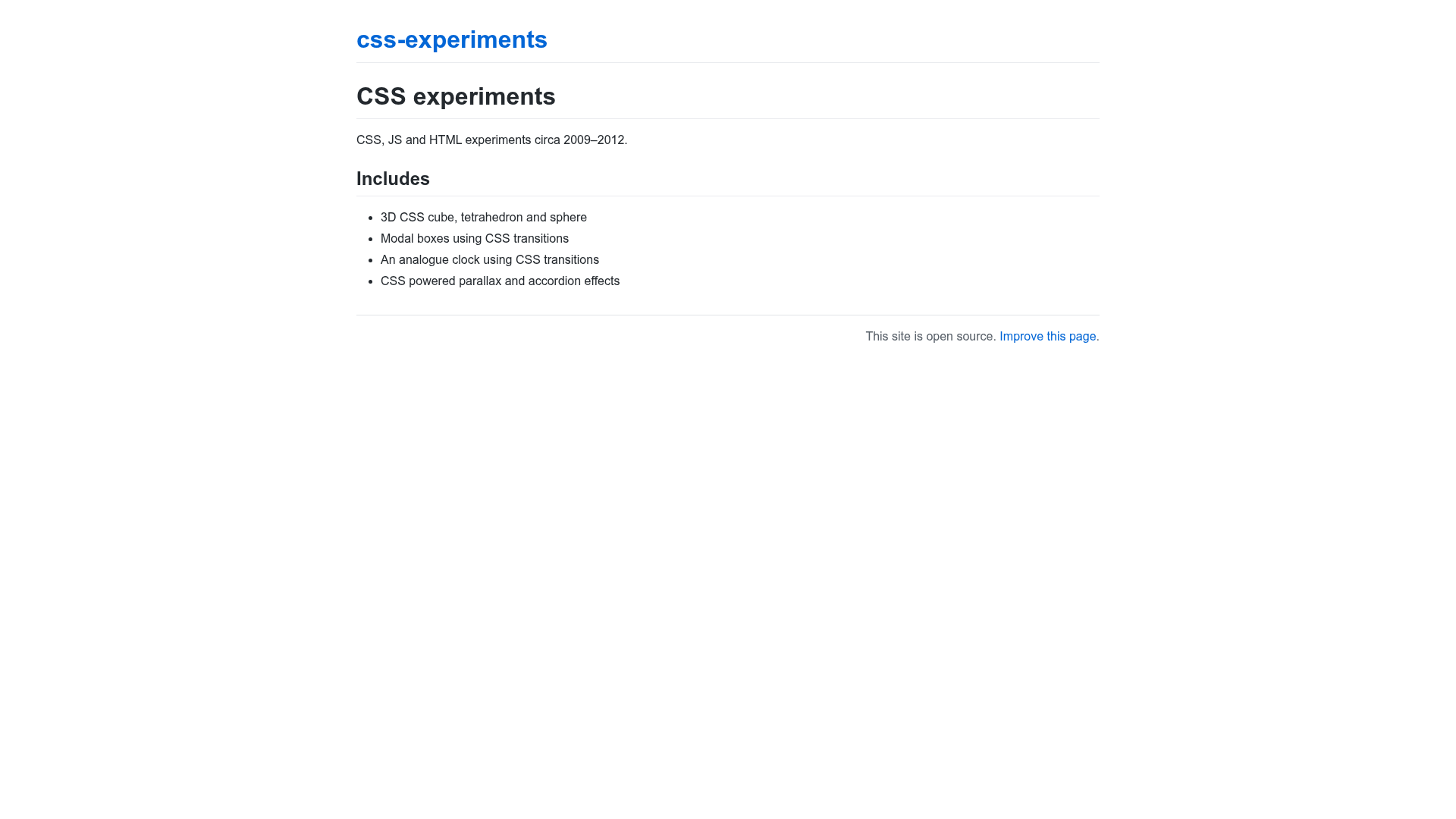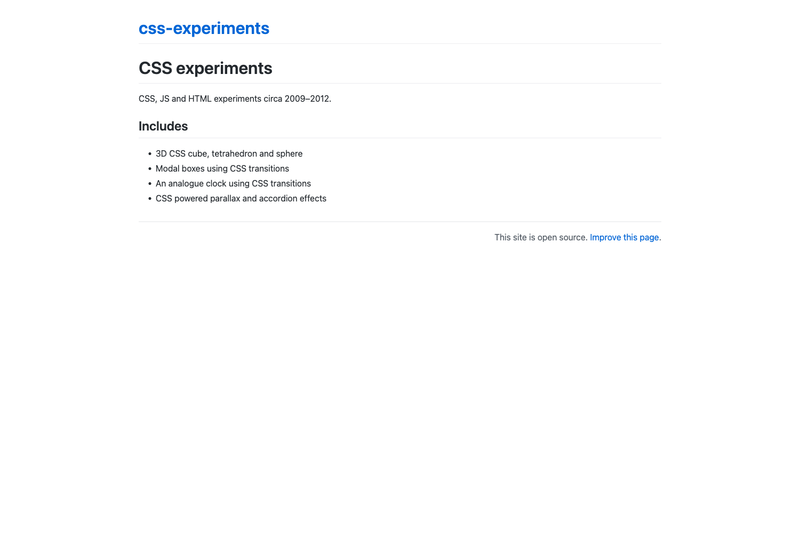
CSS Experiments is a GitHub repository that archives CSS, JavaScript, and HTML experiments written between roughly 2009 and 2012, with its own description pinning the code to 2010 — a standalone collection of demo pages that works as a historical reference for what was achievable with CSS before modern layout tools existed.
What is CSS Experiments?
CSS Experiments is a public code repository whose entire purpose is to demonstrate visual effects built from the CSS, JavaScript, and HTML of the late-2000s and early-2010s browser landscape. It takes handwritten code files as its input and produces working standalone demo pages as output, with no framework named in the project description. The repository explicitly identifies its contents as "CSS, HTML and JS experiments from 2010" and has accumulated 639 stars on GitHub, making it a visible reference for CSS techniques of that period.
Key Features
- 3D CSS cube, tetrahedron and sphere — Geometric solids rendered with CSS 3D transforms, showing perspective-based rotation and positioning techniques from the 2009–2012 era.
- Modal boxes using CSS transitions — Overlay dialogs that animate into view using CSS transition timing rather than JavaScript animation logic.
- Analogue clock using CSS transitions — A clock face whose hands are driven by CSS transitions, demonstrating time-based style updates in the browser.
- CSS powered parallax and accordion effects — Depth-style parallax movement and expanding accordion sections implemented with CSS alone.
- Plain HTML, CSS, and JavaScript stack — The repository description names only HTML, CSS, and JavaScript, with no mention of frameworks such as React, Vue, or jQuery.
- Public GitHub archive — The repository is hosted publicly on GitHub, where it has received 639 stars from other developers.
Who is it for?
- Front-end developers studying how 3D CSS, transitions, and parallax effects were implemented before modern CSS layout modules, using the cube, modal, clock, and accordion demos as reference code.
- Students of web design history looking for concrete, runnable examples of what browsers supported around 2009–2012, since every demo is built purely from the HTML, CSS, and JavaScript described in the repository.
- Developers building CSS-only effects who want to adapt the modal-box, clock, or parallax techniques into their own pages without pulling in a JavaScript library.
What can you do with CSS Experiments?
- Learn 3D CSS techniques: Study the cube, tetrahedron, and sphere demos to see how CSS 3D transforms render solid objects on screen.
- Recreate transition-based UI patterns: Use the modal box and analogue clock as starting points for animated show/hide and time-display interactions.
- Explore parallax and accordion mechanics: Reference the CSS powered parallax and accordion demos to reproduce depth-scrolling and expandable-section effects without a JavaScript library.
FAQ
What does CSS Experiments contain?
The repository contains CSS, JavaScript, and HTML experiments from around 2009–2012, described in its metadata as "CSS, HTML and JS experiments from 2010." The documented demos include a 3D CSS cube, tetrahedron and sphere, modal boxes using CSS transitions, an analogue clock using CSS transitions, and CSS powered parallax and accordion effects.
Is CSS Experiments free?
The repository is publicly hosted on GitHub, where it has collected 639 stars, and the source shows no payment terms or pricing tiers. As a public code repository it is freely accessible to anyone on the platform.
How old are the experiments?
The repository's own description dates the code to 2010, and the project page introducing the repository describes the content as experiments from circa 2009–2012. That places the techniques in the era of early CSS transitions and 3D transforms.
Which browsers do the experiments use?
The demos rely on CSS transitions and 3D transform effects that were emerging in browsers between 2009 and 2012, so they reflect the rendering capabilities of that period rather than modern baseline standards.