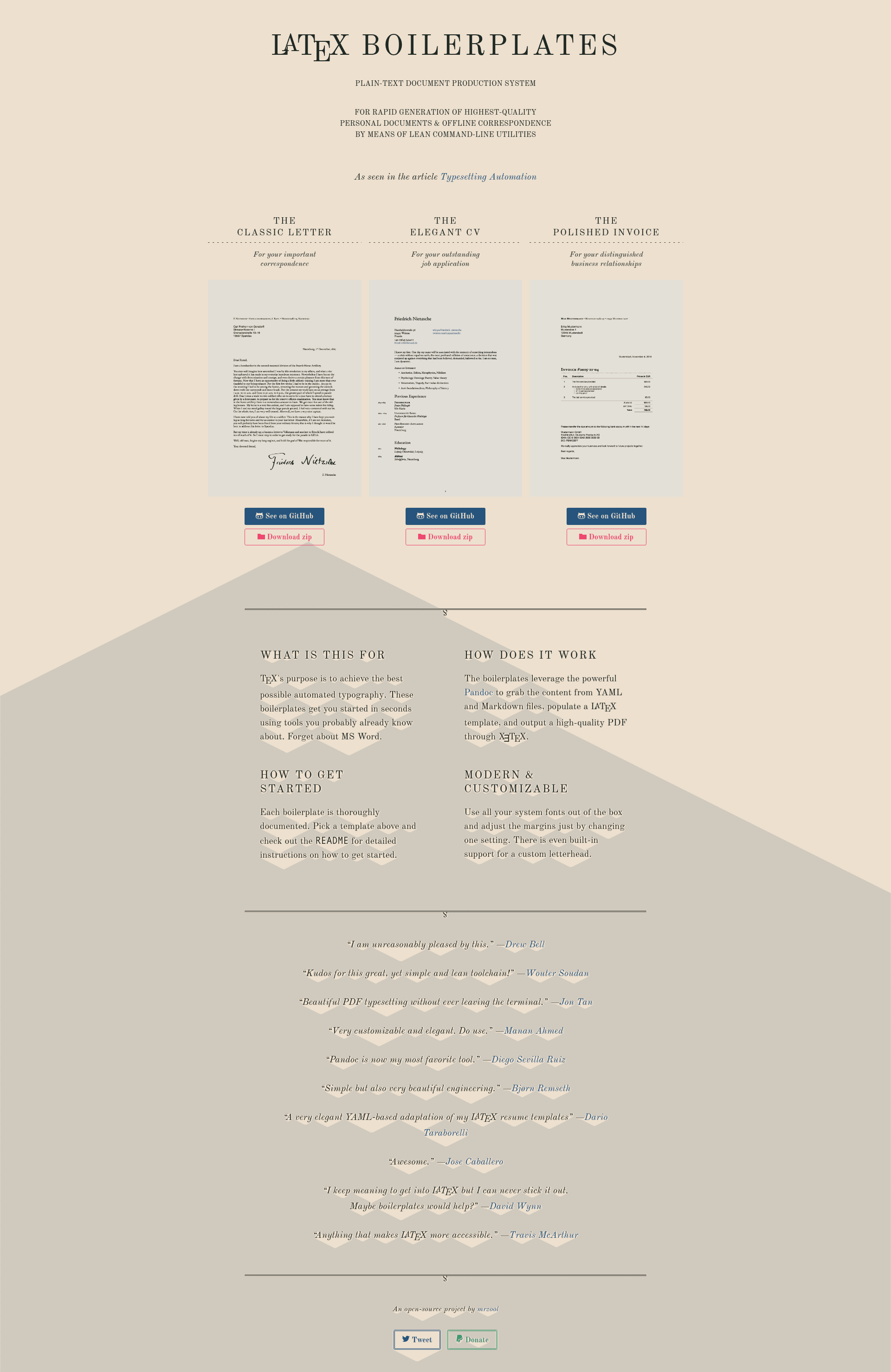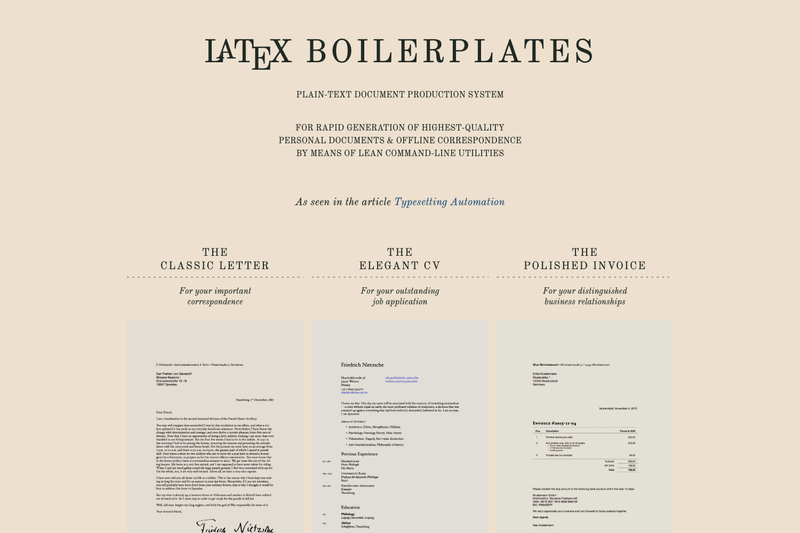
CV Boilerplate is a LaTeX boilerplate that turns a structured YAML file into a polished CV or résumé PDF using Pandoc as the converter. It decouples content from presentation: all your data lives in details.yml, the layout in template.tex, and a single build step produces output.pdf.
What is CV Boilerplate?
CV Boilerplate is a Pandoc-based LaTeX template created by mrzool that programmatically generates CVs. Input is a YAML file containing personal details, work experience, education, and settings; output is a typeset PDF via XeTeX. It requires Pandoc, a LaTeX distribution with the packages listed in the README, and compilation with the xelatex engine. The project is a modified version of Dario Taraborelli's cvtex template and is released under CC BY-SA 3.0.
What makes CV Boilerplate stand out?
- Single-source YAML content —
details.ymlstores name, address, email, experience, education, and settings; updating the CV means editing one plain-text file. - Pandoc template syntax —
template.texuses$for(experience)$loops and$experience.years$-style variables to iterate over structured lists, making repetitive sections trivial to render. - XeTeX typesetting — works with system fonts via
fontspec; the defaultmainfontis Hoefler Text, and any installed font can be used. - Configurable settings —
fontsizeaccepts 10pt, 11pt, or 12pt;langsets the main language throughpolyglossia;geometrydefines page margins with a string passed to the geometry package. - Simple build process — running
makecompiles the PDF; Windows users can fall back to the Pandoc command with--pdf-engine=xelatex. - Portable and versionable — the whole CV resides in YAML, so it can be kept in a gist, tracked with Git, or exported to other formats like HTML for Jekyll.
Who should use CV Boilerplate?
Developers and engineers who prefer writing in plain text and want to version-control their résumé will find the YAML pipeline natural. Academics who need a clean, typographically consistent CV without fiddling with LaTeX layout can just fill in the data. Job seekers who need to produce updated CVs frequently will benefit from the one-command make build. Automation enthusiasts can extend the workflow, as described in a linked article, to compile CVs automatically via GitLab CI.
What can you do with CV Boilerplate?
- Version-controlled CV: keep
details.ymlin a gist or Git repository, then generate a PDF at any time. - Multi-format output: convert the same YAML to HTML (e.g., for Jekyll) or other Pandoc-supported formats.
- Customized layouts: tweak
template.texwith LaTeX until the design matches your taste, and adjustmainfont,fontsize,geometry, andlangwithout touching content. - Automated builds: pair the template with continuous integration, as demonstrated in a linked medium article that uses GitLab CI to typeset a CV.
How does CV Boilerplate work?
First, fill details.yml with your personal data and settings. Then run make to compile, or use the Pandoc command shown in the README on Windows. Finally, tweak template.tex for custom styling; the template must be compiled with XeTeX.