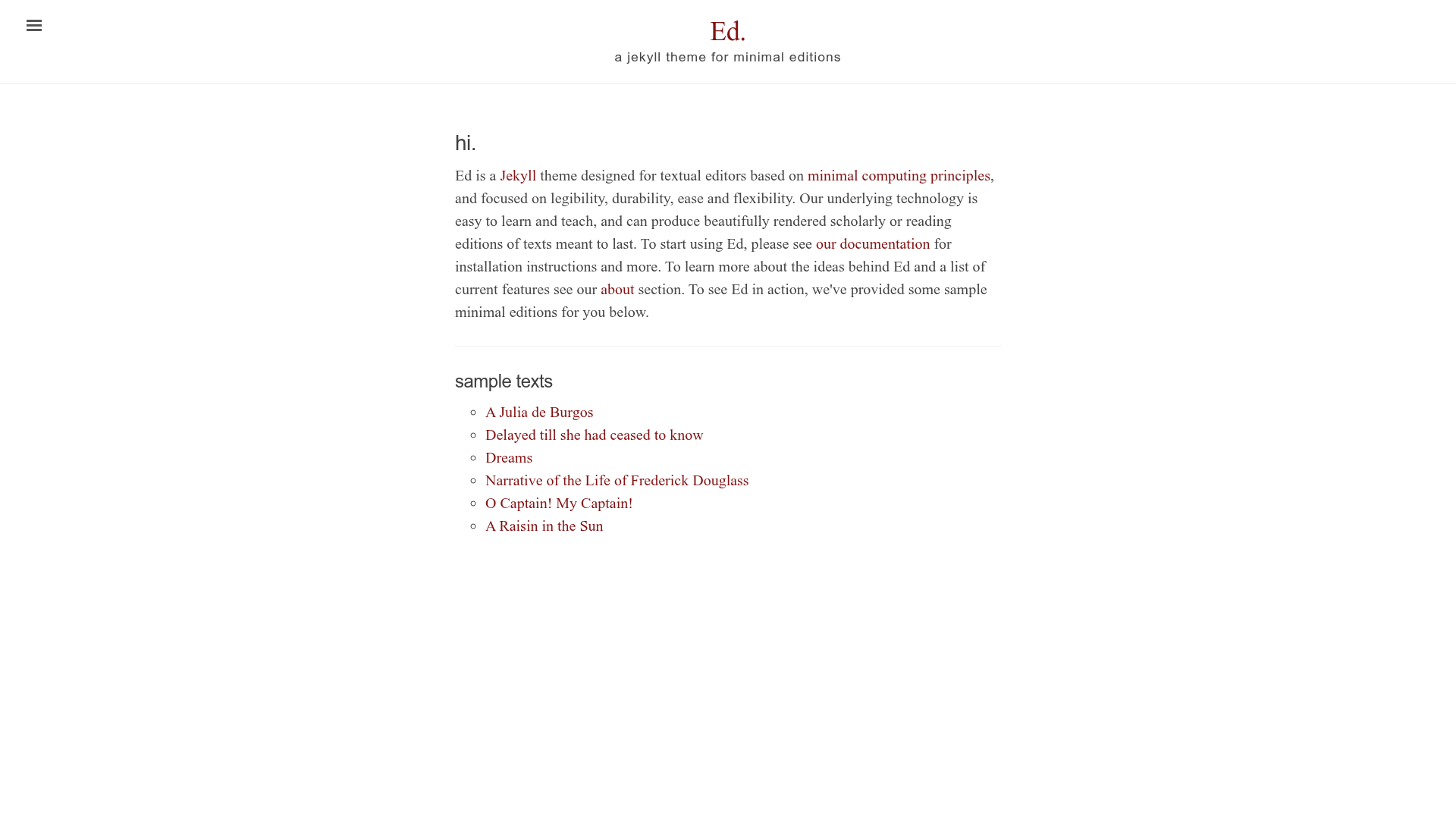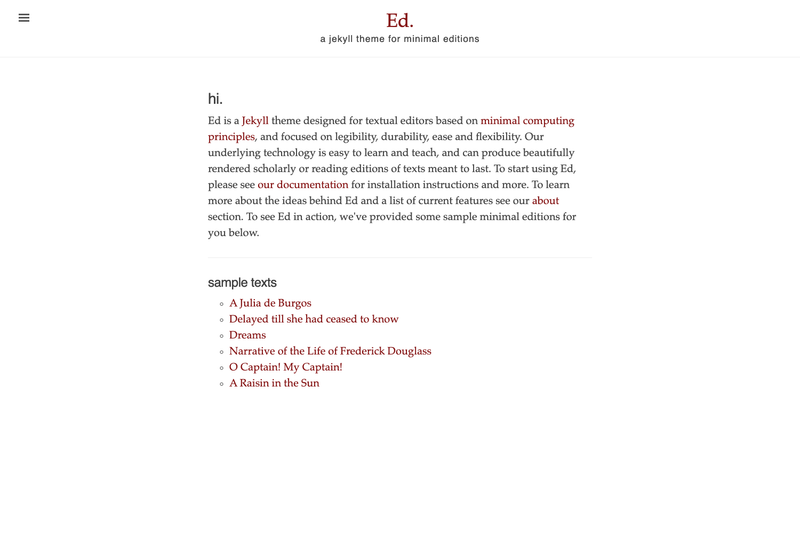
Ed is a free, open-source Jekyll theme for building minimal scholarly text editions, prioritizing legibility, durability, and low computational overhead.
What is Ed?
Ed is a Jekyll theme designed by the minicomp project for textual scholars who want to publish static editions without complex backend systems. It accepts Markdown content and produces a static website with templates for narrative, drama, and poetry, plus optional footnotes and bibliography. The theme is built around minimal computing principles, meaning it keeps file sizes and technical requirements low while remaining easy to teach and preserve.
The project emerged from the observation that many scholarly digital editions rely on databases and custom development, making them expensive to produce and maintain. Ed instead generates plain static pages that decay less quickly than database-driven systems, consume less bandwidth, and can be hosted on free platforms like GitHub Pages.
Key Features
- Templates for narrative, drama, and poetry — Provides distinct page layouts for each genre out of the box, so editions in different forms can be published without custom coding.
- Unobtrusive footnotes — Renders footnotes without disrupting the reading flow, which is essential for scholarly editions.
- Automatic table of contents generation — Builds a table of contents from document headings automatically.
- Simple search functionality — Allows readers to search the static site without a server-side search engine.
- Annotations via hypothes.is — Integrates the hypothes.is web annotation tool for collaborative reading.
- Metadata in Dublin Core and OpenGraph — Embeds structured metadata compatible with Zotero, libraries, and social media.
- Responsive design — Adapts layouts for mobile phones, tablets, and desktop PCs.
- Optional well-formatted bibliographies and linked citations — Can generate bibliographies and citations when enabled in the configuration.
Who is it for?
- Textual scholars and editors — Publish critical editions with footnotes, bibliographies, and genre-specific layouts without relying on a dedicated technical team.
- Digital humanities instructors — Use Ed to teach students a complete digital editing workflow in one academic semester, as the minicomp team demonstrated with their MinimalEditions course.
- Libraries and archives — Preserve text artifacts as static HTML files, which are easier to archive and require less ongoing maintenance than dynamic databases.
- Independent publishers of public-domain works — Produce open-access reading editions that can be deployed free on GitHub Pages.
What can you do with Ed?
- Publish a reading edition — Use the narrative template to create a clean, distraction-free version of a text for general readers.
- Build a scholarly edition — Add critical footnotes, a generated bibliography, and linked citations to produce an edition with full academic apparatus.
- Teach digital editing — Use Ed as a hands-on example of transforming Markdown sources into a live static website, with no server-side code.
- Deploy on GitHub Pages — Push the generated site to a GitHub repository and serve it from a github.io URL at no cost, following the pattern of the sample editions linked from the project site.
Pricing
Ed is a free, open-source theme. The complete source code is available on GitHub, and there are no paid tiers or subscriptions associated with using the theme itself. Hosting on GitHub Pages is free for public repositories, making the entire publication workflow cost-effective.
FAQ
Is Ed free?
Yes, Ed is a free, open-source Jekyll theme. The source code is publicly available on GitHub, and there are no costs to download or use the theme itself. If you host on GitHub Pages, a free static site host, your edition can be published without any hosting fees.
What static site generator does Ed use?
Ed is built on Jekyll, a Ruby-based static site generator. Content is written in Markdown and rendered into plain HTML files, which means the output is fast, secure, and easy to archive. Jekyll provides the templating system that powers Ed's layouts.
Does Ed support footnotes and bibliographies?
Yes. Ed includes unobtrusive footnotes out of the box and an optional system for generating well-formatted bibliographies and linked citations. These features meet the core needs of scholarly editions without requiring custom development.
Can I use Ed for poetry or drama?
Absolutely. Ed provides dedicated templates for narrative, drama, and poetry, allowing each genre to be published with an appropriate layout. The theme also outputs responsive pages that work on mobile phones, tablets, and desktops.
Can I host Ed on GitHub Pages?
Yes. Ed is designed for GitHub Pages. You can commit the generated static files to a GitHub repository and serve them from a github.io address. Several sample editions on the project site, including the minicomp sample site and Fugitive Verses, run this way.