
Template details
FintechPro
Landing page for a fintech trading platform built with Astro 5 and Tailwind CSS v4, featuring a live Binance crypto dashboard with candlestick charts.
About this template
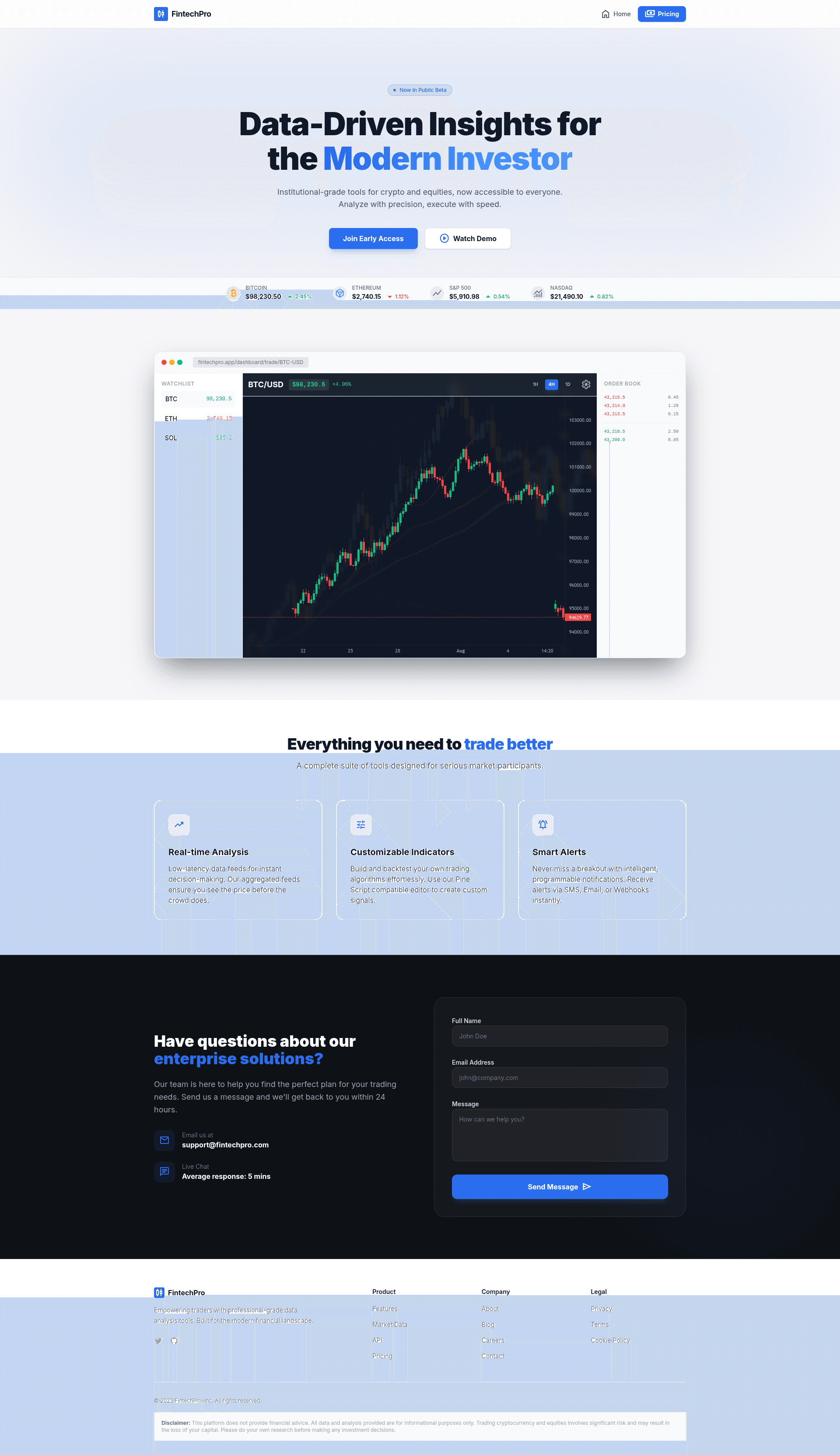
FintechPro is a high-performance landing page template for a fintech trading platform, built with Astro 5 and Tailwind CSS v4, that embeds a live crypto trading dashboard powered by the public Binance API.
What is FintechPro?
FintechPro is a landing page template that combines static site generation with Astro's islands architecture to deliver a real-time trading dashboard inside a marketing site. It takes the Binance public API endpoints for ticker prices and candlestick data as input, and renders a live-updating dashboard with a watchlist for BTC, ETH, and SOL, candlestick charts, and an order book simulation as output. The template runs on Astro 5 and is authored by Sebastián Zhunaula (devsebastian44) as a portfolio project. It includes a landing page, a pricing page, and an enterprise contact form.
Key Features
- Real-time market ticker — A
MarketTicker.astrocomponent pulls prices from the Binance REST API every 3 seconds and simulates S&P 500 and NASDAQ index movements, displayed as a scrolling tape in the header. - Interactive trading dashboard —
PlatformPreview.astrorenders candlestick charts with TradingView's Lightweight Charts 4.1.1, with timeframe selection for 1H, 4H, and 1D, plus a simulated order book. - Dynamic watchlist — BTC, ETH, and SOL pairs are supported; switching assets instantly updates the chart and header data.
- Astro islands architecture — Only interactive components (ticker, chart) are hydrated on the client; the rest of the site is served as pure static HTML for performance and SEO.
- Sticky navbar and hero — A responsive navbar with scroll behavior and a hero section with dual CTAs for platform access and enterprise sales.
- Enterprise contact form — A
CTA.astrocomponent with fields for company, trade volume, and custom message for institutional lead capture. - Pricing page —
/pricingincludes a comparison table for Pro and Institutional plans with distinct CTAs. - Tailwind CSS v4 with
@theme— Styling uses Tailwind v4's CSS-first engine with design tokens defined insrc/styles/global.css. - Material Symbols icons — Google Fonts' Material Symbols (Outlined) provide consistent iconography across the UI.
- Dev tooling — TypeScript strict via
astro/tsconfigs/strict, ESLint flat config, Prettier, Playwright E2E tests, and a fixed Node version via.nvmrc.
Who is it for?
- Fintech startups — who need a production-quality landing page that shows live market data to build trust with prospective traders.
- Crypto exchanges or trading platforms — that want to demonstrate charting and real-time price feeds directly on their marketing site.
- Frontend developers — who want a reference implementation of Astro islands, Tailwind v4, and third-party charting integration for their own portfolio or client projects.
What can you do with it?
- Trading platforms: showcase a working trading dashboard with live BTC/ETH/SOL prices and candlestick charts without building a backend.
- Agencies and freelancers: use this template as a starting point for fintech clients who need an interactive, high-converting landing page.
- Portfolio projects: demonstrate skills in Astro, Tailwind CSS v4, TypeScript, and financial API integration to potential employers.
How does it work?
The site is a static Astro project. During development, run npm install, copy .env.example to .env, and start npm run dev. The Binance REST API is public and requires no API key for the endpoints used. On the client, the MarketTicker and PlatformPreview components fetch data from Binance at intervals to update prices and charts, while the rest of the page remains static. To deploy, run npm run build to generate the static output in ./dist/.
Pros and cons
- Pros: No backend needed — Binance's public API is used directly; static output can be hosted on any static host; strong developer tooling (ESLint, Prettier, Playwright); strict TypeScript improves reliability.
- Cons: The ticker uses REST polling every 3 seconds rather than WebSockets, which the roadmap notes could add latency and throttling; the repository currently has no explicit license, with all rights reserved by the author.