Free Tier Dev is a Jekyll-based directory of free-tier developer tools that helps developers identify cost-free resources for building SaaS applications. The project is hosted on GitHub Pages and is available at mattmajestic.github.io/free-tier-dev.
What is Free Tier Dev?
Free Tier Dev is a GitHub-hosted list of developer tools that offer free tiers, published as a static website built with the Ruby-based Jekyll framework. The repository, mattmajestic/free-tier-dev, has 106 stars and its primary language is Ruby. The site organizes tools into eight chapters: Docker Containers, Docker Images, Databases, Authentication, Frontend, Python Apps, Payments, and LLM. Each chapter provides a brief overview of its topic and highlights a specific free resource that developers can use to build their own SaaS products.
Key Features
- Eight topic chapters — Dedicated pages for Docker containers, Docker images, databases, authentication, frontend apps, Python apps, payments, and LLM tools, each covering free-tier offerings.
- Jekyll static site — Built with Ruby on Jekyll, the site deploys to GitHub Pages, which is free and accessible without a custom domain.
- Free-tier focus — Every highlighted resource is selected for having a usable free tier, letting developers build and host SaaS applications without initial costs.
- GitHub-hosted — The source is publicly available under mattmajestic/free-tier-dev, making it straightforward to fork or star.
- YouTube companion — The maintainers run a YouTube channel called Majestic Coding that provides tech tutorials and quick hacks, with a subscribe link on the site.
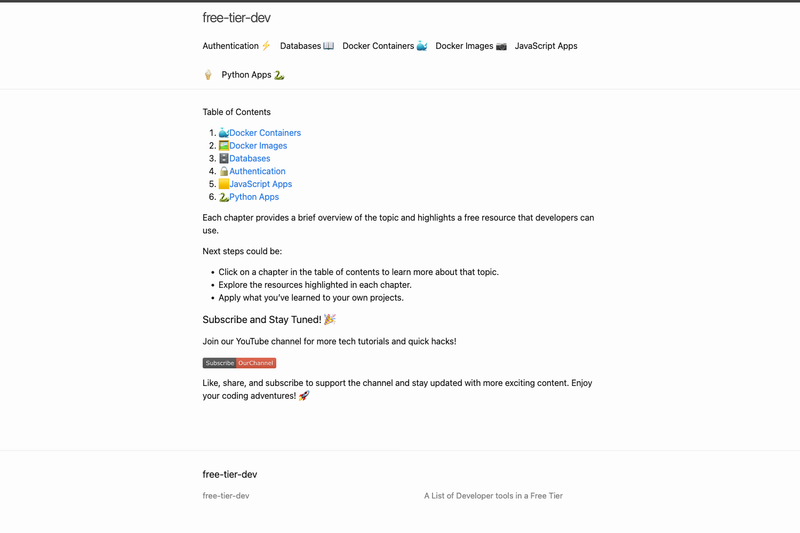
- Beginner-friendly navigation — The homepage lists the table of contents with emoji-labeled chapters, and a "Start By" section gives three steps: click a chapter, explore the resources, and apply them to your own projects.
Who is it for?
- Indie hackers building SaaS on a budget — They can scan the Databases and LLM chapters to pick free-tier services for their stack.
- Developers new to Docker — The Docker Containers and Docker Images chapters point to free resources for containerization and deployment.
- Students learning web development — They can use the Authentication and Frontend chapters to find free auth providers and static hosting options.
- Content creators — The accompanying YouTube channel offers video tutorials that expand on the text-based listings.
What can you do with Free Tier Dev?
- Find a free database for a side project — Visit the Databases chapter to see which managed databases offer a usable free tier for prototyping.
- Choose an authentication service without paying — The Authentication chapter highlights a free auth resource you can integrate into your app.
- Get started with LLM APIs — The LLM chapter lists free-tier language model services to experiment with AI features in your own software.
- Deploy a Dockerized app — The Docker Containers page points to free hosting options for running containers.
How does it work?
The site's homepage presents a table of contents with eight chapters. Each chapter page gives a short overview of the topic and spotlights one free resource. The "Start By" section instructs newcomers to click a chapter, explore the highlighted resource, and then apply what they learned to their own projects.
FAQ
Is Free Tier Dev free?
Yes, the entire directory is free to browse. It lists tools that have free tiers, and the site itself is hosted on GitHub Pages at no cost to users.
What topics does Free Tier Dev cover?
It covers Docker Containers, Docker Images, Databases, Authentication, Frontend, Python Apps, Payments, and LLM — eight categories of developer tools relevant to building a SaaS product with free resources.
Who maintains Free Tier Dev?
The repository is published as mattmajestic/free-tier-dev on GitHub, and the companion YouTube channel is Majestic Coding. The same person appears to run both the site and the video tutorials.
Can I contribute to the list?
The project is open on GitHub under mattmajestic/free-tier-dev, so anyone can fork the repository and submit changes. Updates to existing entries and new free-tier tool suggestions would be typical contributions.
Does the site cover payment processing?
Yes, the Payments chapter highlights a free-tier resource for accepting payments, which is useful for developers monetizing their SaaS applications.