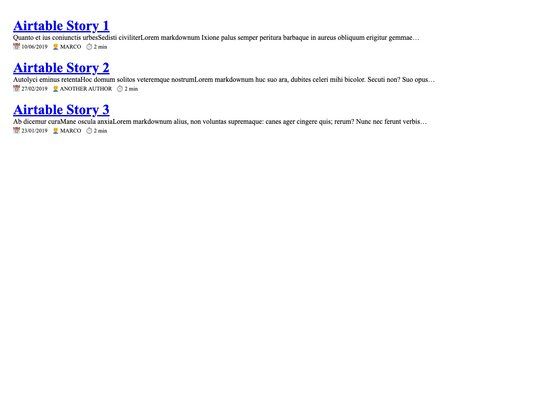
Gatsby Airtable Advanced Starter is a Gatsby v2 blog starter skeleton that uses Airtable as its content source, letting you manage blog posts and authors in Airtable bases and publish them as a static Gatsby site. This open-source project, maintained on GitHub by Marco Melilli, is built on top of the Gatsby Advanced Starter by Vagr9K and aims to give developers a minimal base for building advanced Gatsby blogs without UI limitations.
What is the Gatsby Airtable Advanced Starter?
The Gatsby Airtable Advanced Starter is a boilerplate for creating blog sites with Gatsby v2 where all content lives in Airtable instead of Markdown files or a CMS. It accepts Airtable API credentials and table names via environment variables and generates a fully static blog with posts, authors, tags, categories, RSS feeds, and SEO metadata. The starter targets Gatsby version 2 and ships with a demo Airtable base you can inspect online.
Key Features
- Airtable as content backend — Configure the API key, base ID, and table names for posts and linked authors in environment files, and Gatsby pulls content from Airtable at build time.
- Markdown rendering — Posts support code syntax highlighting, embedded YouTube videos, and embedded Tweets.
- Tags and categories — Each post can have tags and categories, and the starter generates separate pages for every tag and category.
- Disqus commenting — Enable feedback on posts by setting a Disqus shortname in the site config.
- Google Analytics — Add a tracking ID to the site configuration for visitor analytics.
- Social sharing — Posts include Twitter tweet buttons and share counts for Facebook, Reddit, LinkedIn, and Telegram.
- SEO built in — Sitemap generation, robots.txt, and configurable site metadata for search engines.
- RSS feed — Outputs an RSS feed at the path you define, such as /rss.xml.
- PWA and offline support — Web App Manifest and offline support make the blog installable and usable without a connection.
- Netlify deployment — Includes Netlify deploy configuration for one-click publishing.
Who is it for?
- Bloggers who prefer spreadsheets — Manage posts and authors in Airtable's grid interface and publish a static blog without touching Markdown files.
- Gatsby developers — Fork the starter as a minimal foundation and build custom UI on top, since the project deliberately leaves UI unrestricted.
- Teams with structured content — Use Airtable's linked records to relate authors to posts and keep editorial workflow in one place.
What can you do with it?
- Content editors: write posts and author bios in Airtable and generate a production-ready Gatsby blog with tags, categories, RSS, and sitemap.
- Developers: customize the site config file (site title, URL, logo, date format, social links) and deploy to Netlify using the included configuration.
- SEO-focused site owners: benefit from sitemap.xml, robots.txt, and automatic meta tags defined in the site config.
How does it work?
The setup flow starts with cloning the repository and installing dependencies with npm or yarn. You then create development and production environment files containing your Airtable API key, base ID, and the table names for posts and linked authors. Finally, edit the site configuration file and run the Gatsby development server to preview your blog locally.
FAQ
Do I need an Airtable account to use this starter?
Yes. The starter loads all post and author content from Airtable, so you need an Airtable API key and a base with tables for posts and authors. The README links to demo bases you can view to see the expected schema.
Is the Gatsby Airtable Advanced Starter free?
The project is open source and hosted on GitHub under a standard open-source license. You can clone it, modify it, and deploy it without paying any licensing fee.
How do I change my site's title and description?
Edit the site configuration file located at data/SiteConfig.js. There you can set the site title, short title, URL, description, RSS path, Google Analytics ID, Disqus shortname, theme color, and other site-wide settings.
Can I add videos and tweets to my posts?
Yes. The starter's Markdown rendering includes support for embedding YouTube videos and Tweets directly in post content, along with syntax-highlighted code blocks.