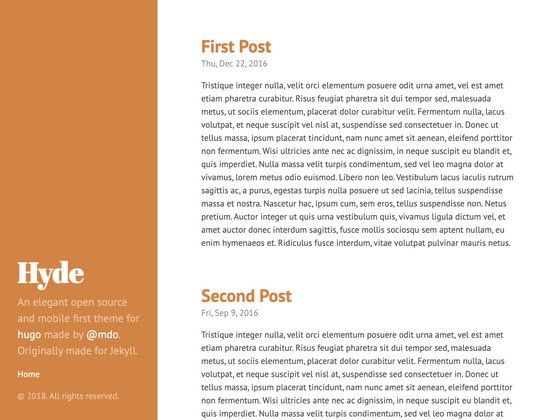
Hyde is a Hugo boilerplate that integrates the Hugo static site generator with a Gulp and Webpack asset pipeline and pre-configures Netlify CMS for Git-backed content editing.
What is the Hyde CMS Template?
The Hyde CMS Template is a boilerplate project for building static websites with Hugo as the site generator and Gulp and Webpack as the asset pipeline. It takes as input content authored in Markdown or through the Netlify CMS admin UI and produces a fully static site that can be deployed to Netlify via continuous deployment from a GitHub repository. The template is maintained by bdougie (Brian Douglas) and is available under an MIT license.
Key Features
- Hugo static site generator — All site content, layouts, and templates live under the
site/folder, with content pages and collections insite/content, layouts insite/layouts, and static files insite/static. - Gulp and Webpack asset pipeline — Source files in
src/pass through a build pipeline: CSS insrc/cssis compiled with PostCSS Next to/dist/css/, and JavaScript insrc/js/app.jsis bundled with Babel to/dist/app.js. - Netlify CMS integration — The CMS is a single-page app pulled into the
/adminroute of the site, with asite/static/admin/config.ymlfile that describes the content model and connects to a GitHub repository backend. - GitHub-based authentication — The default backend uses Netlify's Authentication Provider feature to let editors log in with GitHub and then create or edit content through the API.
- BrowserSync live reload — Running
npm startlaunches a local server at http://localhost:3000/ that automatically reloads CSS or refreshes the page when stylesheets or content change. - One-click Netlify deployment — The repository includes a Deploy to Netlify button that scaffolds a new site linked to a GitHub repo, with builds triggered on every push.
- Modern JavaScript and CSS — You can use ES6 modules and import npm libraries in the webpack build, and any CSS file placed directly under
src/css/is processed with PostCSS. - MIT license — The project is open source and free to use and modify.
Who is it for?
- Developers starting a Hugo site — They can clone or deploy the repository to get a working Hugo project with a configured asset pipeline rather than wiring up Gulp, Webpack, PostCSS, and Babel themselves.
- Content teams wanting a Git-based workflow — Editors can log into the
/adminsection and publish content that is committed to a GitHub repository, while developers review changes through pull requests. - Netlify users — The template is configured for continuous deployment to Netlify and uses Netlify's authentication providers for the CMS login.
What can you do with the Hyde CMS Template?
- Launch a blog with a CMS admin — Create and edit Markdown posts through Netlify CMS and have them built into static pages by Hugo.
- Use the asset pipeline for custom themes — The
srcfolder is the entry point for CSS and JavaScript, so you can write PostCSS and ES6 code that gets compiled and minified into thedistfolder. - Deploy a static site to Netlify — Push the repository to GitHub and link it to Netlify; every push triggers a production build.
How does the Hyde CMS Template work?
After cloning the repository, run npm install and npm start to serve the site locally. To build the static output, use npm run build, which outputs to /dist. To enable the CMS, edit site/static/admin/config.yml to change the GitHub repository owner and name under the repo key, then set up continuous deployment from GitHub to Netlify and configure GitHub as an authentication provider. Once that is done, visiting /admin prompts a GitHub login, after which users can create or edit content.
FAQ
Is the Hyde CMS Template free?
Yes, the project is licensed under the MIT License, and the Hugo static site generator, Netlify CMS, and all build tools used are open source. You only pay for hosting if you choose a paid Netlify plan.
What do I need to install before using it?
You need Node.js, npm, and Hugo installed. The README notes that if you need to install Hugo, you can follow the Hugo installation guide, and running npm install will pull in all JavaScript dependencies.
How do I change which GitHub repository the CMS uses?
In the site/static/admin/config.yml file, find the backend section and change the repo value to owner/repo and optionally adjust the branch from the default master. After editing, the CMS will authenticate against that repository.
Does the template support live reload during development?
Yes, npm start runs BrowserSync at http://localhost:3000/, which automatically reloads CSS or refreshes the page when stylesheets or content files change.