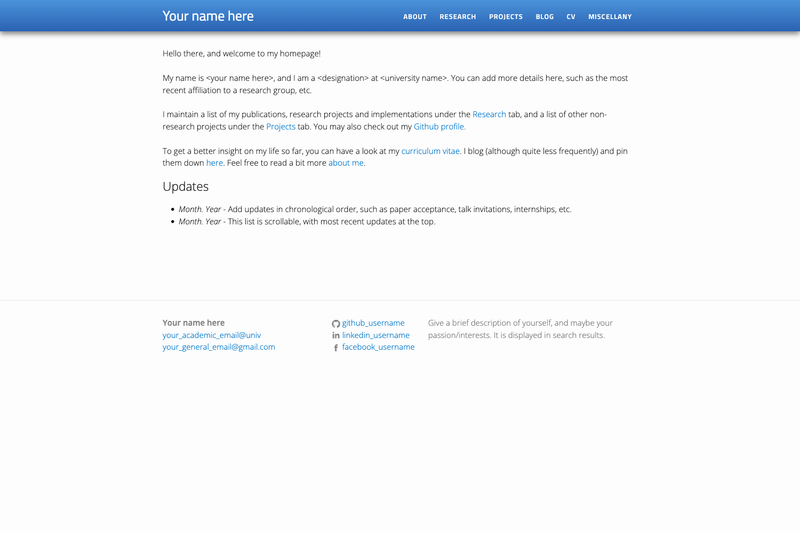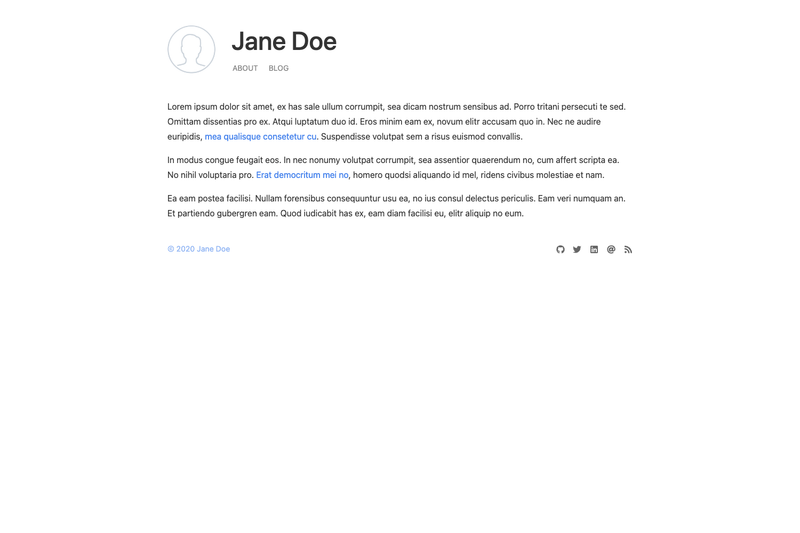
Renga is a Bootstrap 4-based minimalist theme for the Hugo static site generator, designed for building personal websites that combine portfolio pages with a blog. It accepts content written in Markdown or raw HTML and outputs a responsive, mobile-first site with optional math typesetting, syntax highlighting, and progressive image loading. The theme is developed by nanxstats and released under the MIT license.
What is Hugo Renga?
Hugo Renga (or simply Renga) is a Bootstrap 4-based minimalist theme for the Hugo static site generator, created by nanxstats. It takes content written in Markdown or HTML and renders it into a responsive personal website that can mix portfolio-style pages with a blog. The theme is also compatible with blogdown, the R package that builds websites with Hugo.
Key Features
- Responsive & mobile-first layout — Built on Bootstrap 4, so pages adapt to screen sizes automatically.
- Minimalist design with native font stack — Uses system fonts for fast loading and a clean look.
- High contrast — Text and background colors are chosen for readability.
- Math typesetting (MathJax) — Include LaTeX-style math in Markdown or HTML content.
- Syntax highlighting (highlight.js) — Code blocks are highlighted with highlight.js.
- Progressive image loading — Images are loaded lazily via progressively.js.
- Disqus comments — Integrate Disqus for blog posts.
- Google Analytics — Add tracking via config.
- Open Graph and Twitter Cards — Social media meta tags are built in.
- Navigation menus and portfolio pages — Simple Markdown for blog posts, or HTML for complex custom pages.
Who is it for?
Renga suits individuals and professionals who want a personal website with both portfolio and blog sections. Bloggers and academics can publish research notes or articles in Markdown. Designers and developers can create custom portfolio pages using Bootstrap 4 HTML. Users of blogdown can integrate R Markdown to combine R code and prose.
What can you do with Hugo Renga?
- Academics and researchers: Publish blog posts with mathematical formulas rendered by MathJax, and link to publications.
- R users: Use blogdown with Hugo Renga to create a website that blends R Markdown documents with standard pages.
- Creative professionals: Build standout portfolio pages using custom Bootstrap 4 HTML while keeping the blog simple with Markdown.
- Developers: Use features like syntax highlighting, Disqus, and Google Analytics to document projects and share code.
How does Hugo Renga work?
Renga is installed as a Git submodule in your Hugo site's themes directory. After copying the example config file, you write content in Markdown, or HTML for complex pages, and run Hugo to generate the static site.
FAQ
Is Hugo Renga free?
Yes, Hugo Renga is open source and released under the MIT license, so it is free to use and modify for personal or commercial projects.
Can I use Renga with blogdown?
Yes, Renga is advertised as compatible with blogdown. You can use it as your Hugo theme in an R Markdown-based website.
Does Renga support math formulas?
Yes, Renga includes MathJax support, so you can typeset mathematical notation within your content.
How do I install Renga?
Run git submodule add https://github.com/nanxstats/hugo-renga.git themes/hugo-renga inside your Hugo site folder, then copy the example config.toml.
What is the difference between Renga and Tanka?
The page mentions Tanka as a blog-oriented companion theme by the same author, whereas Renga offers a balance between minimalist blog and Bootstrap-customizable portfolio pages.