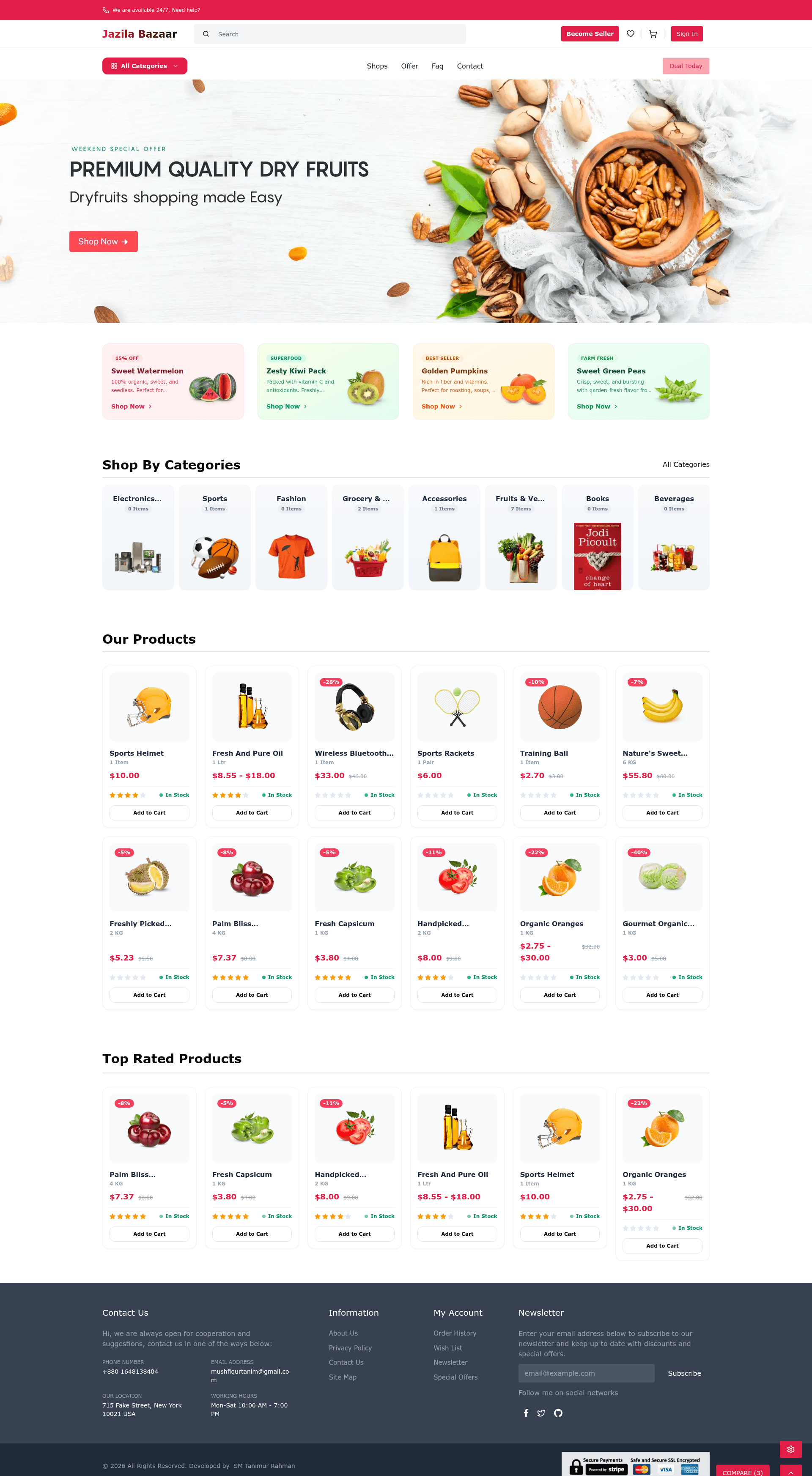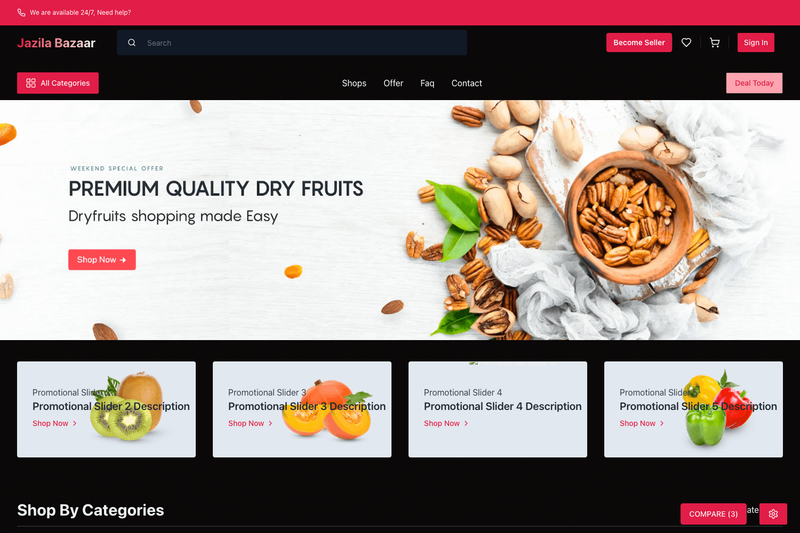
Jazila Bazar is an open-source multi-vendor ecommerce platform that pairs a Next.js 13 storefront with a NestJS backend so vendors can manage their own catalogs and shoppers can search, review, and buy products. The project was created by SM Tanimur Rahman, published on GitHub, and has a live demo at jazila-bazar.vercel.app.
What is Jazila Bazar?
Jazila Bazar is a full-stack TypeScript ecommerce application organized into two codebases: the main storefront repository (Jazila-bazar) and a separate admin dashboard repository (jazila-dashboard). The frontend is built with Next.js 13, Tailwind CSS, and Shadcn UI and handles product search, cart, and checkout, while the backend is a NestJS API using Express, Mongoose for MongoDB, and Passport.js with JWT for authentication. Configuration is driven by environment variables including NEXT_PUBLIC_APP_URL, NEXT_PUBLIC_API_URL, NEXT_PUBLIC_OAUTH_GOOGLE_ID, NEXT_PUBLIC_CLIENT_SESSION, and NEXT_PUBLIC_ADMIN_URL.
Key Features
- Multi-Vendor Support — vendors register and manage their own storefronts within a single platform.
- Product Management — vendors can add, edit, and remove products from their catalog.
- JWT User Authentication — secure login with JWT tokens via Passport.js, with Google OAuth support through the Google client ID environment variable.
- Search and Filters — shoppers can search and filter the product catalog to find items quickly.
- Reviews and Ratings — users can leave ratings and reviews for purchased products.
- Admin Dashboard — a separate dashboard application for platform-wide monitoring and management, connected through NEXT_PUBLIC_ADMIN_URL.
- Responsive UI — Tailwind CSS powers a mobile-friendly interface that works across devices.
- Frontend Tooling — the storefront uses Zustand and Jotai for state, React Query and Axios for fetching, React Hook Form with Yup for validation, Swiper for sliders, and sonner plus sweetalert2 for notifications; Cloudinary handles media uploads.
Who should use Jazila Bazar?
Jazila Bazar suits developers and entrepreneurs launching a marketplace MVP who want a working multi-vendor flow out of the box. Freelancers can fork the repository and rebrand it for client ecommerce projects. Students and self-taught developers can study how a Next.js 13 frontend integrates with a NestJS API, Mongoose models, and a separate admin dashboard.
What can you do with Jazila Bazar?
- Marketplace founders: register vendors, let them manage products, and run a storefront with search and checkout in one deployment.
- Ecommerce developers: extend the NestJS API and Next.js UI with new modules using React Query and Zustand for frontend state.
- Platform admins: track storefront activity from the dedicated admin dashboard repository.
FAQ
Is Jazila Bazar free?
Jazila Bazar is an open-source project on GitHub, so you can clone the repository, set the environment variables, and deploy it yourself.
What tech stack does Jazila Bazar use?
The frontend uses Next.js 13, TypeScript, Tailwind CSS, Shadcn UI, Zustand, Jotai, and React Query. The backend is NestJS with Express, Mongoose, Passport.js, and JWT-based authentication, plus Cloudinary for media storage.
Does Jazila Bazar support multiple vendors?
Yes, it is a multi-vendor marketplace. Vendors can register and run their own storefronts, and a separate admin dashboard repo is provided for platform-level management.
How does authentication work in Jazila Bazar?
Authentication uses JWT tokens with Passport.js on the NestJS backend. The storefront also exposes the NEXT_PUBLIC_OAUTH_GOOGLE_ID environment variable, indicating Google OAuth support for social login.
Alternatives
- Medusa — an open-source headless commerce platform built with Node.js, which centers on a single merchant model.
- Saleor — an open-source GraphQL-first commerce platform with a different admin architecture.