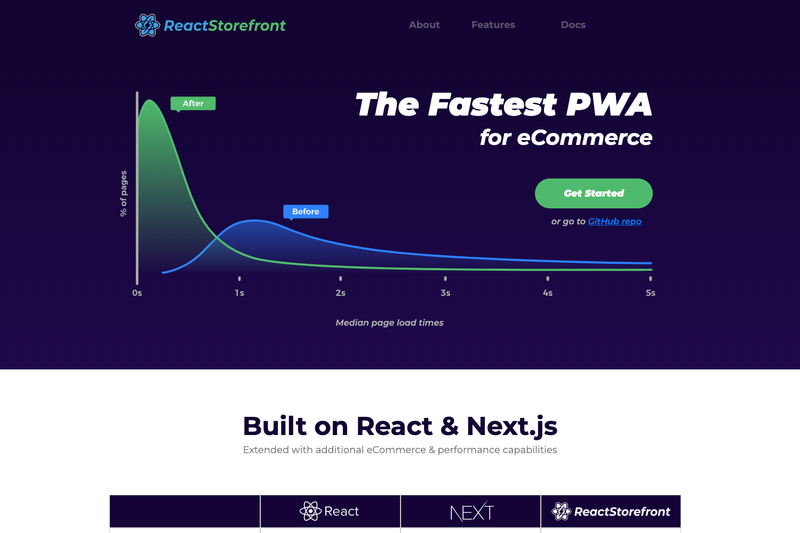
React Storefront is an open-source, Apache-2.0-licensed PWA framework for eCommerce built on Next.js that generates server-side-rendered, headless storefronts from any backend API.
What is React Storefront?
React Storefront (RSF) is a free and open-source framework created by the Storefront Foundation, a group of eCommerce site, agency, and platform engineers. It extends Next.js with eCommerce-specific UI components, data prefetching, and caching so developers can build progressive web apps (PWAs) that connect via APIs to any eCommerce platform, including Magento 2 and Salesforce Commerce Cloud. The output is a deployable Node.js storefront with automatic AMP pages, code splitting, and server-side rendering, ready to run on any Node.js host or the Layer0 serverless platform.
Key Features
- Headless architecture — Connects to any eCommerce platform or backend system through APIs, with documented guides for integrating platforms such as Magento 2 and Salesforce Commerce Cloud.
- Performance optimizations — Includes high cache hit rates for dynamic data, server-side rendering, automatic AMP creation, predictive prefetching, code splitting, and client-side data reuse to speed up page loads.
- Isomorphic JavaScript — A unified code base runs across server, client, and CDN, with support for source maps in Chrome Debugger and Visual Studio Code.
- eCommerce UI components — Ships with UI components and templates designed specifically for storefronts, and preserves your existing URL scheme for SEO.
- Incremental migration — Supports real-world migration of complex eCommerce sites to PWAs in incremental steps, scaling from $10M to $1B+ revenue sites.
- Zero configuration setup — Download and start coding immediately; the opinionated framework handles configuration and guides developers into performance best practices.
- Open-source license — Released under Apache v2.0, free for anyone to use and support.
Who is it for?
- eCommerce developers — build PWA storefronts with Next.js and React without configuring caching, prefetching, or AMP generation manually.
- Agencies — migrate clients from legacy frontends to headless PWAs incrementally using a single code base.
- Merchants with Magento or Salesforce Commerce Cloud — leverage documented API integrations to connect RSF to existing backends while preserving URL schemes.
- Enterprises — deploy to Node.js environments or Layer0 for sub-second dynamic pages; the framework scales to high-revenue sites.
What can you do with React Storefront?
- Launch a storefront — run
npm create react-storefront@latest --yes (my-app-name)and start development withnpm run dev. - Replace a legacy frontend — connect RSF to any eCommerce platform via APIs and incrementally migrate complex sites.
- Improve mobile speed — generate PWAs and AMP pages from one code base, using skeletons and prefetching to accelerate perceived performance.
How does React Storefront work?
RSF extends Next.js with a data layer that fetches product, category, and search results from your backend API. During build, it generates both a server-side-rendered PWA and AMP versions of pages. At runtime, it applies cache optimization, predictive prefetching, and client data reuse; developers can test locally with npm run dev and deploy to any Node.js host.
Pricing
React Storefront is free and open-source under the Apache 2.0 license. It can be tested and deployed on Layer0, which offers a free tier, but the framework itself has no cost.
FAQ
Is React Storefront free?
Yes, React Storefront is completely free and open-source, released under the Apache 2.0 License. Anyone can use, modify, and contribute to the project.
What eCommerce platforms does React Storefront support?
React Storefront is headless and platform-agnostic, connecting to any eCommerce platform via APIs. The repository explicitly documents support for Magento 2 and Salesforce Commerce Cloud, and there are guides for integrating other backends.
How do I create a React Storefront app?
Run npm create react-storefront@latest --yes (my-app-name) with Node 10 or newer, then cd (my-app-name) and npm run dev to start the development server.
Can React Storefront generate AMP pages?
Yes, automatic AMP creation is built in. From a single code base, React Storefront produces both a PWA and AMP versions of pages, which helps with SEO and mobile performance.
Where can I deploy React Storefront?
Like any Next.js project, React Storefront runs on any environment that supports Node.js. The easiest path is Layer0, a serverless PaaS with a free tier, but you can deploy to any Node host.