Jekyll SEO Tag is a Ruby plugin for the Jekyll static site generator that automatically inserts search-engine and social-network metadata tags into the HTML head of every page. It generates page titles, meta descriptions, canonical URLs, JSON-LD structured data, Open Graph tags, and Twitter Summary Card metadata so that search engines and social platforms index and display Jekyll sites correctly.
What is Jekyll SEO Tag?
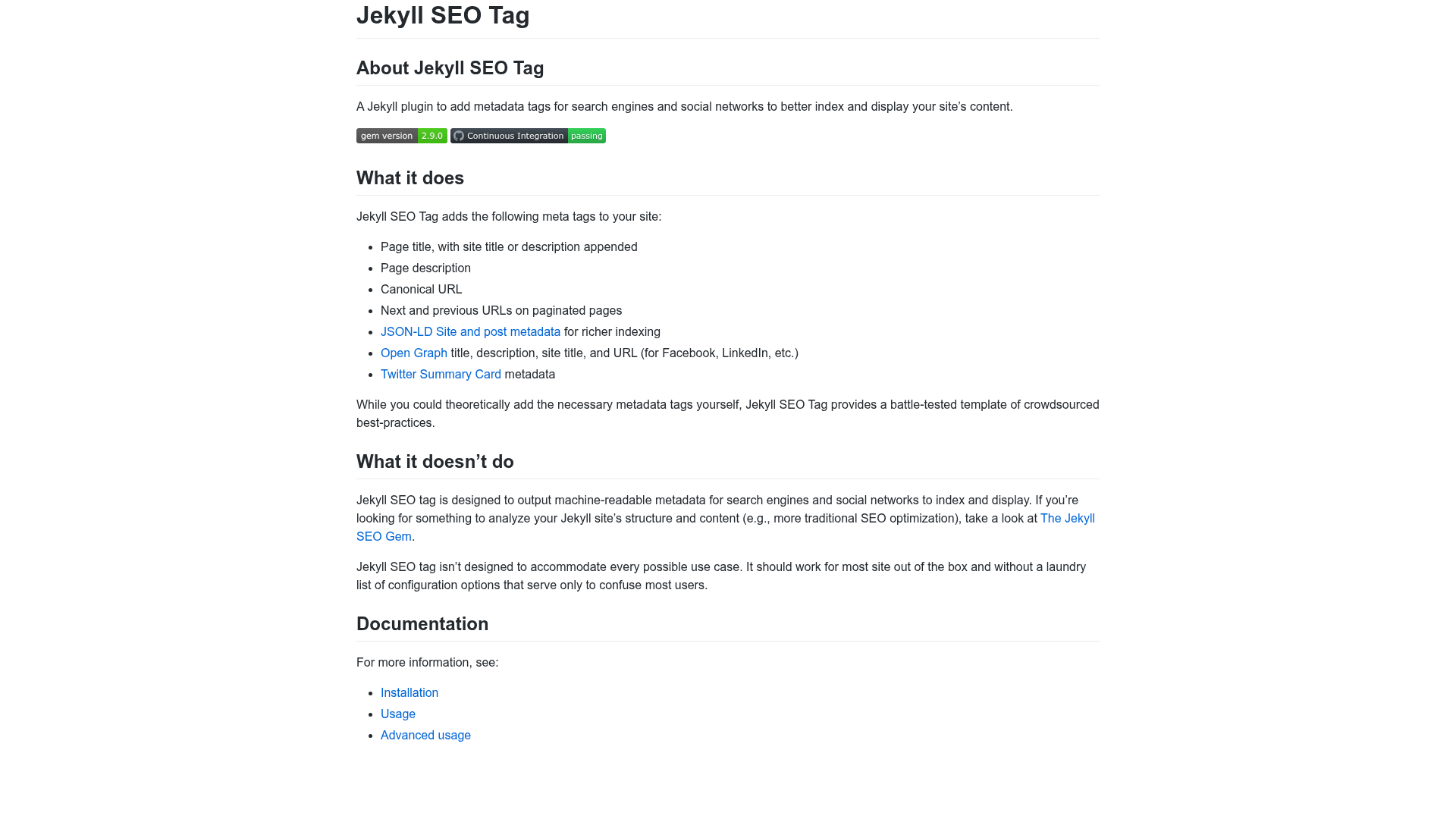
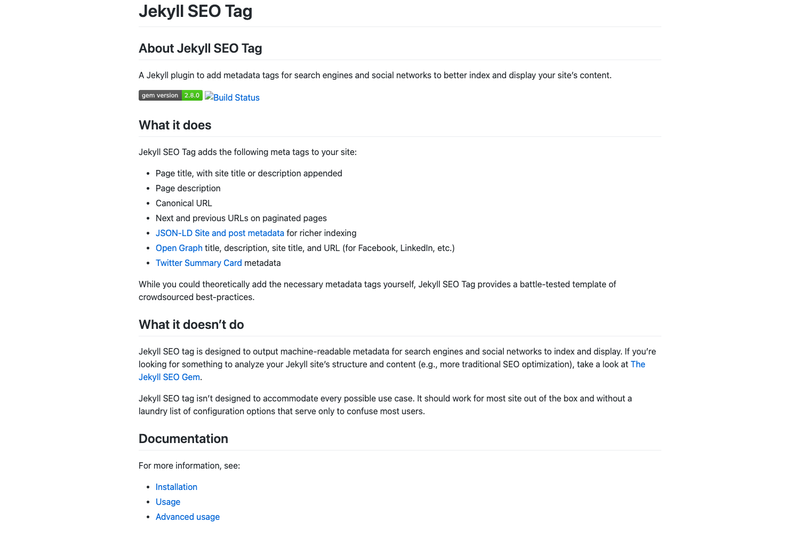
Jekyll SEO Tag is a Jekyll plugin distributed as a Ruby gem and maintained by the Jekyll organization on GitHub. It takes a Jekyll site's layouts, pages, posts, and site configuration as input, and produces a consistent set of machine-readable meta tags in the output HTML. The plugin encodes crowdsourced best practices from the community, which saves site owners from writing or maintaining these tags manually.
Key Features
- Page title tag — Appends the site title or site description to each page's title to form a complete title tag.
- Meta description — Outputs a page description meta tag derived from front matter or site-level settings.
- Canonical URL — Adds a canonical link tag to every page to point search engines to the preferred URL.
- Pagination support — Inserts next and previous URL tags on paginated pages for better crawlability.
- JSON-LD structured data — Includes site and post metadata in JSON-LD format for richer indexing by search engines.
- Open Graph metadata — Provides Open Graph title, description, site name, and URL for Facebook, LinkedIn, and other Open Graph consumers.
- Twitter Summary Card — Adds Twitter Card metadata so shared links render correctly with a summary card on Twitter.
- Out-of-the-box defaults — The plugin is intentionally designed to work for most sites without a laundry list of configuration options.
Who is it for?
Jekyll SEO Tag is for anyone who publishes a site built with Jekyll and wants correct search-engine and social-sharing metadata without manual HTML. It suits personal bloggers who want their links to display well on Twitter, documentation site maintainers who need canonical URLs to avoid duplicate content, and developers building marketing sites or portfolios on Jekyll who want structured data without custom code.
What can you do with Jekyll SEO Tag?
- Bloggers — Let the plugin generate Open Graph and Twitter Card tags from your post's existing front matter, so shared links show a title, description, and correct URL.
- Site maintainers — Use canonical URL tags on all pages to signal the preferred version of each page to search engines.
- Developers — Rely on JSON-LD output for posts and site metadata to support structured-data features in search results without writing JSON-LD scripts by hand.
FAQ
What metadata does Jekyll SEO Tag generate?
It generates a page title tag, a page description meta tag, a canonical URL, next and previous URLs on paginated pages, JSON-LD site and post metadata, Open Graph tags, and Twitter Summary Card metadata.
Does Jekyll SEO Tag do traditional SEO analysis?
No. It only outputs machine-readable metadata for search engines and social networks. For analysis of site structure and content, the project points to The Jekyll SEO Gem.
Is Jekyll SEO Tag free?
Yes. It is an open-source Ruby gem available on GitHub with no paid tiers or license fees.
Is Jekyll SEO Tag configurable?
Yes, but it is designed to work for most sites out of the box. The documentation includes installation, usage, and advanced usage guides that explain how to tailor the tags for specific needs.