Jekyll Webmention_io is a Ruby gem that brings webmention sending and receiving to Jekyll sites through Webmention.io, the IndieWeb's cross-site notification protocol.
What is Jekyll Webmention_io?
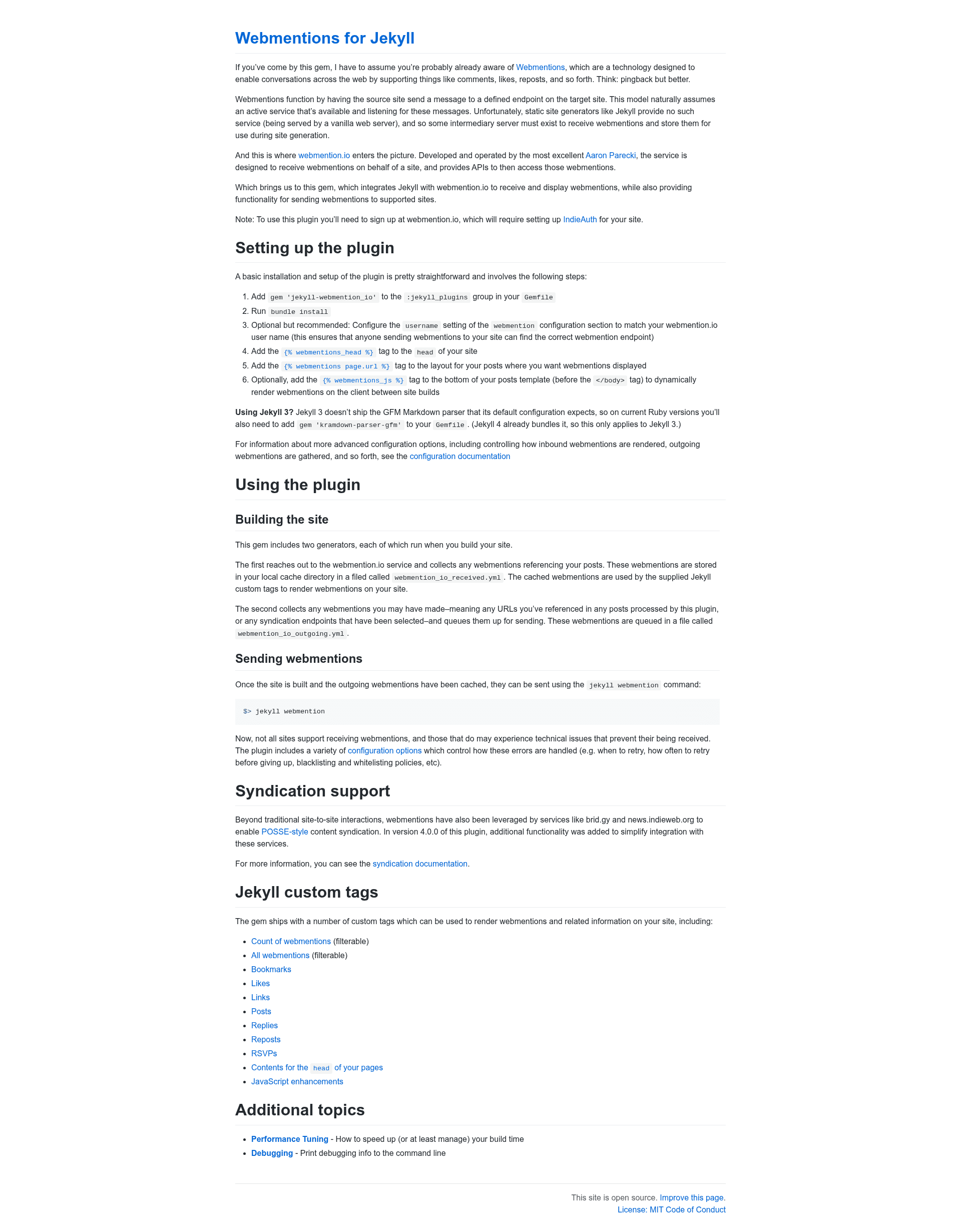
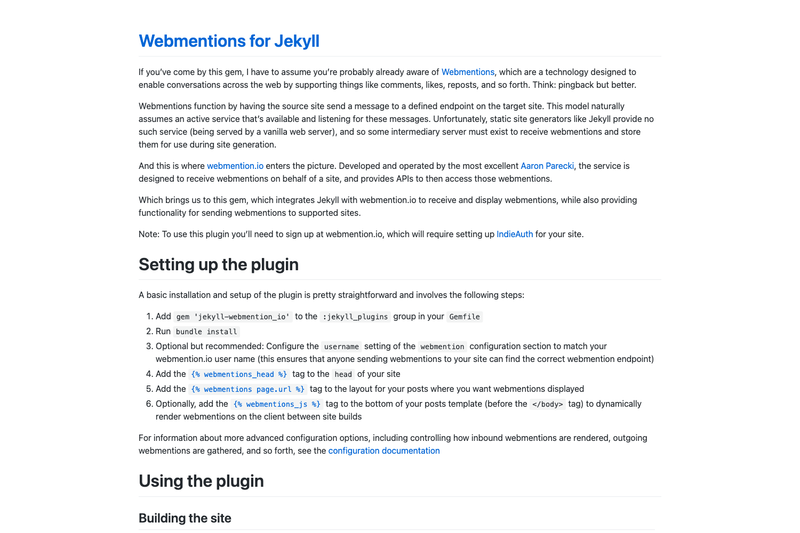
Jekyll Webmention_io is a Ruby gem that extends Jekyll with a suite of tools for managing webmentions, using Webmention.io as the backend. It takes standard Jekyll site content and integrates with Webmention.io to notify other sites when you link to them and to fetch mentions that others send back to your content. The plugin is authored by Aaron Gustafson, maintained by Brett Kosinski, and released under the MIT License, with the source hosted on GitHub.
Key Features
- Webmention sending — Automatically sends webmentions to URLs linked from your Jekyll posts, notifying those sites of the new link.
- Webmention receiving — Fetches incoming webmentions from Webmention.io and makes the data available to your Jekyll templates for display.
- Mention rendering — Renders received webmentions, such as replies, likes, and reposts, as visible content on your Jekyll pages.
- Jekyll plugin architecture — Installs as a standard Ruby gem and plugs directly into Jekyll's build process; no separate server is required to run it.
- Open-source governance — MIT-licensed with a code of conduct and contribution guidelines; issues and feature suggestions are welcome on the GitHub repository.
Who is it for?
- IndieWeb participants — use this plugin to make their Jekyll sites fully webmention-enabled, allowing two-way interactions with other IndieWeb sites.
- Jekyll bloggers — who want to display reactions and comments from across the web without maintaining a database or comment backend.
- Technical site owners — who run Jekyll and prefer a self-contained Ruby plugin over adding third-party JavaScript to handle webmentions.
What can you do with Jekyll Webmention_io?
- Personal bloggers: automatically send webmentions when linking to another article and display incoming mentions on post pages.
- Community sites: let readers send webmention-based replies that appear as comments on your Jekyll pages.
- Project or event pages: aggregate mentions, feedback, and annotations from across the web onto a static page.
FAQ
Is Jekyll Webmention_io free?
Yes. The plugin is released under the MIT License, so it is free to use, modify, and distribute. You can find the license file in the GitHub repository.
How do I install Jekyll Webmention_io?
It is distributed as a Ruby gem, so you can add it to your Jekyll site's Gemfile and run bundle install. Then follow the documentation at the official docs site for configuration.
Who maintains Jekyll Webmention_io?
Aaron Gustafson authored the plugin and originally maintained it. Brett Kosinski now maintains it, with contributions from the community listed on the GitHub contributors page.
What is the code of conduct?
The project follows a code of conduct that asks all participants to be kind to fellow coders. It is linked from the repository and applies to issues, pull requests, and other project interactions.