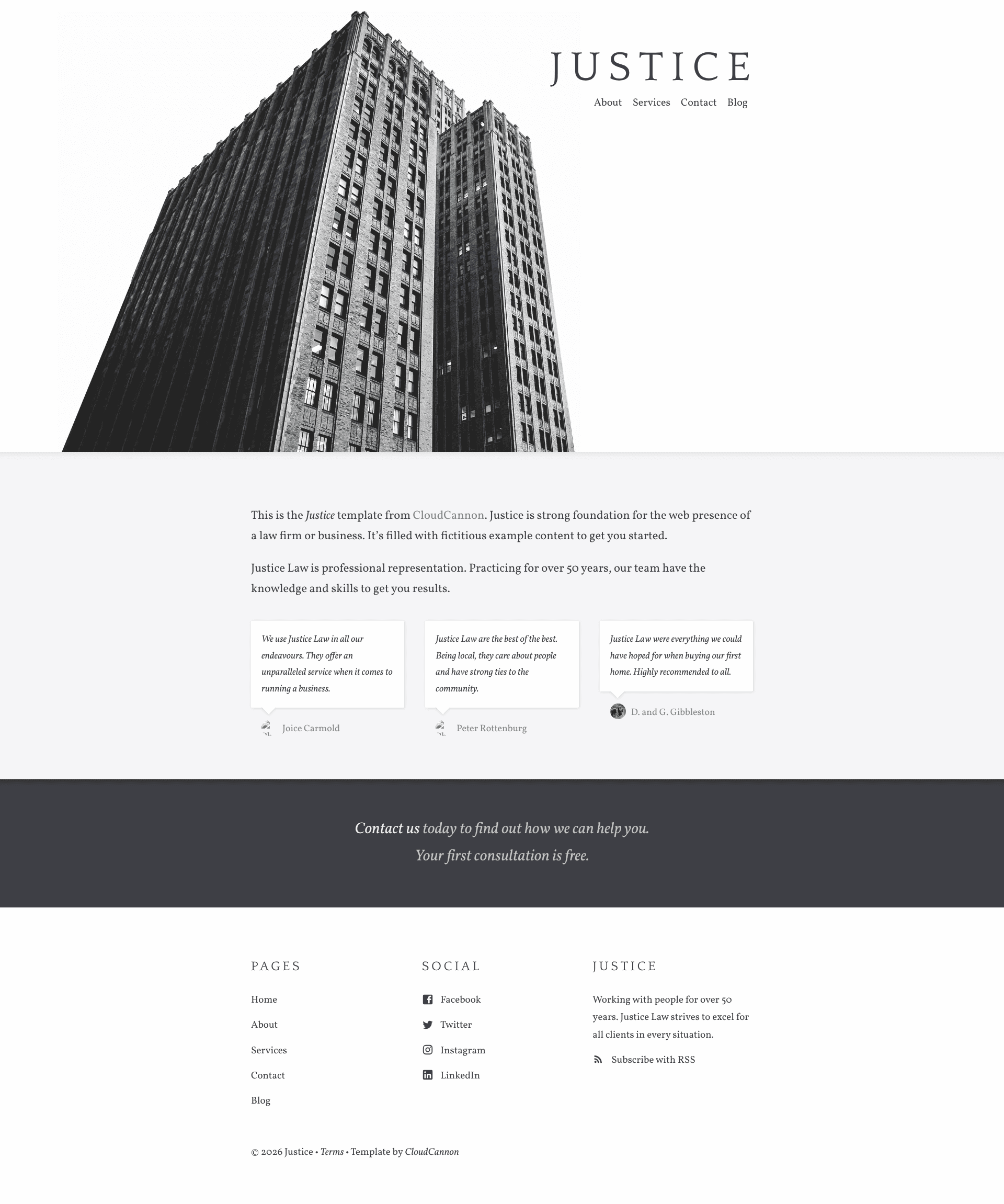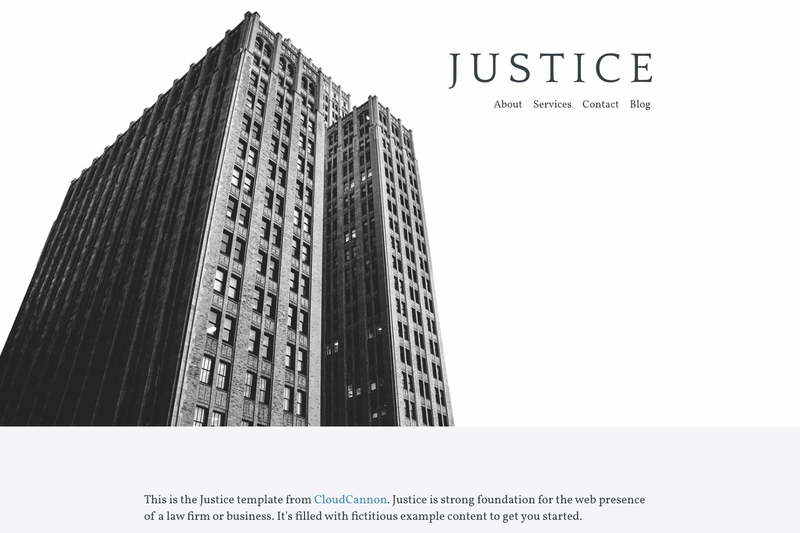
Justice is a law firm themed business template built with Next.js 13.0.4 and designed for editing in CloudCannon, giving legal practices a ready-made marketing website.
What is Justice?
Justice is a law firm themed business template for Next.js, created by CloudCannon, that produces a static marketing website for legal practices. It takes configuration files such as content/data/seo.json and content/data/site.json as inputs and outputs a site with pre-built pages, a blog, staff profiles, and a contact form. The template runs on Next.js version 13.0.4 and is optimised for content editing in CloudCannon. Note that the template is no longer actively maintained but remains available for reference and learning.
Key Features
- Contact form — Preconfigured to work with CloudCannon; form submissions are sent by email to the address listed in company details.
- Blog and post category pages — Posts are managed as a collection, each linked to a staff author; post defaults live in
content/posts/_defaults.md. - Staff and author system — Staff members are defined once in a dedicated collection and reused around the site, avoiding duplicate editing.
- Configurable footer — The footer is exposed as a data file, giving clients a simple way to update footer content in CloudCannon.
- Disqus comments — Blog posts support comment threads, activated by adding a Disqus key to
content/data/site.json. - RSS/Atom feed and SEO tags — Included out of the box, with site and author details managed in
content/data/seo.json. - Google Analytics — Integration enabled by adding your Analytics key to
content/data/site.json. - CloudCannon editing optimisations — Pages, staff, posts, company details, and footer elements can be added, updated, or removed through the CloudCannon UI.
Who is it for?
Justice is for law firms and legal businesses that need a professional web presence without building a site from scratch. It is also suited to web developers and agencies using CloudCannon who want a pre-built business template they can deploy for clients. Because content lives in data files and collections, non-technical editors can manage pages, staff bios, and footer content directly through CloudCannon.
What can you do with Justice?
- Law firm marketing: Launch a site with pre-built pages, a blog for legal insights, and staff profile pages to introduce attorneys.
- Agency client work: Deploy the template to CloudCannon and hand over editing access so clients can maintain their own content.
- Reference project: Use the codebase as a learning resource for how a Next.js content-management template is structured, even though it is no longer maintained.
How does Justice work?
Setup starts by adding site and author details in content/data/seo.json and inserting Google Analytics and Disqus keys in content/data/site.json. Then either run npm install and npm run dev locally, or connect the repository to CloudCannon to get a workflow going and see the generated site. The contact form is preconfigured to work with CloudCannon, sending submissions to the company email address.
FAQ
Is Justice still maintained?
No, the template is no longer actively maintained but remains available for reference and learning. For production sites, CloudCannon recommends its newer modern templates.
What does Justice include?
Justice includes pre-built pages and pre-styled components, a blog with post category pages, Disqus comments, a staff and author system, a configurable footer, RSS/Atom feed, SEO tags, and Google Analytics integration.
How do I set up Google Analytics in Justice?
Add your Google Analytics key to content/data/site.json. The template handles the rest, injecting the analytics tag into the site output.
Can I add a Disqus comment system to blog posts?
Yes, add your Disqus key to content/data/site.json, and Disqus comments will appear on blog post pages.
What version of Next.js does Justice use?
Justice is built with Next.js version 13.0.4, as stated in the template's development notes.