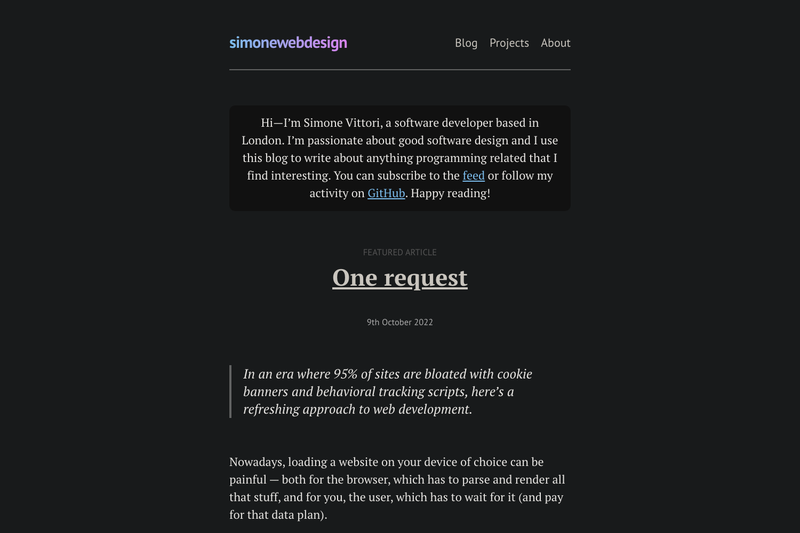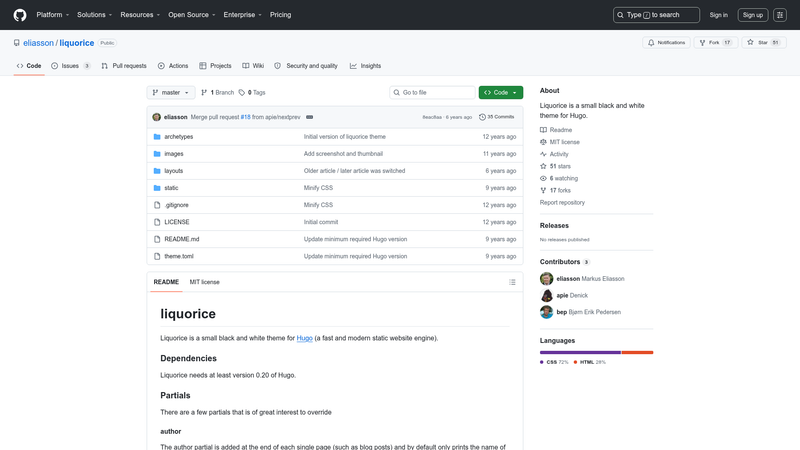
Liquorice is a small black-and-white Hugo theme for creating minimal static websites and blogs, released under the MIT license.
What is Liquorice?
Liquorice is a theme for the Hugo static site generator that produces black-and-white, text-focused web pages from Markdown content. It takes a Hugo project with content files and site configuration as its input and outputs a static HTML site. The theme requires Hugo version 0.20 or newer and consists of templates, partials, shortcodes, and a minified CSS file. The theme is open source under the MIT license.
Key Features
- Black and white visual style — The theme uses only black and white colors, giving all pages a consistent monochrome, high-contrast look.
- Author partial — At the end of every single page, such as a blog post, the theme automatically displays the author's name taken from the
authorparameter defined inconfig.toml. - Overridable author output — To replace the default author markup, create your own
layouts/partials/author.htmlfile and the theme will use it instead. - GitHub gist shortcode — Embed a GitHub gist by writing
{{% gist e572b28c9a0eef0b2763 %}}in a content file, where the first parameter is the gist ID; the theme loads it via GitHub's JavaScript include. - Minified CSS workflow — The theme includes a minified stylesheet at
static/css/liquorice.min.css, regenerated fromstatic/css/liquorice.cssusing the clean-css command-line tool. - Minimal dependency footprint — Only a recent Hugo installation is required; the only build tool mentioned is node's clean-css for the stylesheet.
Who should use Liquorice?
- Hugo bloggers — want a distraction-free, monochrome theme for a personal blog where each post ends with an author byline.
- Developers creating a quick site — need a simple Hugo theme they can read and customize quickly, including partials and shortcodes.
- Technical writers — who publish on GitHub pages or other Hugo-hosting services and want to embed gists in their documentation.
Use cases
- Personal blogs: set the
authorparameter in your site config and every blog post automatically displays that name at the bottom via the built-in author partial. - Code documentation: use the gist shortcode to embed a GitHub gist inline within any page, giving readers a live snippet without extra HTML.
- Customized author blocks: override the author partial to add your own bio, avatar, or social links at the end of each article.
How does Liquorice work?
Install Hugo 0.20 or newer, add the theme to your site, and write content as usual. The theme automatically applies its black-and-white layout, renders the author partial on single pages, and processes any gist shortcodes. If you edit the stylesheet, run cleancss -o static/css/liquorice.min.css static/css/liquorice.css to regenerate the minified CSS.
FAQ
What version of Hugo does Liquorice require?
Liquorice needs at least version 0.20 of Hugo. Older versions of Hugo will not render the theme correctly.
Is Liquorice free?
Yes, Liquorice is released under the MIT license, meaning it is free to use, modify, and distribute, including in commercial projects.
How can I change the author name that appears at the end of posts?
Set the author parameter in your site's config.toml under [params]. By default the theme prints this value at the end of each single page.
Can I customize the author section beyond a plain name?
Yes. Create a file named layouts/partials/author.html in your own project; the theme will use that partial instead of its default author markup, letting you add any HTML you want.
What shortcodes are included with Liquorice?
Liquorice ships with one custom shortcode: the gist shortcode, which embeds a GitHub gist by its ID using GitHub's JavaScript include.