Callmetony is a personal blog and portfolio template built with Next.js and Tailwind CSS, designed to present a developer's projects, writings, reading list, and workspace in a single-page-style site with separate content sections.
What is Callmetony?
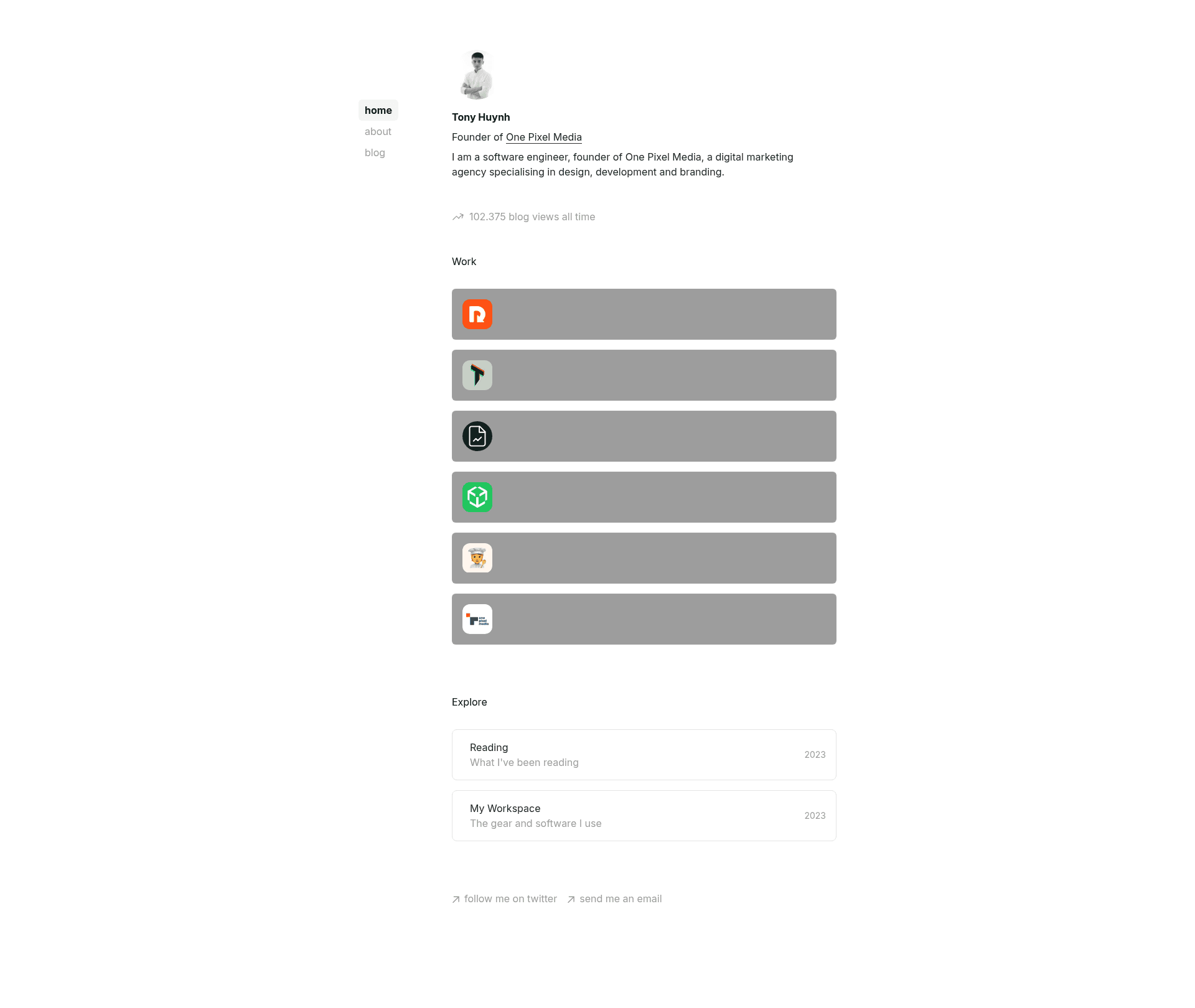
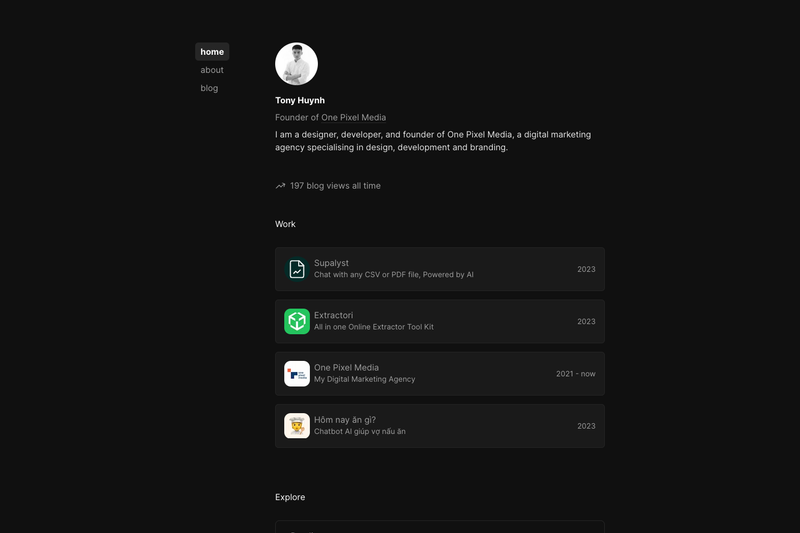
Callmetony is the personal website of Tony Huynh, a software engineer and founder of One Pixel Media, published as a GitHub repository under the topics nextjs-blog, nextjs-example, nextjs-starter, and nextjs-tailwind. The site runs on Next.js with Tailwind CSS and includes a homepage with an avatar and bio, a blog with a total view counter, a Work section listing six projects, and Explore pages for Reading and Workspace. As a starter, it takes your own content — posts, project descriptions, links — and produces a static personal site with the same layout.
Key Features
- Next.js framework — Built with Next.js and written in JavaScript, providing server-side rendering, static site generation, and file-based routing for fast page loads.
- Tailwind CSS styling — The interface is styled with Tailwind CSS, visible in the utility classes and responsive layout used across the public site.
- Blog with view tracking — The homepage displays "102.375 blog views all time," showing that the template includes a counter to display total blog views.
- Work portfolio section — Displays projects with a logo, tagline, and launch year: Repliio (AI email generator, 2024), ToolTik (TikTok video downloader, 2024), Supalyst (CSV/PDF chat, 2023), Extractori (online extractor toolkit, 2023), Hôm nay ăn gì? (AI cooking chatbot, 2023), and One Pixel Media (digital marketing agency, 2021–now).
- Explore pages — Includes a Reading page for books and articles the author is reading, and a Workspace page for the gear and software used.
- Social and contact links — Links to a Twitter profile (twitter.com/callmetonyhuynh) and an email address ([email protected]) for direct contact.
Who is it for?
- Developers — Use this as a Next.js blog starter: clone the repository, swap in your own avatar, bio, posts, and project entries, then deploy.
- Indie hackers and founders — Present your own products the same way the template showcases Repliio, ToolTik, Supalyst, and three other projects, each linking to a live product URL.
- Tech writers and content creators — Publish articles with a built-in blog view counter and add a curated reading list to share what you're consuming.
What can you do with Callmetony?
- Launch a personal site — Replace the placeholder content with your own bio, projects, and blog posts to create a Next.js-powered homepage in a single repository.
- Showcase side projects — Use the Work grid to feature your products with logo, one-line description, and year, exactly as the template does for its six featured projects.
- Curate a reading list — Fill the Reading and Workspace Explore pages to share books, articles, gear, and software with your audience.
FAQ
What tech stack does Callmetony use?
Callmetony uses Next.js with Tailwind CSS and is written in JavaScript. The repository topics also include nextjs-blog, nextjs-example, and nextjs-starter, confirming its role as a blog and starter template.
Who built Callmetony?
Tony Huynh built Callmetony as his personal site. He describes himself as a software engineer and founder of One Pixel Media, a digital marketing agency specializing in design, development, and branding.
What projects are featured in the Work section?
The Work section lists Repliio (2024), ToolTik (2024), Supalyst (2023), Extractori (2023), Hôm nay ăn gì? (2023), and One Pixel Media (2021–now). Each project has a logo, a tagline, and a link to its product page.