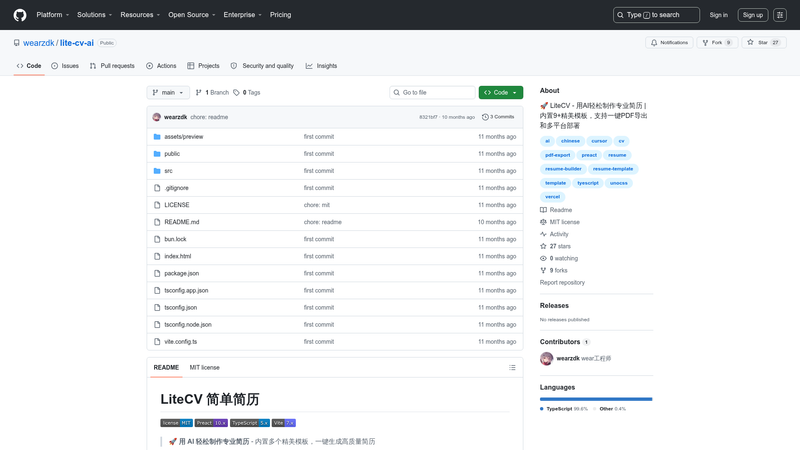
LiteCV is an open-source, AI-friendly resume builder that turns a single TypeScript data file into a fast, static resume website using Preact, TypeScript, Vite, and UnoCSS.
What is LiteCV?
LiteCV is a free, MIT-licensed resume generator designed to be edited with AI coding assistants such as Cursor. It takes a structured TypeScript data file (src/data/resume.ts) containing personal details, job history, education, and project blocks, and produces a static HTML resume site that can be printed to PDF directly from the browser. The project is built on Preact 10.x, TypeScript 5.x, Vite 7.x, and UnoCSS, with static site generation enabled by default, and is maintained on GitHub by the user wearzdk.
Key Features
- 9+ built-in templates — The repository ships with nine named themes: modern, professional, business, elegant, minimal, fresh-grad, senior-tech, international, and next, each geared to a different audience, from fresh graduates to senior technologists and international job seekers.
- AI-friendly architecture — The resume content is isolated in a single TypeScript file and the template is a single React component, which makes the project easy for Cursor, GitHub Copilot, ChatGPT, or Claude to read, modify, and extend.
- Fast static output — Using Preact and Vite with static site generation, the generated resume site loads quickly and can be hosted on any static host.
- Responsive design — Templates adapt to desktop and mobile viewport sizes, so the resume looks correct on phones and laptops.
- Print-to-PDF export — No extra tools are required: open the generated page in a browser, use the print command, and save as PDF.
- Multi-platform deployment — Ready-to-use instructions are included for Vercel, Cloudflare Pages, GitHub Pages, and Tencent EdgeOne Pages; the repo can be forked and imported into these services.
- Fully customizable — The TypeScript types for resume data live in src/shared/resume.ts, so new fields and block types can be added, and new themes can be created by adding a .tsx file to src/themes/.
- UnoCSS styling — The project uses UnoCSS as its style system, so Tailwind-style utility classes work out of the box and presets can be configured in vite.config.ts.
Who is it for?
- Job seekers who want AI help — They can paste their existing resume into an AI assistant and ask it to restructure the content into the resume.ts data format, then deploy the result online.
- Developers building a personal resume site — They get a typed, component-based codebase they can extend with new themes or custom styling using UnoCSS.
- Career changers and students — Templates like fresh-grad emphasize education, while senior-tech highlights project experience, so different career stages have a matching starting point.
What can you do with LiteCV?
- Create a customized resume — Edit the resume data in src/data/resume.ts to update name, contact info, summary, skills, work history, and projects, then switch the active template by changing one import in src/App.tsx.
- Generate a PDF for job applications — Open the local or deployed resume in a browser, right-click and print, and save the page as a PDF without installing software.
- Deploy a public resume page — Fork the repository and connect it to Vercel, Cloudflare Pages, GitHub Pages, or Tencent EdgeOne Pages to publish a live resume URL.
- Build a new template — Developers can copy an existing theme in src/themes/, rename it, and submit a pull request to share it with the project.
How does LiteCV work?
Clone the repository with git, install dependencies using bun or npm, then run the dev server with bun dev or npm run dev to preview at localhost:5173. Edit the resume data file to fill in your information, switch the imported template in src/App.tsx to change the layout, and run the build command to output static files to dist/ for deployment.
Pros and cons
- Pros: Open source under the MIT license, free to use, no account or API key required, quick start with one data file, and explicit support for AI-assisted editing.
- Cons: The project requires a local development setup (Node.js and a package manager) to edit and build; there is no hosted web editor, so non-technical users must interact with code.
Pricing
LiteCV is free and open source under the MIT license. The repository can be cloned, modified, and deployed without payment, and the companion AI resume assistant linked from the page is also described as free.
FAQ
Is LiteCV free?
Yes, LiteCV is distributed under the MIT license, so it is free to use, modify, and deploy. It does not require an account, subscription, or API key, and the repository is publicly available on GitHub.
Does LiteCV work with AI tools?
Yes, the project was designed to be used with AI coding assistants like Cursor and GitHub Copilot. The resume data is isolated in a single TypeScript file and templates are self-contained components, so AI tools can easily read and rewrite the content or create new themes.
How do I export a resume as PDF?
Open the generated resume page in any browser, press the print shortcut (or right-click and select Print), and choose "Save as PDF" as the destination. No print libraries or browser extensions are needed.
Can I host LiteCV online?
Yes, the README includes step-by-step guides for deploying to Vercel, Cloudflare Pages, GitHub Pages, and Tencent EdgeOne Pages. After forking the repository, you can import it into these platforms with default settings.
Can I create my own resume template?
Yes, you can add a new .tsx file under src/themes/, model it after an existing template, and then import it in src/App.tsx. The project's contribution guide also invites users to share new templates via pull requests.