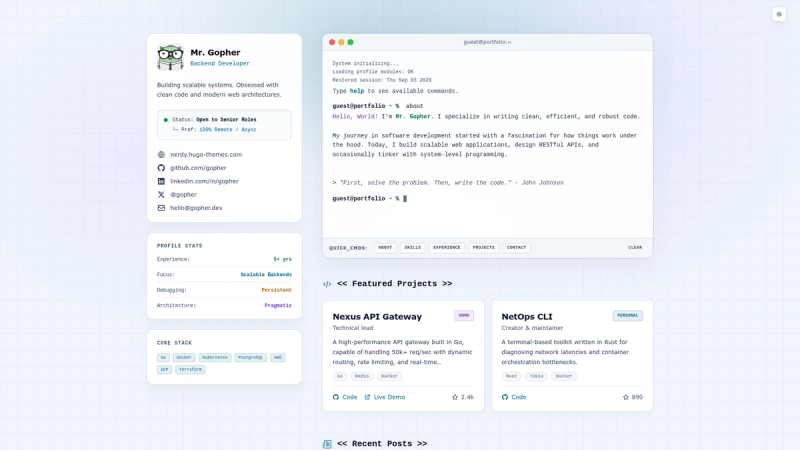
Nerdy is a nerd-vibed Hugo theme for personal portfolios and blogs, made for developers who want an interactive terminal-style introduction on their site.
What is Nerdy?
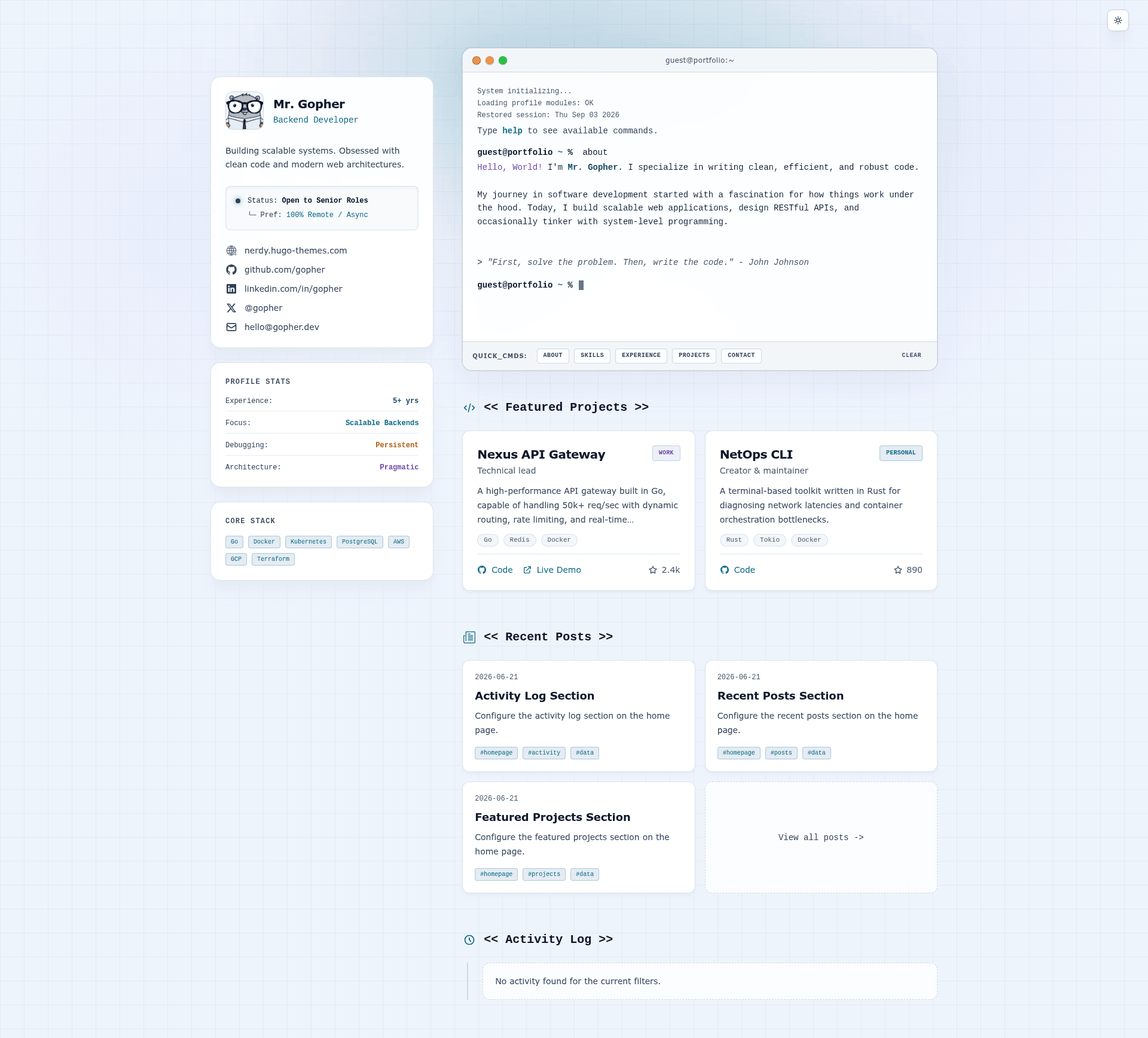
Nerdy is a Hugo theme specifically designed for personal portfolios and blogs that want a "nerd" or developer-oriented look. It takes Markdown content and data files as input and outputs a static site with an interactive terminal, a card-style sidebar, and light/dark modes. The theme is distributed as a Hugo Module from the github.com/hugo-themes/nerdy repository and includes a demo/documentation site at https://nerdy.hugo-themes.com.
Key Features
Nerdy's main features center on an interactive homepage, structured content organization, and Tailwind-based styling. The full list:
- Interactive terminal — A terminal-style component on the homepage lets visitors explore the author by typing commands, pulling answers from data-driven config.
- Card-style sidebar — Gives an at-a-glance author overview with avatar, bio, and key links, so visitors don't have to hunt for context.
- Grouped posts — Posts can be organized by subject, topic, and series, which is useful for tech tutorials or serialized writing.
- Data-driven configuration — Author details and site settings are stored in data files, meaning customization rarely requires editing template code.
- Light and dark themes — A toggle switches between light and dark color schemes on the same static page.
- Hugo Module install — The theme can be pulled into any Hugo project by declaring
github.com/hugo-themes/nerdyin the module imports. - Tailwind CSS + Alpine.js — Styling uses Tailwind CSS while interactivity like the terminal and theme toggle uses Alpine.js; Hugo build stats are enabled so Tailwind can see generated classes.
Who is Nerdy for?
Nerdy is aimed at developers, programmers, and other tech-minded people who maintain a personal portfolio or blog. A developer can use the interactive terminal to showcase projects and command-line skills. A technical blogger can organize tutorials into topic and series taxonomies. A Hugo user learning theming can treat the bundled exampleSite/ as a reference for data-driven Hugo Modules.
What can you do with Nerdy?
Nerdy lets you publish a personal site that feels like a command-line environment. Some concrete applications:
- Developer portfolio: Present your skills and projects through an interactive terminal on the homepage, letting visitors type commands to see details.
- Tech blog: Write posts in Markdown and rely on subject, topic, and series grouping to keep long-running content organized.
- Theme documentation: Use the same structure as Nerdy's own demo site, where documentation posts inside
exampleSite/document every configuration option.
How does Nerdy work?
Nerdy uses a Node.js asset pipeline in front of Hugo's static site generation. After cloning the repository, run npm install and then npm run server to start a live server at https://nerdy.localhost through Portless. Before Tailwind compiles the final CSS, an in-memory Hugo pass creates hugo_stats.json. If you want to bypass Portless, npm run server:local serves the site directly on http://localhost:1313.
Pricing
Nerdy is free and open source, released under the MIT License.
FAQ
Is Nerdy free?
Yes, Nerdy is released under the MIT License, so you can use it at no cost for personal or commercial projects.
What versions of Hugo and Node.js do I need?
Nerdy requires Hugo 0.162.1 or newer and Node.js 24 or newer plus npm. Go is also needed because the theme uses Hugo Modules.
How do I run Nerdy locally without Portless?
Run npm run server:local from the repository root. Hugo will serve the site at http://localhost:1313, skipping the Portless HTTPS proxy used by the default npm run server command.
Does Nerdy support dark mode?
Yes, Nerdy includes both light and dark theme options, with a toggle built into the interface.
Where can I see a demo and documentation?
The live demo and full documentation site are available at https://nerdy.hugo-themes.com. The demo site is generated from the bundled exampleSite/ directory.