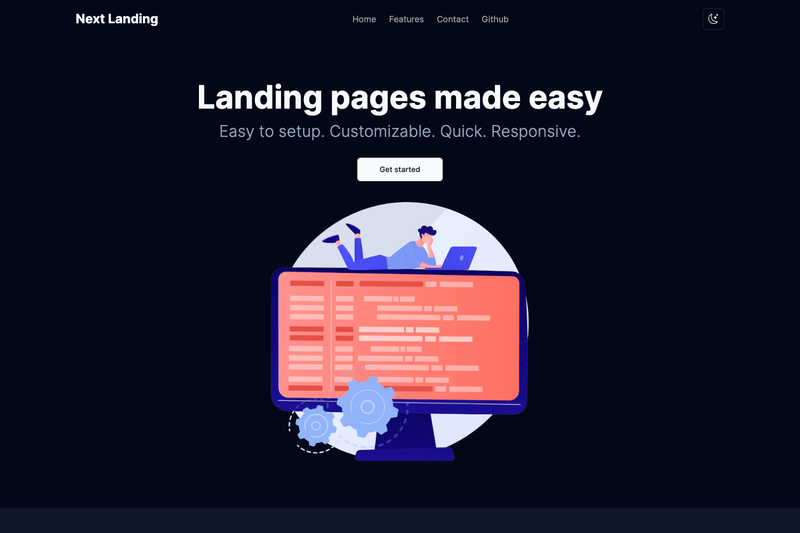
Next Shadcn Landing is a free, MIT-licensed landing page starter built with Next.js and shadcn/ui that scaffolds a responsive marketing site from one command. The project targets developers who want a minimal, configuration-driven starting point rather than a full multi-page website.
What is Next Shadcn Landing?
Next Shadcn Landing is a landing page starter template that takes a fresh Next.js App Router project scaffolded via degit and produces a customizable one-page marketing website. It runs on the Next.js framework using the /app directory for routing and layout, and it uses shadcn/ui for UI components. The template is maintained on GitHub by redpangilinan, with a live preview hosted at nextlanding.rdev.pro.
Key Features
- Next.js App Router — built on the modern
/appfolder structure, with layout and routes modified in the/appdirectory. - shadcn/ui components — UI primitives from shadcn/ui, which use Tailwind CSS for styling, are copied into your project and fully editable.
- Centralized configuration — website content and site settings are edited in the
/configfolder, keeping copy separate from component code. - One-command scaffolding —
npx degit redpangilinan/next-shadcn-landing my-appor the pnpm equivalent clones the entire starter without git history in a single command. - Responsive design — the README describes the result as quick and responsive, so the default landing layout adapts to different screen sizes.
- Vercel deployment — designed to deploy to the Vercel Platform using the standard Next.js deployment process documented in the README.
- MIT License — the project is released under an MIT License, so it can be reused commercially and modified freely.
Who is it for?
Developers launching side projects need a landing page they can put online quickly, and this starter gives them a working Next.js page they can run locally within minutes. Freelancers and agencies can use it as a clean baseline for client marketing pages, then customize the config folder and navigation instead of building from scratch. Developers learning shadcn/ui benefit from seeing a minimal integration of shadcn/ui with Next.js App Router in a real project.
What can you do with it?
- Side-project developers: scaffold the app, edit the content inside the
/configfolder, and deploy to Vercel to get a live product landing page in one session. - Startup founders: use it as a rapid starting point for a responsive marketing site and change the navigation links in
lib/links.tswithout touching page components. - Frontend developers: inspect a small, readable codebase that combines Next.js App Router, Tailwind styling, and shadcn/ui to learn how the pieces fit together.
How does Next Shadcn Landing work?
The README walks through a four-step setup: first, scaffold a new project by running either npx degit redpangilinan/next-shadcn-landing my-app or the pnpm equivalent; second, change the name field in package.json from next-shadcn-landing to my-app; third, install dependencies with npm install or pnpm install; and fourth, run npm run dev and open http://localhost:3000. After that, content edits happen in /config, routing changes happen in /app, and navigation links are edited in lib/links.ts.
Pricing
Next Shadcn Landing is free. It is released under the MIT License, so there are no licensing fees for personal or commercial use.
FAQ
Is Next Shadcn Landing free?
Yes. The repository is licensed under the MIT License, and the README includes a link to the MIT License for full terms. This means you can use and modify it without paying a license fee.
How do I change the navigation links?
Open the lib/links.ts file in the project root and edit the link definitions there. The README explicitly calls out this file as the place to modify navigation links.
How do I deploy Next Shadcn Landing to Vercel?
Connect the repository to Vercel and use the standard Next.js deployment flow. The README links to the Vercel Platform and to the Next.js deployment documentation, and the starter is structured as a standard Next.js app so no special configuration is required.
Which package managers are supported?
The setup instructions in the README cover both npm and pnpm. There are equivalent commands for scaffolding, installing dependencies, and running the dev server with either package manager.
What should I edit after scaffolding?
Change the project name in package.json, then customize content and site settings in the /config folder, adjust layout and routes in the /app folder, and update navigation links in lib/links.ts. The README lists all three locations.