
Template details
NovusAI SaaS
AI-native multi-tenant SaaS development framework built with FastAPI, Vue 3, and PostgreSQL, featuring AI agents, RAG, plugins, RBAC, and async tasks.
About this template
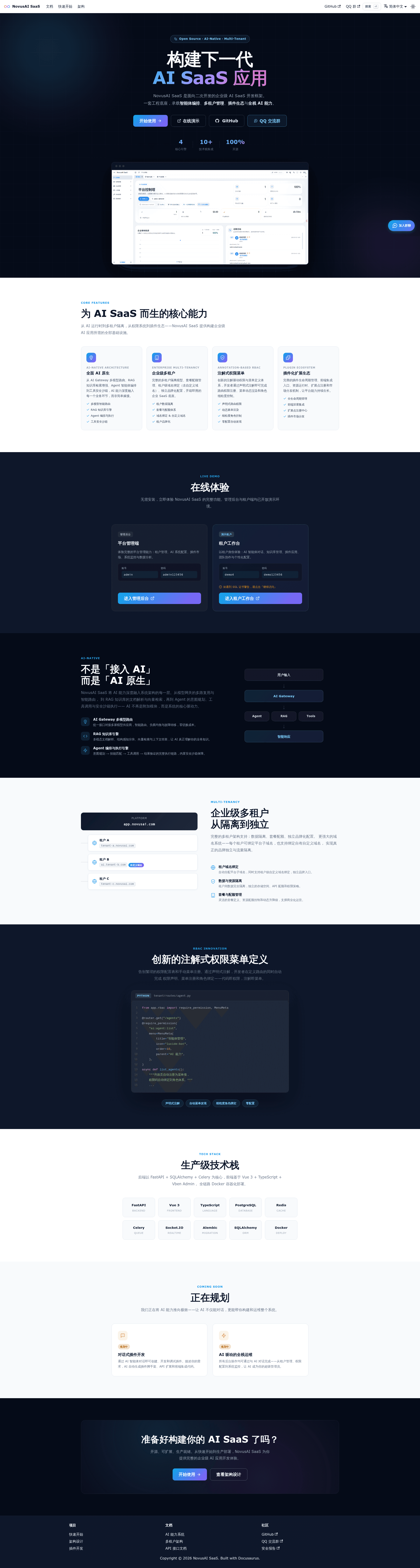
NovusAI SaaS is a multi-tenant AI SaaS development framework that provides a complete starter template for building enterprise-grade applications with FastAPI, Vue 3, and PostgreSQL.
What is NovusAI SaaS?
NovusAI SaaS is a full-stack, multi-tenant SaaS development framework that ships with separate admin, tenant, and user applications, a FastAPI backend, and a Vue 3 frontend. It provides production-oriented building blocks such as RBAC, an AI Agent pipeline, a plugin system, Socket.IO notifications, and Alembic migrations. The framework is designed for secondary development, letting teams extend the codebase rather than start from scratch. It is open-sourced under the MIT License.
Key Features
NovusAI SaaS bundles eight production-ready capabilities that cover the full application lifecycle, from multi-tenant access control to AI agents and code generation.
- Multi-tenant three-end architecture — Admin, tenant, and user apps ship with isolated routes, menus, permissions, and API namespaces.
- AI Agent runtime with RAG — An Agent → Skill → AIGateway chain includes an extensible knowledge base, tool calling, and OpenAI SDK integration.
- Plugin system — Supports backend plugins, frontend plugin entry points, plugin menus, resources, lifecycle hooks, and extension points.
- RBAC and audit — Role-based access control, menu and data permissions, organization boundaries, and operation audit are built in.
- Real-time notifications — Socket.IO delivers notifications and real-time events across admin, tenant, and user surfaces.
- Async tasks with Celery — Celery and Redis handle background jobs, scheduled tasks, and long-running workflows.
- CRUD code generation — Generates admin CRUD code and tracks generated artifacts in
codegen_manifest.jsonfor rollback. - Technology stack — Backend: Python 3.10+, FastAPI, SQLAlchemy 2.x, Alembic, Pydantic, Celery, Socket.IO; Frontend: Vue 3, TypeScript, Vben Admin, Ant Design Vue, Vite, pnpm, vue-i18n; PostgreSQL and Redis with optional pgvector.
Who is it for?
NovusAI SaaS suits teams that want a running multi-tenant SaaS base with built-in AI and plugin infrastructure rather than assembling these systems themselves.
- SaaS startups — Bootstrap a multi-tenant product with ready-made admin, tenant, and user portals instead of building auth, RBAC, and tenancy from scratch.
- AI product teams — Extend the built-in Agent, Skill, and AIGateway chain to add domain-specific AI agents and RAG pipelines.
- Enterprise developers — Build industry SaaS applications on a codebase that includes plugin architecture, async tasks, and production deployment references.
- Full-stack developers — Customize the FastAPI backend or Vue 3 frontend using the CRUD generator and pnpm monorepo structure.
What can you do with NovusAI SaaS?
With NovusAI SaaS you can move directly from a fresh clone to a customized multi-tenant product, an AI business system, or a plugin ecosystem.
- Launch a white-label SaaS — Set up platform, tenant, and user surfaces with separate permissions and branding, then sell subscriptions to multiple organizations.
- Build an AI-native business system — Wire the Agent runtime to your own models, skills, and knowledge bases to add conversational or automated workflows.
- Create a plugin ecosystem — Develop plugins that extend backend APIs and frontend menus without touching core code.
- Generate admin panels quickly — Use the CRUD code generator and rollback manifest to scaffold management pages for new database tables.
How does NovusAI SaaS work?
After cloning the repository, copy the backend environment example, then start PostgreSQL and Redis with docker compose -f docker-compose.dev.yml up -d postgres redis. Run novusai db upgrade head and novusai run --reload in the backend, start a Celery worker with novusai celery dev, and launch the frontend with pnpm dev:antd. A Docker Compose full-stack option builds every service in containers for quick evaluation.
Pros and cons
Pros:
- Open-sourced under MIT License with no vendor lock-in.
- Covers admin, tenant, and user portals with RBAC, plugins, AI runtime, and async tasks out of the box.
- Includes both source development and Docker Compose deployment references.
Cons:
- The first Docker full-stack build takes about 5 to 10 minutes because frontend
pnpm installis time-consuming. - The default
admincredentials are insecure and must be changed immediately in production.
FAQ
What tech stack does NovusAI SaaS use?
NovusAI SaaS uses a FastAPI backend with SQLAlchemy 2.x, Alembic, Pydantic, Celery, and Socket.IO, and a Vue 3 frontend with TypeScript, Vben Admin, Ant Design Vue, and Vite. PostgreSQL and Redis serve as the database and cache, with optional pgvector for vector search.
Is NovusAI SaaS free?
Yes, NovusAI SaaS is open source and released under the MIT License. You can freely use, modify, and distribute it, including for commercial products, with no license fees.
What is the default admin account?
The initial migration creates a platform super administrator with username admin, password admin123456, and email admin@novusai.com. This default account is only for local development and initial testing; change the password immediately after deploying to production.
How do I run the project locally?
Start PostgreSQL and Redis with Docker Compose, copy the backend environment example, then run novusai db upgrade head and novusai run --reload in the backend. In another terminal start the Celery worker, and in the frontend directory run pnpm install and pnpm dev:antd. The web app will be available at http://localhost:5666.