RealEstate is a Next.js boilerplate template that demonstrates a full-stack real estate listing platform, pairing MongoDB Atlas for data persistence with Firebase Storage for image uploads. Built by developer cvrlnolan, the project is a learning-oriented quickstart for integrating Next.js with MongoDB and covers the real-world flow of adding properties to a database and rendering those listings to users.
What is RealEstate?
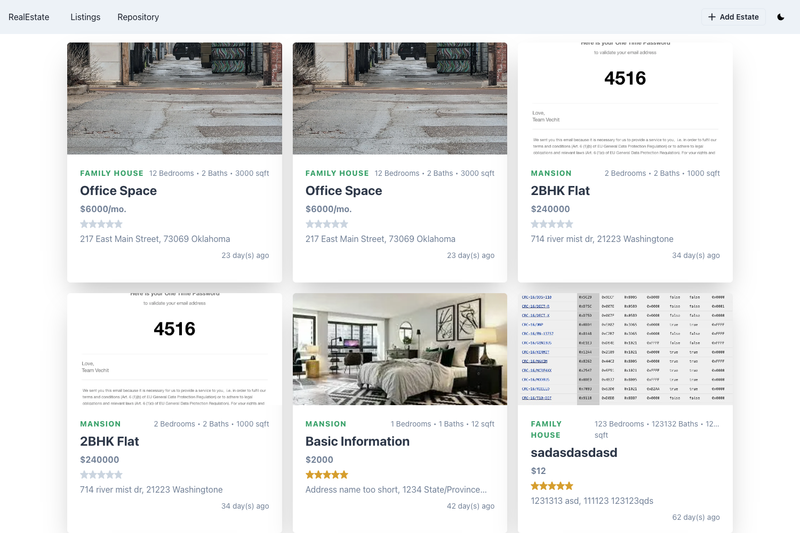
RealEstate is an open-source template application built with Next.js that models a real estate marketplace. It takes property data submitted through React Hook Form forms, stores it in MongoDB Atlas via Next.js API routes (serverless functions), and displays the saved listings to visitors. The template also handles image uploads through Firebase Storage, compressing images client-side with Compressorjs before uploading. The application follows an MVC architecture, with view pages under the pages folder and backend logic in pages/api.
Key Features
- Next.js full-stack structure — Uses the pages router with both UI views and API serverless functions in the same repository, so frontend and backend stay colocated.
- MongoDB Atlas integration — The
mongodbfolder exports a client variable that establishes connections to a MongoDB Atlas cluster, letting you insert and query property records. - Firebase Storage uploads — The
firebasefolder contains initialization configs and the logic to upload property images, with client-side compression via Compressorjs to reduce file sizes before upload. - Form handling with react-hook-form — Lightweight JavaScript form validation and data capture for the estate creation flow.
- Reactive data fetching with SWR — Client-side data fetching and revalidation keeps the listings UI reactive when new estates are added.
- Chakra UI component library — The front end uses Chakra UI for styled, accessible React components instead of hand-rolled CSS.
- Rating component — Integrates react-simple-star-rating to let users rate properties with a styled star-rating UI.
- Testing setup — Includes Jest and Testing Library with unit tests for major components; run them with
yarn test index.
Who is it for?
RealEstate is aimed at developers who want a starter foundation for Next.js and MongoDB projects. It suits:
- Full-stack JavaScript developers — Learn how to structure a Next.js app with API routes, MongoDB connections, and file storage in a realistic model.
- Students or self-taught coders — Use the repository as a practice ground to study MVC patterns, serverless functions, and third-party service integration.
- Hackathon or MVP builders — Clone the repo to get a property-listing CRUD app skeleton running quickly, then expand it with extra features.
What can you do with RealEstate?
- Add property listings — Fill out a form that validates input with react-hook-form, upload property images to Firebase Storage, and save the estate record to MongoDB Atlas.
- Display listings to users — Browse the saved estates on the front end, with SWR revalidation so newly inserted properties appear without a manual refresh.
- Test major components — Run the included Jest unit tests to verify the UI renders correctly, then extend the test suite for new components.
- Deploy to Vercel — Push the GitHub repository to Vercel for an integrated deployment pipeline suited to Next.js apps.
How does RealEstate work?
The repository provides setup steps in its README. First, clone the repository and configure a .env file with Firebase and MongoDB Atlas credentials. Then install dependencies with npm install or yarn install, and start the development server with npm run dev — the app launches at http://localhost:3000. Tests are executed with yarn test followed by a test name.
The project includes inline comments throughout the source to explain how important modules work, and the code quality was checked with JSLint.
FAQ
How do I install RealEstate?
Clone the repository, create a .env file with your Firebase and MongoDB Atlas credentials, install dependencies with npm install or yarn install, and run npm run dev to start the development server at http://localhost:3000.
What services does RealEstate integrate with?
The template integrates MongoDB Atlas for database storage, Firebase Storage for image uploads, Next.js API routes for backend logic, and Chakra UI for styling. Additional libraries include axios, SWR, react-hook-form, Compressorjs, moment, and react-simple-star-rating.
Can I expand RealEstate beyond the base features?
Yes, the README describes the project as a flexible foundation. The code is structured with inline comments, and the roadmap mentions adding new features. You can extend the template with additional web technologies or services to suit your own requirements.