
Template details
Tiny Rocket
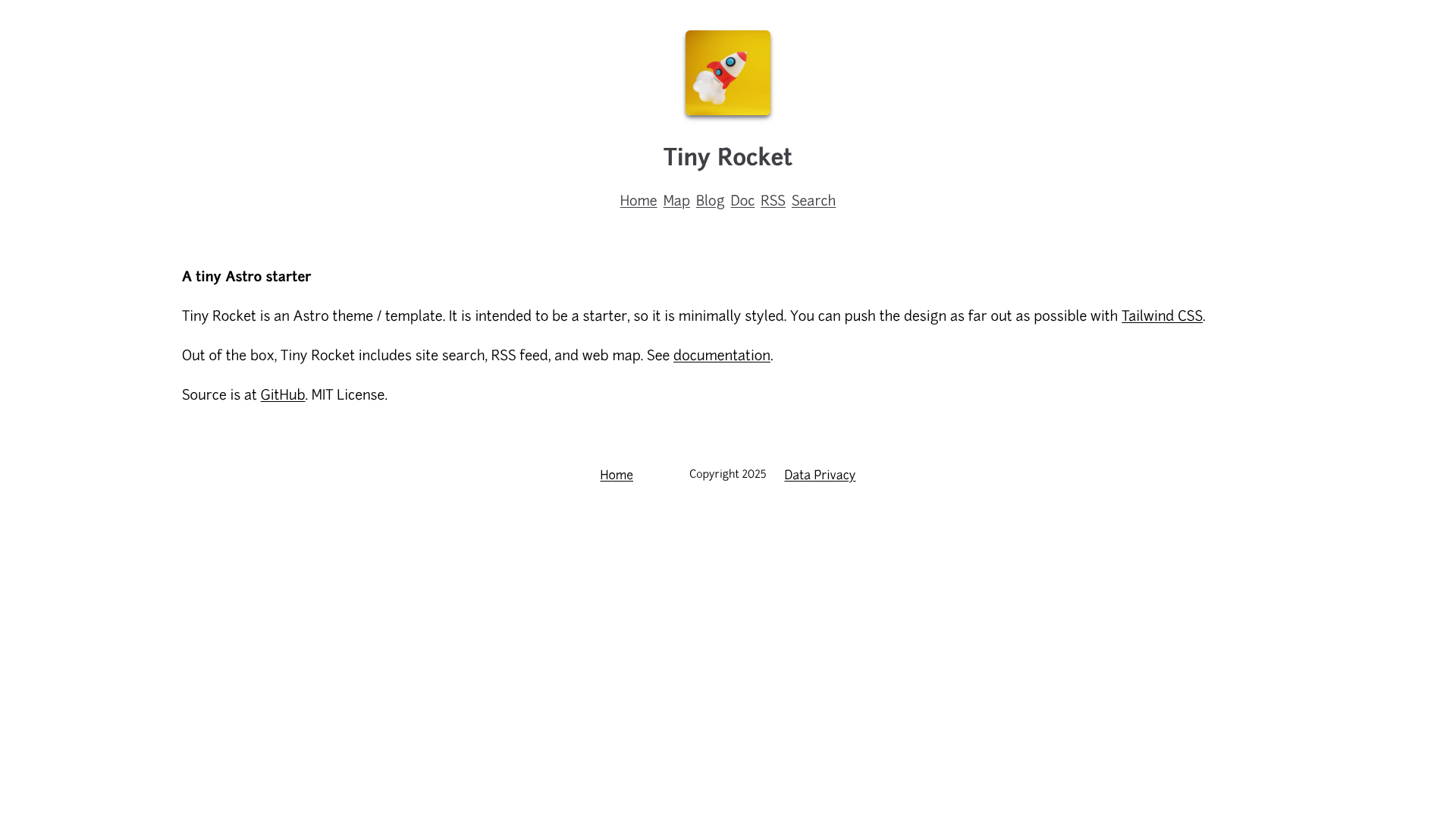
A minimal Astro starter theme for company or personal websites with a blog, styled with Tailwind CSS.
About this template
Tiny Rocket is an Astro starter theme for building a company or personal website with a blog, styled with Tailwind CSS and designed to keep client-side JavaScript to a minimum.
What is Tiny Rocket?
Tiny Rocket is a starter theme (boilerplate) for Astro, a static site generator. It takes Markdown and MDX content as input and produces a static website with a blog, RSS feed, sitemap, search, and a geolocation map. The theme was designed around minimizing JS dependency: JavaScript is only required for the search and the map, making the rest of the site static and fast. The repository ships with preconfigured pages including a home page (index.astro), about page (about.mdx), documentation page (doc.mdx), privacy policy (privacy.mdx), a 404 page, map.astro, and search.astro, plus an rss.xml.ts generator.
Key Features
- Designed for company and personal sites — The layout fits both a business website with a blog and a simple personal website, with Markdown support through .mdx files.
- Tailwind CSS styling — The visual style is customizable using Tailwind CSS utility classes, and the project includes a Tailwind setup in astro.config.mjs.
- Client-side search with Pagefind — A search page (search.astro) uses the lightweight client-side search library pagefind.app, requiring JS only for that page.
- RSS feed generation — An rss.xml.ts file generates an RSS feed for the blog, letting readers subscribe to new posts.
- Sitemap generation — The theme automatically generates sitemap.xml for search engine indexing.
- Web map / geolocation — A map.astro page integrates Leaflet (via the public/_leaflet folder) for displaying a web map with geolocation.
- View transitions — Built-in support for Astro's View Transitions API for smooth page transitions.
- Minimal JavaScript — Only the search and map pages require client-side JS; the rest of the site renders as static HTML.
Who is it for?
- Companies that need a brochure-style website with a blog and want a minimal, fast static site.
- Personal bloggers who want a simple, customizable site with RSS and search without heavy JavaScript.
- Developers who prefer Astro and Tailwind CSS and want a ready-made starting point with map and search included.
What can you do with it?
- Add blog posts by writing Markdown or MDX files in the contents directory; the theme generates pages, RSS, and sitemap automatically.
- Customize the design using Tailwind CSS utility classes without touching JavaScript logic.
- Add a location map by editing the map page that uses Leaflet.
- Deploy to any static host — because Astro outputs static HTML, the built site can be deployed to any static hosting service.
How does it work?
Tiny Rocket is an Astro project. You write content as Markdown/MDX in the contents folder, and Astro builds static pages from the components and layouts in src. The configuration in astro.config.mjs defines the Tailwind CSS integration, sitemap, and RSS behavior. Running the build command produces a dist folder ready to deploy.
FAQ
Is Tiny Rocket free?
Tiny Rocket is hosted in a public GitHub repository (26 stars per the page metadata). The theme itself is provided as a starter template, and no commercial pricing is mentioned in the documentation.
Does Tiny Rocket require JavaScript on every page?
No, JavaScript is only used for the search page (via Pagefind) and the map page (via Leaflet). The rest of the site is static HTML.
Can I use Tiny Rocket for a personal blog?
Yes, the theme is described as simple enough for a personal website and/or blog, with Markdown support and RSS generation.
Does Tiny Rocket include a map feature?
Yes, it includes a map.astro page that uses Leaflet for web map/geolocation, and the public folder contains the _leaflet assets.
What is the project structure?
The theme includes public/ for static assets (_leaflet, robots.txt, favicon.ico) and src/ with components, contents, layouts, and pages. Key pages are index.astro, about.mdx, doc.mdx, blog/, 404.astro, and search.astro.