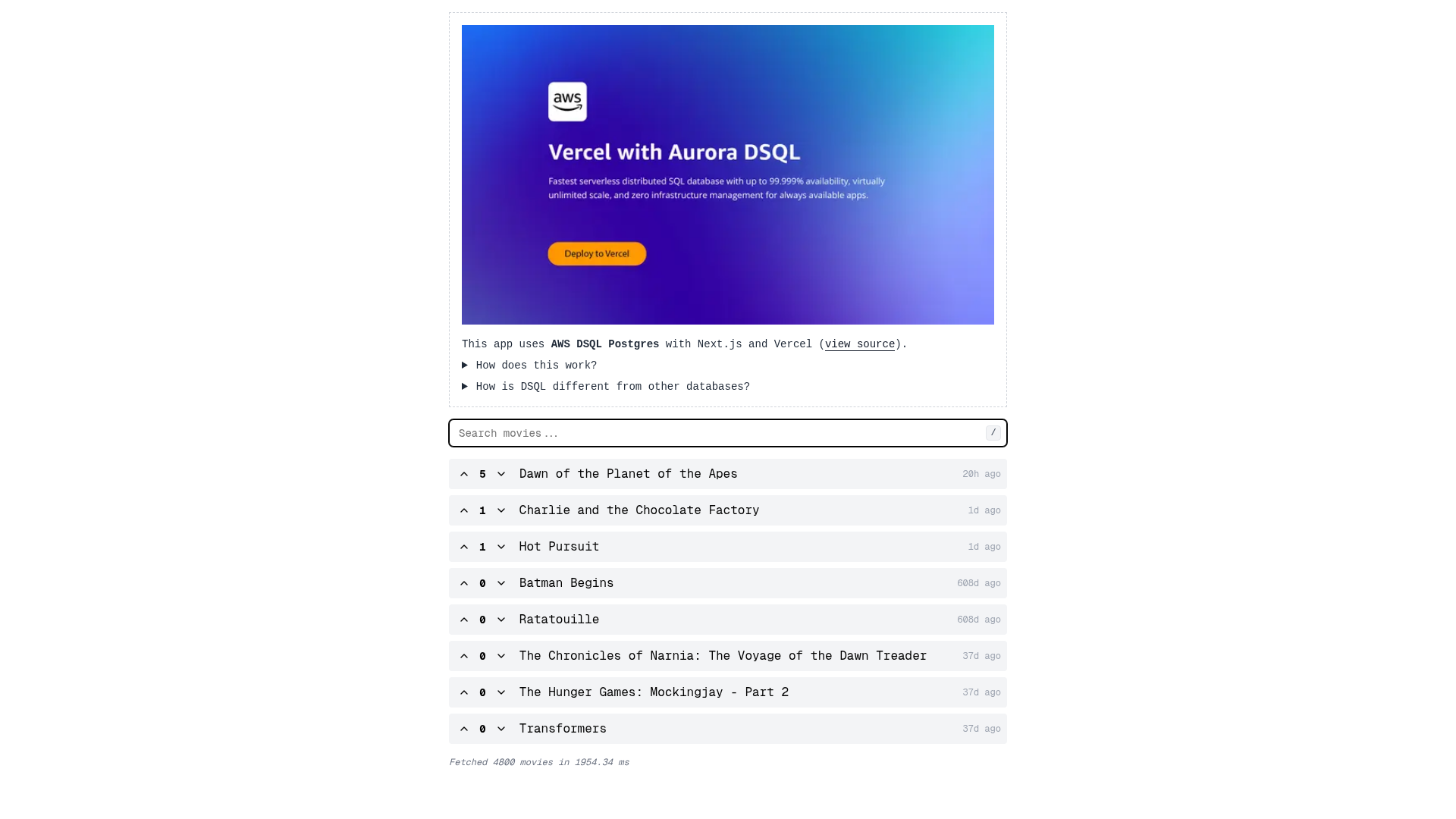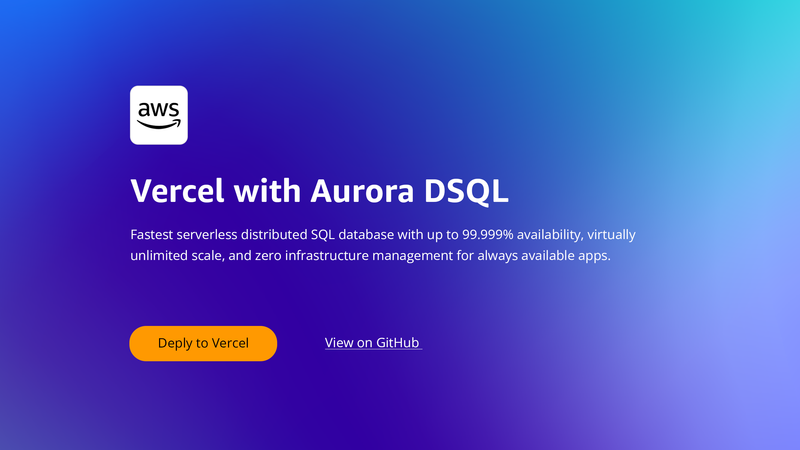
The AWS Aurora DQSL Movies Demo is a boilerplate project that shows how to build a Next.js application on Vercel that securely connects to an AWS Aurora DSQL Postgres database without hardcoded credentials.
What is the AWS Aurora DQSL Movies Demo?
The AWS Aurora DQSL Movies Demo is a sample application built with Next.js that fetches movie records from an Aurora DSQL Postgres database. It runs on Vercel and is provided by Vercel Labs, with a live demo at https://aws-dsql-movies-demo.labs.vercel.dev. Its purpose is to demonstrate how Vercel's OIDC Federation enables a serverless app to authenticate with AWS DSQL dynamically, eliminating the need to store access tokens in configuration files.
Key Features
- One-click Deploy with Vercel — Clicking the Deploy button in the README clones the GitHub repository, creates a new Vercel project, sets up the AWS integration, and provisions a DSQL database in a single flow.
- OIDC Federation for secure access — The app connects to DSQL using Vercel's OIDC Federation, meaning AWS credentials are issued on-demand instead of being hardcoded in the codebase.
- Next.js frontend — The movie listing interface is rendered with Next.js and deployed on Vercel, with a public demo available at https://aws-dsql-movies-demo.labs.vercel.dev.
- Local development workflow — Developers can run
vercel env pullto fetch environment variables,pnpm installto install dependencies, and usepnpm run db:migrateandpnpm run db:seedto create and populate the movie tables. - Aurora DSQL via Vercel Marketplace — Aurora DSQL is installed from the Vercel Marketplace, which means the database is provisioned as part of the standard Vercel deployment experience.
- Seeded movie dataset — The database includes seed data for movies, allowing immediate testing of queries without requiring external data.
Who is it for?
Developers who want a working reference for integrating Vercel, Next.js, and AWS Aurora DSQL will find this template useful. It's also for teams evaluating Aurora DSQL who need a concrete example of secure authentication, and for those learning how Vercel's OIDC Federation can replace long-lived database secrets.
What can you do with it?
- Full-stack developers: Deploy a complete Next.js and Aurora DSQL stack in minutes by clicking the Vercel Deploy button, then clone the generated repository to work on it locally.
- Platform engineers: Study how the OIDC Federation claim allows a Vercel deployment to obtain short-lived AWS credentials, and reuse that pattern for other AWS-backed services.
- Database evaluation teams: Use the seeded movie dataset to run performance or compatibility tests against Aurora DSQL without first building a project scaffold.
How does it work?
The deployment flow starts when you click the Deploy button in the repository README. That action clones the repo, creates a Vercel project, installs the AWS integration, and provisions an Aurora DSQL database. After that, you can work locally by pulling environment variables with vercel env pull, running pnpm install, then pnpm run db:migrate to create the schema, pnpm run db:seed to load movie data, and finally pnpm run dev to start the Next.js development server.