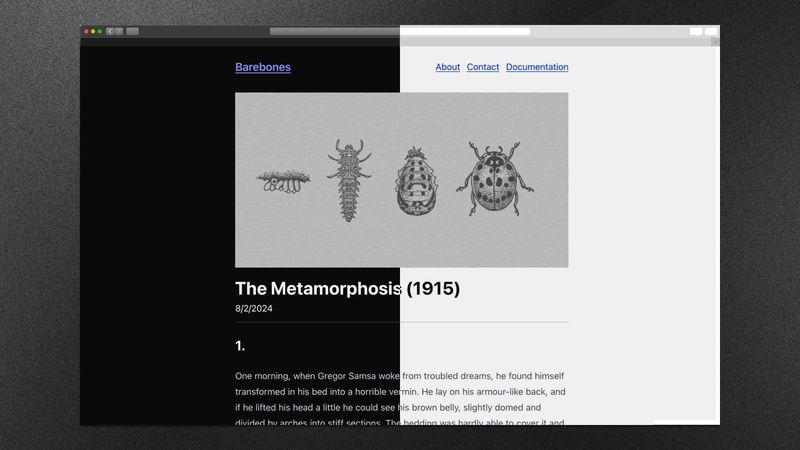
Barebones is an open-source blog starter template built for Astro that turns Markdown content into a static website styled with Tailwind CSS, without adding any client-side JavaScript framework.
What is Barebones?
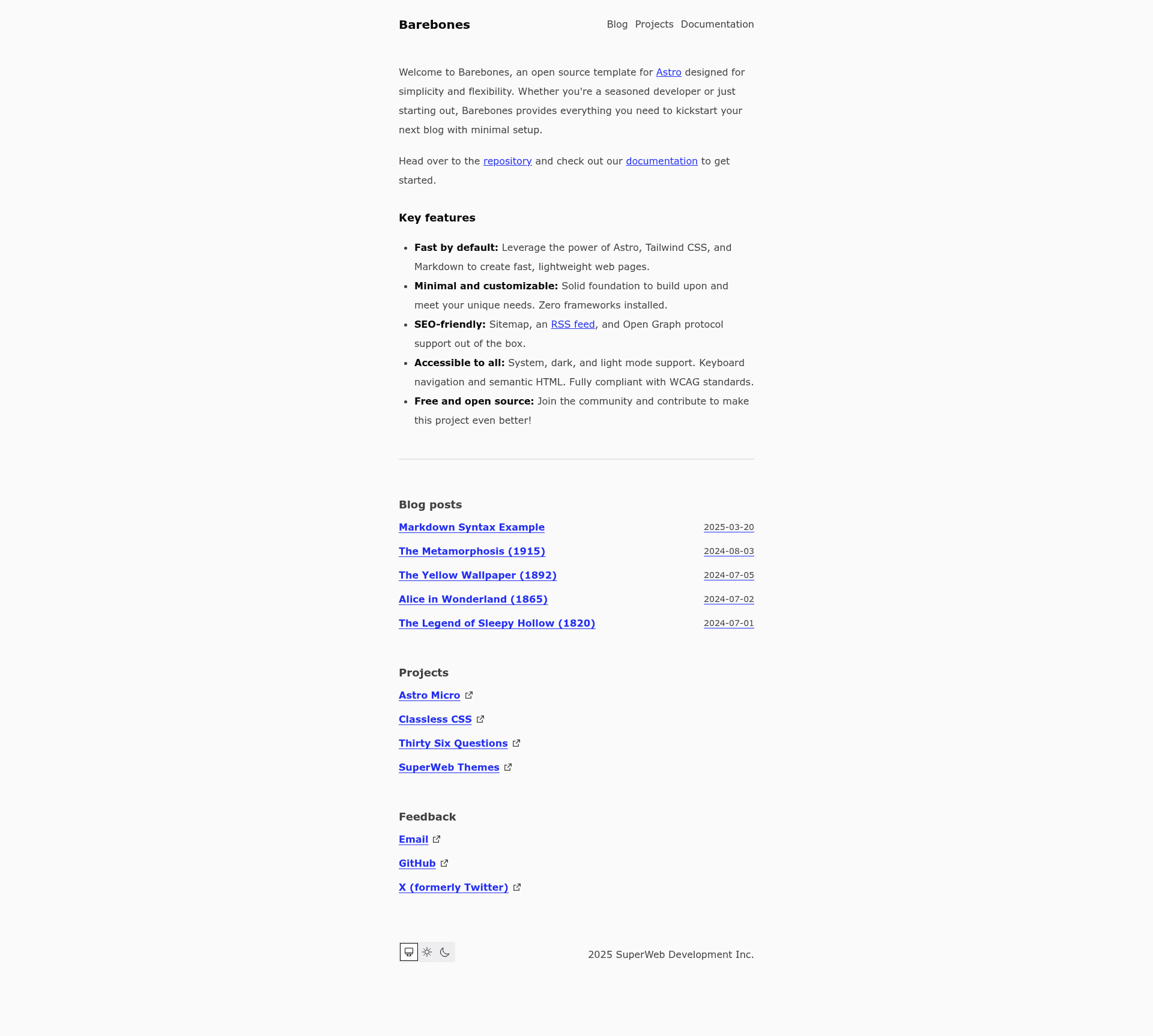
Barebones is an ultra-minimalistic starter template created by Trevor Tyler Lee for building blogs with Astro. It takes Markdown files as input and generates a static website as output, with SEO and accessibility features included by default. The template runs on the Astro framework, uses Tailwind CSS for styling, and includes a live demo and documentation at barebones.trevortylerlee.com.
Key Features
Barebones combines speed, minimalism, SEO support, and accessibility in a single starter kit. The specific features are:
- Fast by default — Uses Astro's static site generation with Tailwind CSS and Markdown to output lightweight pages that avoid heavy client-side JavaScript.
- Minimal and customizable — Provides a solid base with zero frameworks installed, so you can add React, Vue, or Svelte only if your project needs them.
- SEO-friendly — Ships with sitemap generation, an RSS feed at /rss.xml, and Open Graph protocol support for social sharing.
- Accessible to all — Includes system, dark, and light mode support, plus keyboard navigation and semantic HTML for assistive technologies.
- Free and open source — Released as an open-source project on GitHub under trevortylerlee/barebones, so you can use, modify, and contribute to it freely.
Who should use Barebones?
Barebones suits developers who want a clean Astro blog without framework complexity, and people who prioritize Core Web Vitals. The main audiences are:
- Developers starting a blog — Set up a blog quickly by cloning the template and writing Markdown posts without learning a complex framework.
- Astro learners — Beginners can study a minimal Astro project that uses Tailwind CSS and Markdown to understand the core concepts.
- Performance-focused site owners — People who need a small, fast site with 100 scores in Core Web Vitals for Performance, Accessibility, Best Practices, and SEO.
What can you do with Barebones?
You can launch a personal blog, customize its design, and deploy the static output anywhere. Specific uses include:
- Launch a personal blog — Write entries in Markdown and publish them with a minimal, accessible layout.
- Customize the design — Since it uses Tailwind CSS, you can adjust colors, spacing, and typography by editing the Tailwind config or stylesheets.
- Deploy to any static host — Run npm run build to produce a static site in ./dist/ that can be served from any static hosting service.
How does Barebones work?
You operate Barebones from the command line using npm scripts. After installing dependencies, you run the dev server, write Markdown, and build the production site.
- Run
npm installto install dependencies. - Use
npm run devto start a local development server at localhost:4321. - Write Markdown content in the source folders.
- Run
npm run buildto generate the production site into ./dist/. - Preview the build locally with
npm run previewbefore deployment.
FAQ
Is Barebones free?
Yes, Barebones is free and open source. It is hosted on GitHub at trevortylerlee/barebones and is released under an open-source license, meaning anyone can use, modify, and contribute to it.
What frameworks does Barebones use?
Barebones uses Astro as its static site generator and Tailwind CSS for styling. It has zero client-side frameworks installed, so no React, Vue, or Svelte runtime is included unless you add it yourself.
Does Barebones include an RSS feed?
Yes, Barebones includes RSS feed support out of the box. An RSS feed is available at /rss.xml, which is useful for readers who subscribe to blog updates.
What are the Core Web Vitals scores?
The Barebones demo site reports 100 in all four Core Web Vitals categories: Performance, Accessibility, Best Practices, and SEO. These scores reflect the template's lightweight and accessible default setup.