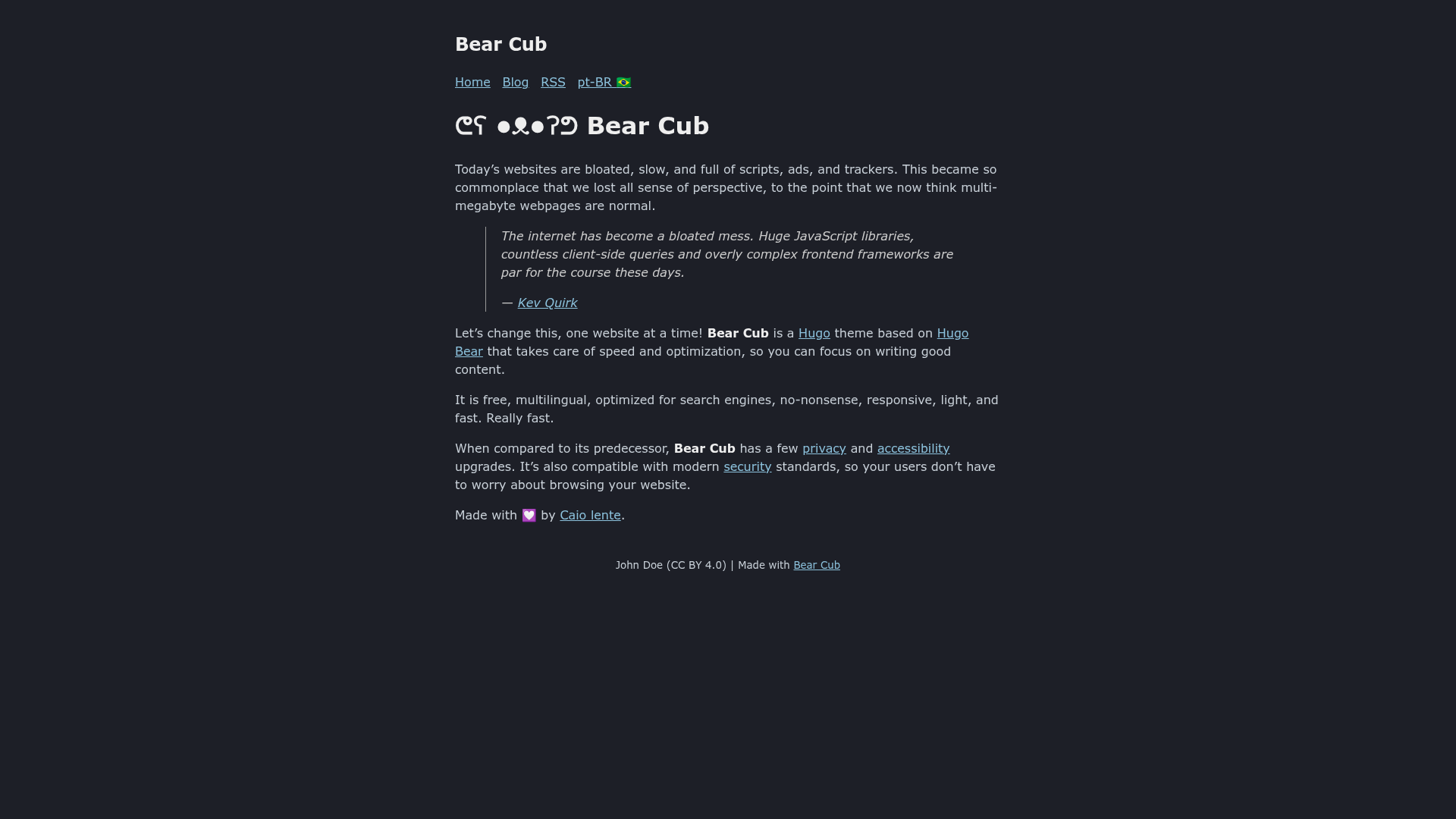
Bear Cub is a free, open-source Hugo theme that creates lightweight, fast-loading static blogs with no JavaScript, no trackers, and optional multilingual support. It is a fork-inspired variant of Bear Blog and Hugo Bear Blog, maintained by clente on GitHub.
What is Bear Cub?
Bear Cub is a Hugo theme that takes your Hugo site content and outputs a static website optimized for speed and accessibility. It is free and open source under the MIT license. The theme produces pages around 5kb, passes Google's PageSpeed test, and is designed to be responsive and readable on any device. It runs on Hugo's static site generator and is written to work with Hugo's TOML configuration.
Key Features
- Tiny output — Pages are roughly 5kb with no trackers, ads, or external scripts.
- Zero JavaScript and no inline styles — The theme uses no JavaScript at all and no inline CSS, which helps with Content Security Policy compliance and Mozilla Observatory security scores.
- Accessible color palette and tap targets — Overhauled contrast for low-vision users and larger interactive elements for motor impairments, plus a keyboard-focusable skip link.
- Multilingual support — Built-in translation button that can be disabled or hidden; sample configuration for English and Portuguese in the demo.
- Full-text RSS feed — Automatically generated feed that includes properly encoded full post content.
- Dynamic social cards — When a post lacks preview images, the theme generates a social card from the title via the
generateSocialCardparameter. - Reply by email — Adds a reply button to the footer of every post when an author email is set, with per-post suppression via
hideReply. - Static content links — Posts can link to static files using front matter, and blank pages can be suppressed with
render: false.
Who is it for?
- Independent bloggers seeking a fast, minimalist site without trackers or scripts.
- Developers using Hugo who want a well-documented theme with straightforward TOML configuration.
- Multilingual writers who need a theme with built-in language switching.
- Accessibility-conscious publishers who need contrast-friendly colors, larger tap targets, and keyboard navigation support.
What can you do with Bear Cub?
- Personal bloggers: publish posts that compile into tiny static pages with full-text RSS for distribution.
- Technical writers: use Hugo's shortcodes, including a custom
absfigureshortcode that converts relative image URLs to absolute. - Organizations concerned with security: deploy with Netlify or Cloudflare Pages headers to improve Mozilla Observatory scores.
How does Bear Cub work?
Installation follows Hugo's quick start: create a site, add the theme as a Git submodule with git submodule add, and append theme = "hugo-bearcub" to the site config. Configuration happens in hugo.toml, where you can set baseURL, copyright, multilingual languages, and experimental parameters like themeStyle and generateSocialCard.
Pricing
Bear Cub is free and open source under the MIT license.
Alternatives
- Bear Blog — the original lightweight blogging platform that Bear Cub draws inspiration from.
- Hugo Bear Blog — the predecessor Hugo theme Bear Cub is based on.
FAQ
Is Bear Cub free?
Yes, Bear Cub is free and distributed under the MIT license. You can use it for personal or commercial projects without paying, and you can modify it.
Does Bear Cub require JavaScript?
No. Bear Cub uses zero JavaScript in its theme, relying on pure CSS and HTML. This helps with page speed and security, and it means your blog works without client-side scripting.
Can I write my blog in multiple languages?
Yes. Bear Cub has built-in multilingual support. You configure multiple languages in hugo.toml under [languages], and the theme displays a translation button unless you set hideUntranslated = true.
What are the experimental features?
Bear Cub includes experimental options: a themeStyle of "herman" for a more modern CSS look, per-page CSS with style front matter, conditional loading of syntax CSS, and dynamic social card generation. These are marked experimental in the documentation.