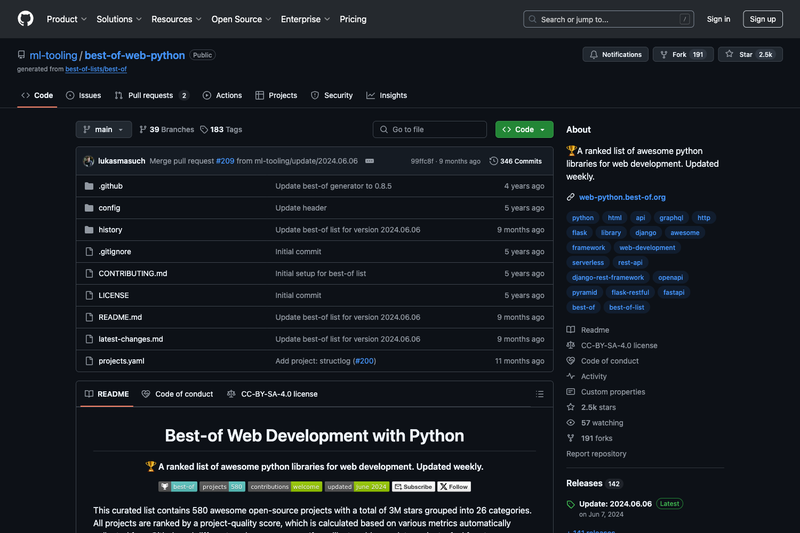
Best-of Web Development with Python is a curated, ranked directory of 590 open-source Python libraries for building web applications, updated weekly and maintained by the ml-tooling community.
What is Best-of Web Development with Python?
This GitHub repository is a living list that collects and ranks Python projects for web development across 26 categories, from web frameworks and HTTP clients to Django utilities and serverless tools. It takes project metadata from GitHub and package managers like PyPI and Conda, then outputs a ranked list where every project is scored by a combined project-quality metric. The list lives in the ml-tooling GitHub organization and is updated weekly, with community contributions accepted via issues, pull requests, or direct edits to the projects.yaml file.
Key Features
- 590 ranked projects — The list covers 590 open-source libraries with a combined 3.4 million GitHub stars, grouped into 26 topic categories.
- Automatic quality scoring — Each project receives a combined score (shown as 🥇/🥈/🥉) calculated from metrics automatically collected from GitHub and different package managers.
- Framework badges — Entries carry small icons that mark whether a project is Flask-, Django-, FastAPI-, Pyramid-, OpenAPI-, or GraphQL-related, so you can filter by stack at a glance.
- Project health signals — Status emoji indicate new projects (under 6 months old), inactive projects (6 months of no activity), and dead projects (12 months of no activity), plus trend up/down indicators.
- Rich per-project metrics — Each entry lists contributor count, fork count, issue count, latest package-manager update timestamp, monthly downloads, and number of dependent projects.
- Install snippets — Most projects include ready-to-copy git clone, pip install, and conda install commands taken from their official package pages.
- Community editable — The underlying data lives in projects.yaml; anyone can open an issue, submit a pull request, or edit the file directly to add or update projects.
Who should use Best-of Web Development with Python?
Python web developers use this list to discover the most popular and well-maintained libraries before choosing a stack or adding a dependency. Technical leaders can quickly compare frameworks like Django, Flask, and FastAPI by their star counts, download numbers, and contributor activity. Package maintainers can verify where their library ranks and can submit updates to keep their project's metrics and links current. Anyone evaluating Python web tooling for a new project gets a single, up-to-date overview with concrete numbers.
What can you do with it?
- Framework selection: Compare the top-ranked web frameworks (Django, Flask, FastAPI, Tornado, Sanic, and more) side by side using their GitHub and PyPI metrics.
- Library discovery: Browse dedicated sections for HTTP clients, auth, web scraping, testing, Admin UI, and 20 other categories to find a library that fits a specific need.
- Stack navigation: Use the Flask, Django, FastAPI, Pyramid, OpenAPI, and GraphQL badges to quickly spot libraries that integrate with a framework you already use.
- Project monitoring: Watch the trend indicators and status emoji to see which libraries are actively maintained, newly released, or dead before you commit to them.
- Community contribution: Add or correct projects by editing projects.yaml and submitting a pull request, or by opening an issue to suggest something new.
How does the ranking work?
The project-quality score is calculated automatically from metrics collected from GitHub and different package managers. The underlying data is stored in a projects.yaml file, and the repository is regenerated from that data. Because the ranking is metric-based rather than human-chosen, the order changes as new metrics are collected.
FAQ
How many projects are listed?
The list currently contains 590 awesome open-source projects with a total of 3.4 million stars, grouped into 26 categories. The numbers change as the list is updated weekly.
How often is the list updated?
The list is updated weekly. The update date is visible in the repository's release badge, and users can subscribe to the ml-tooling newsletter on Substack to receive updates and trending projects.
How are projects ranked?
Projects are ranked by a project-quality score that combines various metrics automatically collected from GitHub and package managers. A higher rank corresponds to a higher combined score, and the top three in each category are marked with 🥇, 🥈, and 🥉.
Can I add a project to the list?
Yes. Contributions are welcome. You can open an issue, submit a pull request, or directly edit the projects.yaml file in the repository. Reviewers then process the change and the list is regenerated.
Is the list free to use?
The repository is a public, open-source GitHub project, so the list itself is free to browse, clone, and reuse. It also links out to other best-of lists from the best-of.org ecosystem.