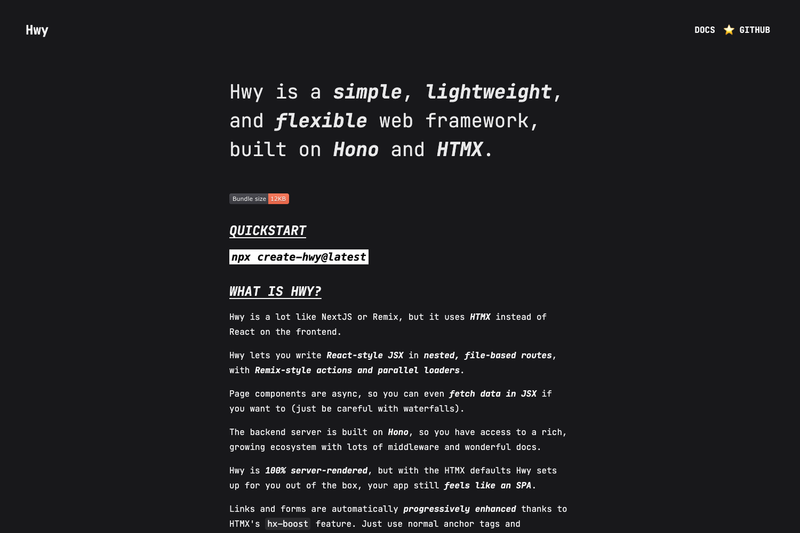
Vorma is a Go-powered metaframework for building full-stack web applications, marketed as "The Next.js of Golang" and deeply integrated with Vite. It combines a Go backend with a React, Solid, or Preact frontend, giving developers a single codebase with nested routing, end-to-end type safety, and parallel-executed route loaders. The project is maintained by the vormadev organization and distributed as both an npm package and a Go module.
What is Vorma?
Vorma is a meta-framework similar to Next.js, Remix, or TanStack Start, but it uses Go on the backend instead of JavaScript. It accepts a project scaffolded via the command line and produces a full-stack application with your choice of React, Solid, or Preact on the frontend. The framework handles routing on both sides, provides type-safe data fetching through route loaders, and integrates tightly with Vite for development-time hot module reloading.
Key Features
- Nested routing — Define routes hierarchically on both frontend and backend, matching URL structure to code organization, similar to file-based routers in Next.js.
- End-to-end type safety — Type information flows from Go server code to React/Solid/Preact components, including typesafe Link components that catch broken routes at compile time.
- Parallel route loaders — Data-loading functions for sibling routes run concurrently, reducing page load latency without manual orchestration.
- Framework choice — Bring your own frontend library: React, Solid, or Preact, all fully supported with the same backend APIs.
- Vite integration — Leverages Vite for fast dev server startup, Hot Module Replacement, and production builds, giving a modern JavaScript dev experience to Go developers.
- npm + Go distribution — Installable via
npm create vorma@latestfor scaffolding, with the backend available as a Go module on pkg.go.dev.
Who is it for?
- Go backend developers — Developers who want to build rich frontends without learning a new server language can leverage their existing Go skills.
- Full-stack TypeScript developers — Teams comfortable with React, Solid, or Preact can add a Go backend while keeping the frontend tooling familiar.
- Startups and small teams — The single-codebase model and type safety reduce boilerplate and make it easier to maintain a full-stack app with a small team.
What can you do with Vorma?
- Full-stack web applications — Build a server-rendered or client-rendered app where Go handles API and business logic while React/Solid/Preact render the UI.
- Type-safe data fetching — Define loaders in Go and receive fully typed data in your frontend components, eliminating manual API contract maintenance.
- Rapid prototyping — Use the Vite-powered dev server with HMR to iterate on UI changes instantly, while Go endpoints hot-reload during development.
How does Vorma work?
Getting started is straightforward: run npm create vorma@latest in a terminal and follow the prompts to scaffold a new project. The CLI sets up both the Go backend and the chosen frontend framework, configured to work together out of the box. During development, Vite serves the frontend with HMR while the Go binary runs the backend, with route definitions shared across the stack.
Alternatives
- Next.js — A JavaScript/TypeScript metaframework that runs on Node.js, without native Go support.
- Remix — A full-stack React framework that runs on Node.js, also without Go integration.
- TanStack Start — A TypeScript metaframework built on the TanStack Router, again Node-based.
FAQ
Is Vorma production-ready?
According to the project's status, Vorma's underlying tech has reached a good degree of stability, but its APIs are still evolving. Sub-1.0 releases may contain breaking changes, so it's more suitable for early adopters than risk-averse production teams.
Does Vorma support hot module reloading?
Yes. Vorma integrates deeply with Vite, providing full hot module reloading for frontend components during development. This lets you see UI changes instantly without restarting the Go server.
What frontend frameworks can I use with Vorma?
Vorma officially supports React, Solid, and Preact. You choose which one when scaffolding your project, and the framework adapts the routing and type generation accordingly.
How do I get started with Vorma?
Run npm create vorma@latest and follow the interactive prompts. This sets up a new project with a Go backend and your selected frontend framework. Detailed documentation is available at vorma.dev/docs.